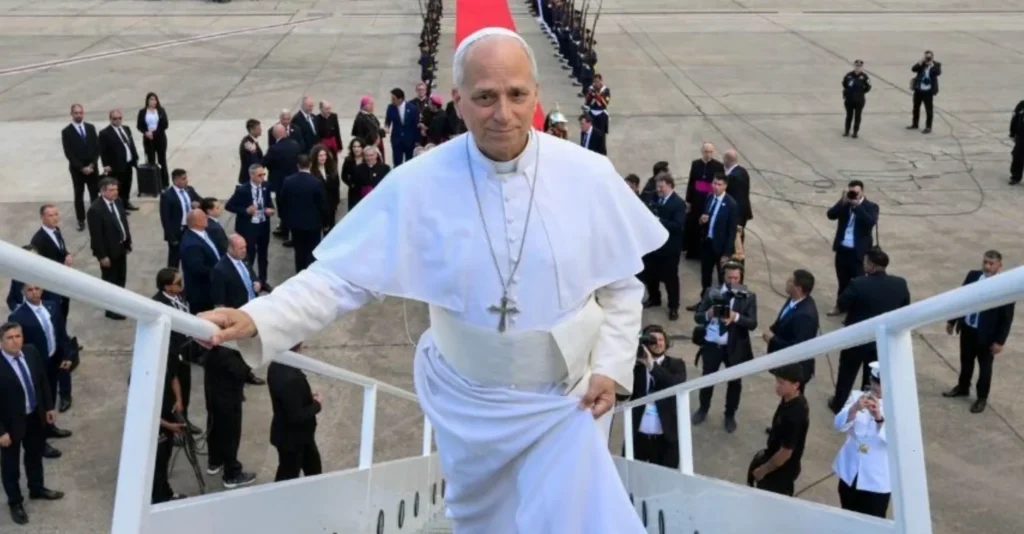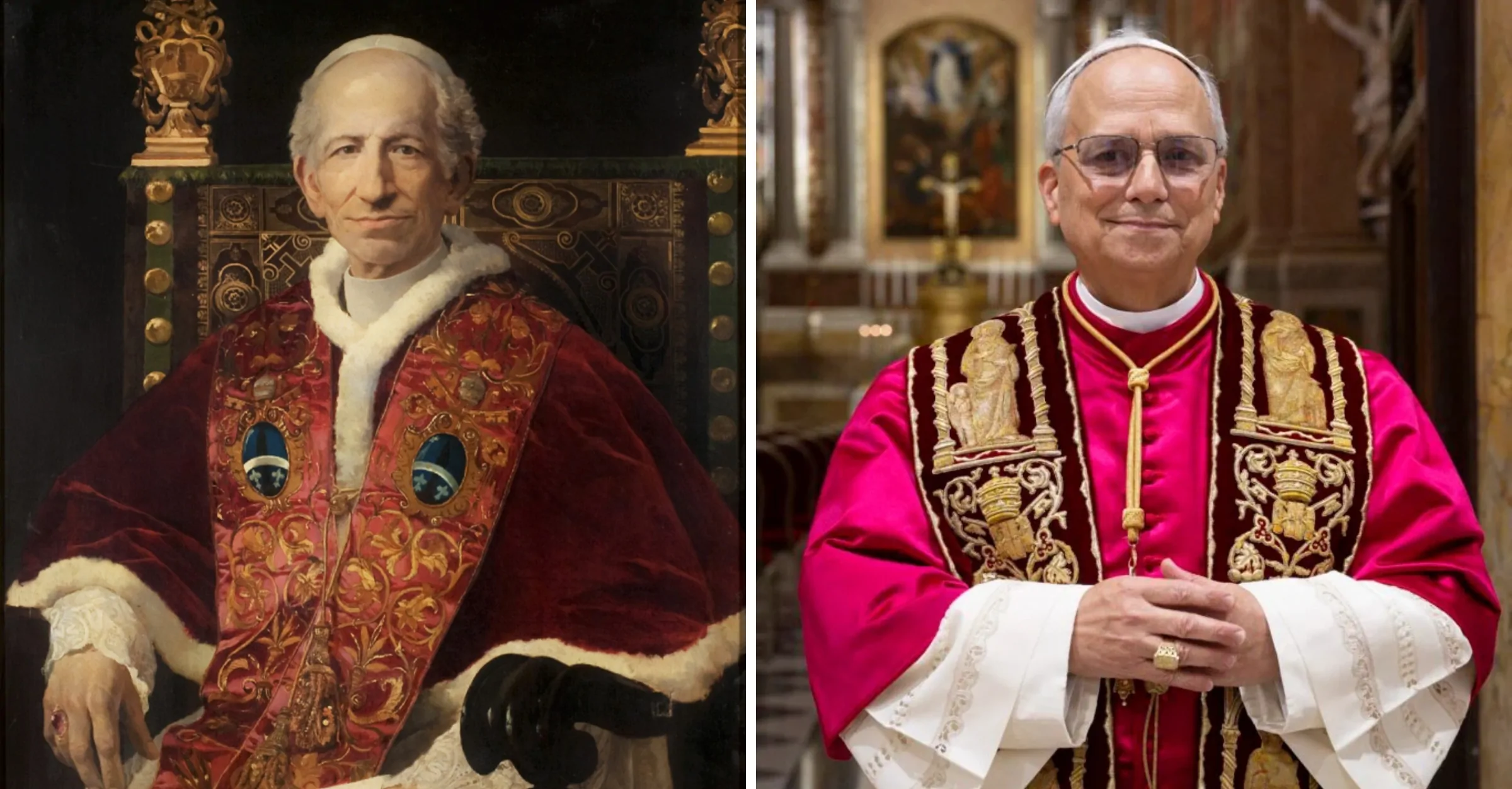


In the corridors of the Vatican, where tradition weighs heavily and history breathes through stone, the election of Pope Leo XIV marks a turning point — not only for the Church but for the world.
In his first address to the College of Cardinals on May 10, Pope Leo XIV made a startling and prophetic claim: “Just as Pope Leo XIII read the signs of the Industrial Revolution and responded with Rerum Novarum, we must now respond to a digital revolution that places not machines in factories, but algorithms in hearts, minds, and lives.”
With these words, he positioned artificial intelligence not at the margins of moral inquiry, but at its very center.


Pope Leo carries with him a rare and powerful combination: a background in mathematics and a profound sensitivity to the emerging moral questions of our digital age. His election in 2025 is not just a symbolic departure from Eurocentric papacies, but a decisive theological and ethical gesture toward confronting one of the gravest challenges of our time — artificial intelligence.
Leo is no alarmist. He is not a technophobe lamenting the rise of machines. Instead, he emerges as a discerning voice, bridging the chasm between tradition and technological disruption.
His formation in mathematical logic provides a unique clarity and structure to his moral reasoning, while his pastoral experience grounds his ethical concerns in lived human realities. This synthesis enables him to approach AI not merely as a tool or a threat, but as a revelatory moment — a mirror in which humanity must confront itself.
What distinguishes Leo’s approach is his conviction that AI is not merely a technological development — it is a moral test. This echoes a profound intuition voiced by Pope Francis: “We have to be vigilant and work to ensure that the discriminatory use of artificial intelligence does not take root at the expense of the most fragile and excluded.”
Francis, who had already begun addressing issues of digital injustice and technological ethics in his final years, provided the theological framework upon which Leo XIV now builds.
Leo’s primary concern is the displacement of the human person from the moral center of decision-making. As AI becomes more capable of making predictive decisions — from judicial rulings and employment screening to medical diagnoses and military targeting — the question arises: Who decides what is just, fair, or humane?
Algorithms are designed not only to reflect data but also to act upon it. If these systems are programmed without ethical oversight or with implicit biases, they become instruments of systemic exclusion rather than tools of liberation.
Yet, for Leo, the problem is not that machines are thinking. The more profound concern is that humans are forgetting how to feel. His vision for AI is therefore not about stopping progress but slowing down its ethical erosion.
“The soul of the machine,” he declared in a Palm Sunday homily, “is not in silicon but in the human intentions that build, train, and deploy it.” He sees in AI a profound paradox: a tool that has no soul, yet magnifies the soul of its creator, for better or worse.
This emphasis on human dignity is not novel in Catholic thought, but Leo XIV gives it renewed urgency. His proposed framework for evaluating AI technologies rests on four pillars: dignity, solidarity, subsidiarity, and sustainability.
Each acts as a moral filter through which digital tools must pass. Do they preserve the dignity of individuals? Do they contribute to the common good? Do they respect the agency of local communities and human judgment? And do they align with long-term goals for ecological and societal well-being?
But Leo is not only concerned with big ethical principles. He brings the conversation to the daily experiences of people at the margins. His years in Peru taught him that technology, like theology, must be judged by its fruits.
In slums where data is scarce, surveillance is more common than service, and automation threatens already fragile livelihoods, AI often feels like a foreign imposition rather than a shared benefit. For Leo, ethical AI must begin with these voices, not as afterthoughts, but as protagonists in their own stories.
He has called for an international Vatican commission on AI and human flourishing, composed not just of theologians and bishops, but of ethicists, engineers, labor leaders, and ordinary citizens.
This interdisciplinary approach reflects the pope’s conviction that the Church cannot speak in abstraction — it must speak in collaboration. The challenge of AI, like the climate crisis, is planetary and intergenerational. It cannot be addressed by one institution or ideology alone.
In many ways, Leo continues the trajectory set in motion by Pope Francis. In Laudato Si’, Francis wrote: “Technological products are not neutral … they create a framework which ends up conditioning lifestyles and shaping social possibilities along the lines dictated by the interests of certain powerful groups.”
Leo XIV now carries that insight into the heart of AI. He asks: Who benefits from machine learning? Whose knowledge is considered legitimate? And can we develop technologies that reflect the profound diversity and moral complexity of the global human family?
Theologically, Leo XIV presents a subtle yet radical proposal: AI, when rightly formed, can become a space of openness where algorithms reflect not only utility but also mercy, creativity, and shared truth. It is a deeply Augustinian notion that even our tools can mirror our desire for God — if we desire rightly.
Perhaps the most hopeful dimension of Leo XIV’s vision is his belief in formation. Just as the Church forms consciences, it must now also form coders. Ethics cannot be an add-on to design; they must be integral to the architecture. He envisions partnerships with universities, especially in the Global South, to train a new generation of ethical technologists — people for whom AI is not merely profitable, but prophetic.
To the critics who accuse the Church of meddling in science, Leo responds not with defensiveness but with humility. “We do not claim to understand all technologies,” he has said, “but we do know the human heart. And that is where every technology begins and ends.”
It is this understanding — deep, ancient, and painfully relevant — that makes his papacy not only timely but transformative.
In the quiet power of his logic and the luminous clarity of his moral purpose, Pope Leo offers something rare in our age of speed and spectacle: a call to slow down, to listen, and to discern. Not to fear the future, but to shape it — with the wisdom of our traditions, the intelligence of our hands, and the compassion of our hearts.