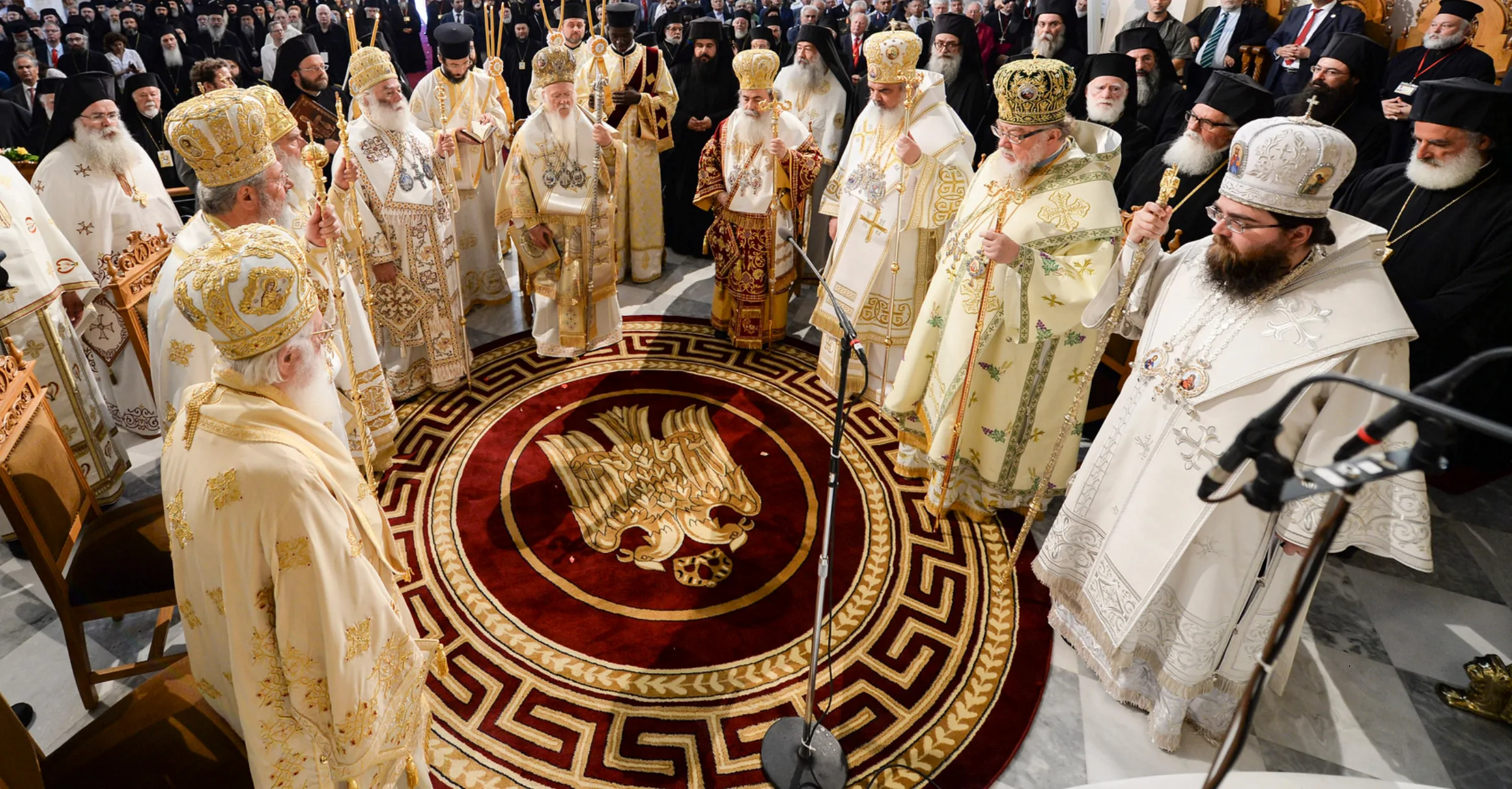
Last month, I attended a conference at the Pontifical University of Saint Thomas Aquinas (Angelicum) in Rome commemorating the tenth anniversary of the Council of Crete, at which Ecumenical Patriarch Bartholomew I received an honorary doctoral degree in theology.
Bartholomew’s reflection on the council was powerful and carried an important message that requires discernment and theological tools to understand.
While commenting on Crete, Bartholomew emphasized an important ecclesiological principle that “unity requires encounter.” He said the conciliar tradition requires encounters, meetings, deliberation, listening, and shared discernment, meaning that unity without encounter will be an illusion.


The Council of Crete is a work in progress, and the challenges it sought to address remain on the table. Crete’s unfinished work is important for Catholics and Orthodox alike, as both are called to “bear witness to the transforming power of the Gospel in the heart of the world.”
As an Eastern Catholic, I feel compelled by the patriarch’s invitation to bear witness. How can full ecclesiastical communion in the Eucharist between Catholics and Orthodox be restored while both Churches preserve their theological traditions, as stated in Vatican II’s Decree on Ecumenism, Unitatis Redintegratio (1, 14, 17-18)?
Crete’s unfinished work matters to Catholics because it shows how both Churches can continue ecumenical dialogue and move toward Eucharistic communion.
Crete’s promise and limits
The Council of Crete was held from June 18-26, 2016, on the Island of Crete. After decades of preparation, it brought together ten autocephalous (self-governing) Orthodox Churches under the presidency of Patriarch Bartholomew I.
The ten churches represented at the council were the Ecumenical Patriarchate, the Patriarchates of Alexandria and Jerusalem, and the Churches of Serbia, Romania, Cyprus, Greece, Poland, Albania, and the Czech lands and Slovakia. However, Antioch, Bulgaria, and Georgia did not take part.
Neither did the Russian Orthodox Church, whose Holy Synod decided not to attend the council days before the start, on June 13, 2016.
The Council of Crete adopted six official documents, focusing on mission, the diaspora, autonomy, marriage, fasting, and relations with other Christians, along with an important encyclical and a message.
The documents that emerged from the council connect the Church’s understanding of herself to the world the Church serves, with a razor focus on preserving the dignity of the human person, freedom and responsibility, and peace and justice.
The absence of those Churches from the council’s table creates a difficulty and an obstacle to Orthodoxy speaking with one united voice on crucial theological and societal matters.
A July 16, 2016 report on the Holy Synod of the Russian Orthodox Church’s response to the documents adopted by the Council of Crete stated that the documents were available online but have “not been officially received by the Russian Orthodox Church to this day.”
It also said that “a number of hierarchs of various Local Orthodox Churches who participated in the Council are reported to have stated that they refused to sign the document on ‘Relations of the Orthodox Church with the Rest of the Christian World’ because they disagreed with its contents.”
The same report said that the Holy Synod of the Orthodox Church of Antioch “recognized the meeting, which took place, as ‘a preliminary gathering on the way to a Pan-Orthodox Council,’ while the documents it adopted as not final and open for discussion.”
Crete’s decisions and authority have been contested. A council’s teaching must be received within the life of the Churches if it is to shape their common theology, pastoral work, and the faithful’s response.
For Crete, this means discerning how its decisions express Orthodox tradition and addressing the objections raised against the council. The same questions of participation, decision-making, and reception will also shape any future Catholic-Orthodox agreement.
Crete produced substantial documents that shape Orthodox theology and its mission. An important message from Crete, by Patriarch Bartholomew at the Angelicum, is that “the Orthodox Church does not understand itself as a federation of independent churches existing in isolation.” There is one Orthodox Church, andits unity becomes visible in conciliar life.
Crete’s message also proposes a council to gather every seven or ten years. Such regular consultation would give shared responsibility a continuing institutional expression. An anniversary offers an opportunity to ask whether that practice is taking root.
For Catholics, the stakes are theological. Vatican II’s Unitatis redintegratio (14-15) recognized the Eastern Churches’ apostolic succession, priesthood, and Eucharist, and urged attention to their traditions and history when seeking restored communion.
Catholics already share profound sacramental and theological bonds with the Orthodox Church. Taking Crete seriously follows from that recognition and from the responsibility to understand the Church with which we seek unity, as Unitatis redintegratio (9) made clear: Catholics “need to acquire a more adequate understanding of the respective doctrines of our separated brethren, their history, their spiritual and liturgical life, their religious psychology and general background.”
Keeping dialogue open
Crete’s document on the Orthodox Church’s relations with other Christians affirmed the ecumenical mission as an expression of Orthodox faith and tradition. It also sets out clear and practical safeguards. A dialogue can continue even if an individual Orthodox Church declines to participate, provided this is not a pan-Orthodox decision (9).
“It is clear that in the theological dialogues the common goal of all is the ultimate restoration of unity in true faith and love” (12). An unresolved theological difference can be recorded while discussion continues (11). These provisions help preserve the progress of theological work despite disagreements.
The document also requires unanimous agreement among the local Orthodox Churches to restore ecclesiastical communion (15). It is important to distinguish between continuing dialogue and restoring communion, as they are distinct ecclesial acts. Crete offers a way to continue working toward agreement. Its potential contribution to unity lies in holding those responsibilities together and in sustaining dialogue.
Metropolitan Job of Pisidia, a distinguished Orthodox theologian and a leading figure in Catholic–Orthodox dialogue, offers a candid assessment of Crete’s achievements and unresolved questions.In his October 8, 2026, anniversary address at Chantilly, Job asked whether other non-Orthodox Christian Churches and Confessions could be reduced to the designation “historical name” accepted by the council without adequately clarifying their ecclesial reality.
The metropolitan’s question is important to Catholics: what does Orthodoxy recognize in Catholic baptism, ministry, and sacramental life? An agreed-upon ecumenical vocabulary must carry clearer theological meaning to identify the reality of non-Orthodox churches.
In his theological-canonical evaluation of the council, Job turns his attention to ancient canons governing the reception of Christians from outside Orthodox communion: Canon 7 of the Second Ecumenical Council, Constantinople I (381), and Canon 95 of the Quinisext Council, also called the Council in Trullo (692), both cit in the English version of the Crete document (20).
The metropolitan argues that receiving certain groups through a profession of faith or chrismation, without another baptism, implies recognition of the reality of their previous baptism and of “a certain ecclesial character of their community.”
He then asks what this means for contemporary Christians outside Orthodoxy. He argues that this practice invites discernment of the reality of baptism beyond Orthodoxy’s canonical boundaries. This is a theological implication that Job draws from the canonical tradition. Crete itself did not settle the question.
His approach nevertheless identifies a fruitful method: returning together to the canonical and sacramental inheritance that predates our present divisions.
Another issue the metropolitan examines is the reality of mixed marriages, which give theological questions about baptism a human face. Crete retained the prohibition on Orthodox–non-Orthodox Christian marriage under strict canonical application, while leaving pastoral accommodation to each autocephalous synod.
The Council states that “Marriage between Orthodox and non-Orthodox Christians is forbidden according to canonical akribeia (Canon 72 of the Quinisext Ecumenical Council).”Job questions applying ancient prohibitions against heretics to contemporary Catholic and Protestant Christians who confess the Nicene-Constantinopolitan Creed.
For a Catholic and an Orthodox Christian preparing to marry, ecclesiology shapes the formation of a household. Greater clarity and coordinated pastoral care from both sides could make the fruits of dialogue tangible.
Job’s discussion of akribeia and oikonomia is well articulated and argued. Job questions a distinction that presents akribeia as the strict application of the rule and oikonomia as a pastoral dispensation from that rule.
He understands canonical discernment in terms of its healing and salvific purpose and worries about contradictory pastoral decisions among local Churches. Among the Fathers, oikonomia designates the mystery of man’s salvation.
His concern connects internal Orthodox unity with ecumenical progress. Common pastoral reflection and the return to the sources (St. Basil the Great) would help Catholics and Orthodox understand what commitments mean across jurisdictions, especially when families move between countries and encounter different ecclesial practices.
According to Metropolitan Job, “canon law, in the Orthodox Church, was never conceived as legal legislation, but as pastoral therapy.”
He cites Canon 102 of the Council in Trullo: “It behooves those who have received from God the power to loose and bind, to consider the quality of the sin and the readiness of the sinner for conversion, and to apply medicine suitable for the disease, lest if he is injudicious in each of these respects he should fail in regard to the healing of the sick man.”
Learning to decide together
Bishop Maxim of the Serbian Patriarchate, measuring Crete against Zizioulas’ hope, recalled Metropolitan John Zizioulas’ acceptance of the compromise regarding other Christian Churches, despite judging it weaker than the original formulation.
Maxim draws the lesson: “Communion must shape how the Churches gather, listen, and decide.” His account makes the council’s achievement more credible precisely because it preserves the difficulty of reaching it.
Catholic–Orthodox dialogue already provides a framework for learning from this experience. The joint international commission’s 2023 Alexandria document treats primacy and synodality as interdependent. It places Catholic efforts to strengthen synodality alongside the Orthodox practice of holy and great councils.
The question concerns how authority serves communion at the local, regional, and universal levels. Crete offers a concrete experience for examining that relationship, including the challenges of participation, decision-making, and reception.
Full communion still requires agreement on disputed questions, including the exercise of Roman primacy. Catholic attention to Crete can nevertheless deepen the discussion by bringing institutional practice into conversation with theological principles.
How are local Churches heard? How are common decisions sustained? How can leadership enable participation and assume responsibility? These questions invite mutual examination. Catholics bring their own experience of authority and consultation to the encounter, along with matters requiring further discernment.
The Dicastery for Promoting Christian Unity’s 2024 study, The Bishop of Rome, compiled the results of ecumenical dialogue on primacy and synodality. Its publication shows that the search for an exercise of primacy that serves Christian unity continues within Catholic reflection.
Reading Crete’s documents alongside the Alexandria document and The Bishop of Rome would help Catholics connect an Orthodox council with questions already under examination within their own Church.
Making unity visible
Crete grounds common witness in human dignity. Its encyclical connects the ecological crisis with spiritual crisis, consumerism, and the exploitation of creation, while addressing social injustice. These matters provide substantial ground for cooperation between Orthodox and Catholics.
Catholic and Orthodox communities could join in caring for vulnerable neighbors, supporting families, and protecting their environment. Working together would allow Christians to encounter the spiritual convictions behind each other’s actions while continuing the necessary doctrinal conversation.
Pope Leo XIV gave this shared responsibility a contemporary Catholic expression on June 30, 2026, when he addressed a delegation of the Ecumenical Patriarchate. He grounded cooperation on peace, technology, and creation in the Gospel and identified the Nicene Creed as the foundation of the ecumenical journey. His emphasis links unity in faith to responsibility for human suffering.
The shared Nicene inheritance has also found a new setting for encounter. On November 7, 2026, Archbishop Rino Fisichella inaugurated a Pilgrims’ House in Nicaea and consecrated its chapel altar; Pope Leo donated a chalice. Bishops and representatives of Christian communities attended the event.
The initiative extends the 2025 commemoration of the First Council of Nicaea’s 1,700th anniversary through pilgrimage and prayer. The Pilgrims’ House offers a practical reminder that the search for unity requires places where Christians can encounter one another and deepen their understanding of their shared Nicene faith.
As an educator, I strongly believe that reception requires education: joint study of Crete’s documents in seminaries and Catholic universities, parish discussions, and consultation among bishops and clergy. Such efforts would help the council’s teaching reach the faithful and inspire cooperation.
Metropolitan Job ends his Crete anniversary assessment by asking when another Holy and Great Council will be convened. The question directs attention to the future: can the experience of Crete become a continuing practice of shared discernment?
Catholics have reason to hope so. An Orthodoxy able to address its disagreements together would bring that strengthened conciliar life to the search for restored communion.
Bartholomew’s appeal at the Angelicum placed “communion before nationalism.” Crete’s promise will depend on how that priority is lived out: in relationships among Orthodox Churches, in dialogue with Catholics, and in the ordinary pastoral life of Christians.
Ten years later, its unfinished work presents the Churches with a concrete task: to cultivate the practices through which the unity they seek can become visible.