
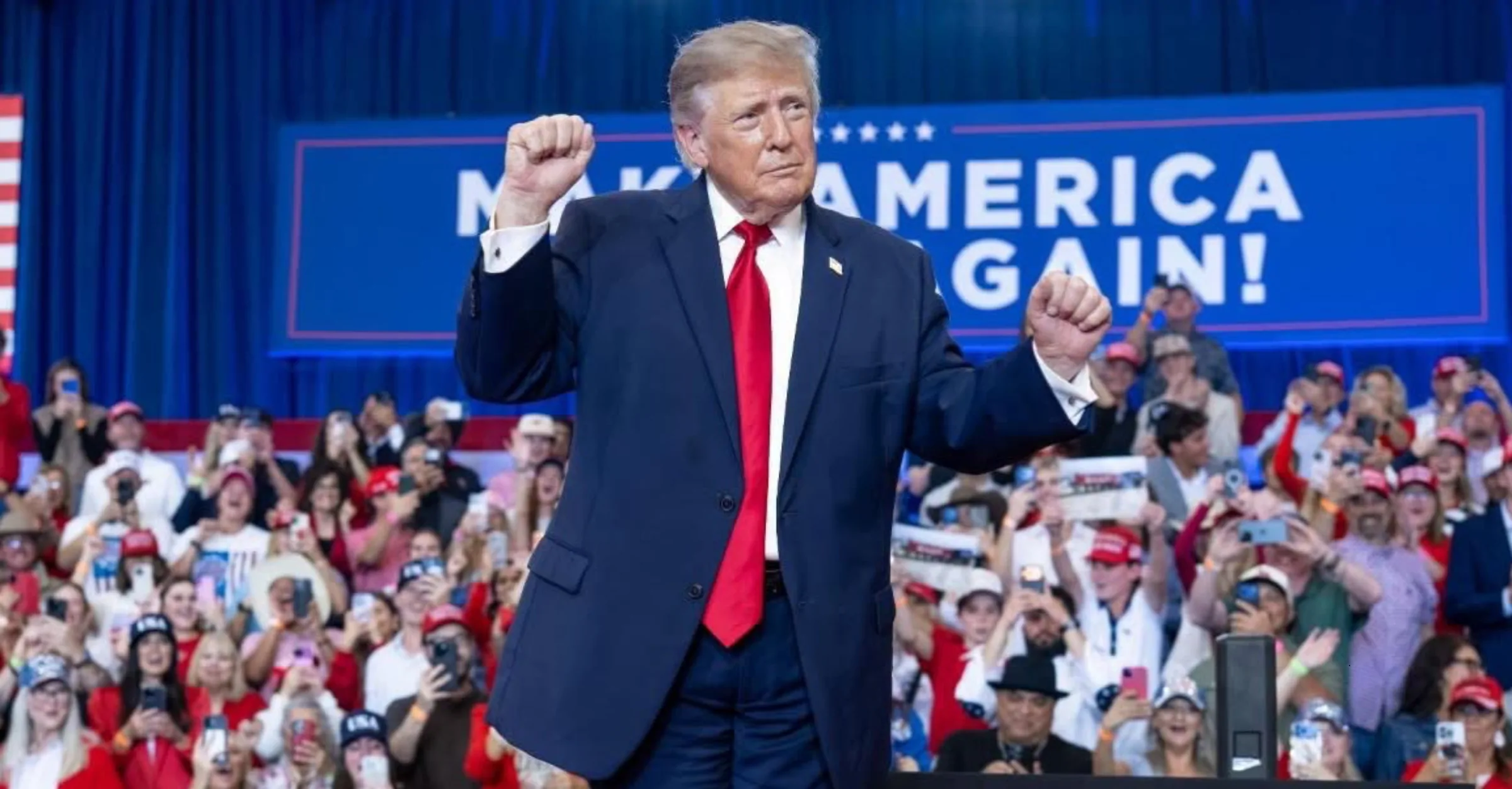
Donald Trump and the Republican Party have been utterly defeated in the 2026 midterm elections in America.
The result is also a rebuke to the political-religious messianism with which Trumpism has cloaked itself: the idea of a “savior of the nation” sent by God to fight against immigrants, Muslims, and socialists.
The vox populi has spoken out against a Byzantine-style “imperial court” engaged in the political exploitation of religion, aided by a cabal of “court prophets”. Perhaps this is the beginning of the end.


But this is not the end yet—not just because President Trump and Vice President J. D. Vance’s terms expire only on January 20, 2029. Trumpism serves as the vehicle for the political-religious project of transforming America into an illiberal, populist regime.
Different interpreters of this undertaking gave it different names: “Christian nationalism,” “Catholic integralism,” “holy Fascism,” etc.
This project did not end with the 2026 midterm elections: for example, after the comprehensive political and policy initiative known as “Project 2025,” the Heritage Foundation is already working on “Project 2029.”
In 2026, these projects could not withstand the force of discontent with the economic situation and the distortions of America’s democratic system. But the ideologues behind these projects have always played the long game, and we should not expect a sudden conversion to liberal-democratic constitutionalism.
There is no “religious left” in the United States comparable to the “religious right” in terms of organizational capacity, financial resources, intellectual self-confidence, and media reach.
The repudiation of Trump’s agenda was also a religious response coming from civic-minded moderates and religious voters, only some of which can be described as the “religious left”.
The US Catholic Church’s liberating moment
The US Catholic bishops’ conference began changing its tune from the start of Trump’s second term in January 2025, recognizing the impossibility of bringing the MAGA project back within the bounds of a presentable, constitutional conservatism. This turn among the US bishops became even more visible after the election of Pope Leo XIV in May 2025.
Catholic voters have shifted their alignment from 2024 to help propel Democratic politicians on Nov. 3. But the Catholic vote is still evenly split between the Democratic and the Republican party.
Deep within American Christianity and American Catholicism, the fear of secularization, Islamization, and socialism persists. Among social issues, the transgender issue has replaced abortion, and the internal divides on this issue among the anti-Trump forces were eclipsed this year by the economic situation and the blatant corruption of the elites in power.
This situation presents new opportunities for the Catholic Church. Domestically, both parties are redefining their ideologies. This could be a liberating moment for the Catholic Church in the USA: not to form an impossible “Catholic party” or to pretend to wield disproportionate influence in American politics.
The urgent need is to liberate the Catholic Church from the preternatural association with partisan agendas whose entanglements and extremizations have led not only Catholic politicians but also Catholic clerical leaders to positions that are a grotesque caricature or an outright denial of the Church’s moral and social teaching.
The Vatican can help achieve this liberation from the ideological captivity of US Catholicism, also thanks to Leo XIV, the first pope from the USA.
As Olivier Roy wrote recently in Esprit, at the conclave of 2025 the conservative international (led by the Trump administration) tried and failed to impose a right-wing pope.
The strategy is now to bypass the papacy and its message. Another right-wing strategy could aim to weaken the papacy by returning to what was Gallicanism for France centuries ago: a nationalist American Catholic Church. But this option has become even less plausible after the election of Leo XIV and his engagement with American democracy, including his participation as a US voter.
Will the hierarchy now distance itself from the Trump regime?
It remains to be seen how members of the clergy who are unmistakably close to the Trump administration, and who served as agents of ideological and religious legitimation for domestic regime change, will reposition themselves. In this sense, the upcoming Nov 16-19 assembly of the US bishops’ conference in Baltimore will address this issue, directly or indirectly.
Looking at a certain kind of high-profile Catholics who have been or still are instruments in the hands of Trumpism, it is unclear whether they will try to distance themselves from that regime, seeking moral redemption and a political way out, or remain loyal until the bitter end.
The real American problem, in the long run, even bigger than Trump and Trumpism, is Elon Musk, Muskism, and all that. US-based billionaires running the “digital revolution” have penetrated— and, to a certain extent, already captured— the heart of American power: political, economic, financial, military, and mediatic.
The “broligarchy” of the authoritarian tech right has already replaced politics, and they plan to do so even more.
The Catholic Church in the USA should not lose sight of the fact that the results of the 2026 midterm elections were also a rebuke of technocracy: the idea that the individual person no longer matters; that human labor will be replaced by robots on an unprecedented scale; that there is no meaningful difference between truth and lie, or between reality and virtuality; that critical thinking about technology is a mortal enemy; that democracy can be bought by entrepreneurs thanks to their literally unlimited checkbook; that we are only atomized individuals, not communities; that for humans and everything human, there is no alternative to being reduced to data.
The real opportunity is given by the fact that there is no other moral agent like the Catholic Church that has developed an analysis of the present situation: Pope Leo XIV’s encyclical Magnifica Humanitas and a consistent body of teaching on Artificial Intelligence and the technocratic paradigm starting with post-Vatican II papal teaching.
As the opening lines of Pope Leo XIV’s Magnifica Humanitas state: “Humanity, created by God in all its grandeur, is today facing a pivotal choice: either to construct a new Tower of Babel or to build the city in which God and humanity dwell together.”
After being “one revolution late” so many times over the past four centuries (the scientific, democratic, and sexual revolutions), Catholic teaching, for once, does not have to make up much time.
The 2026 midterm elections were about the fate of the “second American revolution” the MAGA movement attempted. But they were also about the social and political effects of the digital revolution, in which Trumpism is not just a by-product but also a puppet.
The Vatican cast its “vote” with Pope Leo’s encyclical in May 2026, six months before US citizen Robert Francis Prevost cast his ballot by mail. We will see how the Catholic Church in the USA takes up this challenge and invitation.