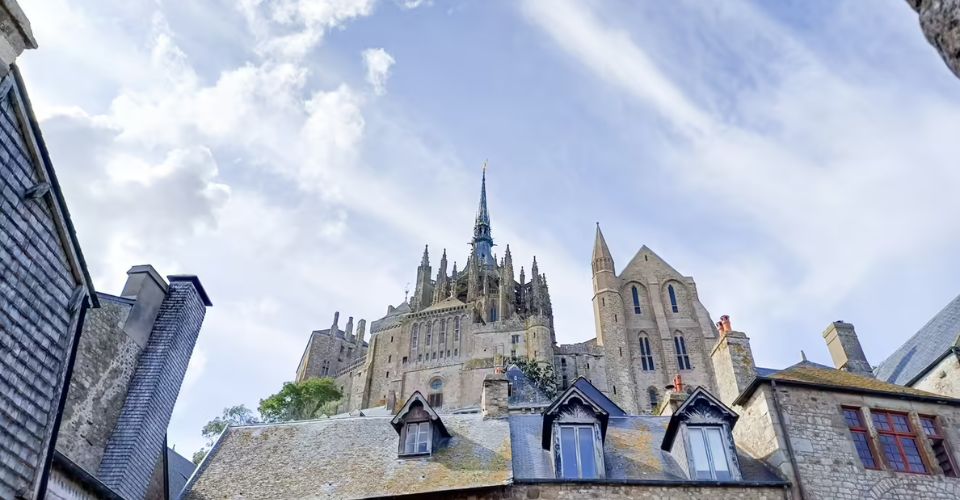
The rocky island of Mont-Saint-Michel rises dramatically from the tidal flats of France’s Normandy, its houses, walls, and towers stacked one above another.
During the day, narrow medieval streets fill with crowds of tourists weaving past restaurants and souvenir shops.
Above them all stands a solitary figure: the Archangel Michael, his golden sword raised toward the sky atop the abbey’s highest spire.


By evening, however, Mont-Saint-Michel changes completely.
As the sun sets, the last day visitors cross the bridge back to the mainland, shops close, and the voices fade away. Only a handful of residents and overnight guests remain.
In the quiet, it becomes easier to understand why medieval monks chose this isolated rock as the site of a monastery. Suspended between land and sea, earth and sky, Mont-Saint-Michel possesses an almost otherworldly atmosphere.
According to a modern legend, it is also part of a much greater mystery.
A ‘sword strike’ across Europe
The legend claims that Mont-Saint-Michel lies on an imaginary line stretching more than 2,500 miles (4,000 kilometers) across Europe and the Middle East.
The line begins at Skellig Michael in Ireland, passes through St. Michael’s Mount in Cornwall and Mont-Saint-Michel in France, continues to two shrines dedicated to St. Michael in Italy, then reaches the Greek island of Symibefore ending at Mount Carmel in Israel.
According to the story, this so-called St. Michael’s Line marks the path of the Archangel Michael’s sword as he cast Satan out of heaven.
The first three sites along the route are particularly striking: three monastery islands off Europe’s western coast.
Three islands, one archangel
At first glance, the islands appear remarkably similar.
Skellig Michael rises from the Atlantic Ocean off Ireland’s southwest coast.St. Michael’s Mount stands just offshore in Cornwall, and Mont-Saint-Michel towers above the tidal flats of Normandy.
Both Mont-Saint-Michel and St. Michael’s Mount are tidal islands.
In Cornwall, a cobblestone causeway emerges at low tide before disappearing beneath the sea for several hours when the tide returns.
Mont-Saint-Michel, by contrast, is now permanently connected to the mainland by a bridge.
The resemblance between the French and English islands is no coincidence.
Following the Norman Conquest of England, St. Michael’s Mount became a dependency of Mont-Saint-Michel Abbey.
A church and a small Benedictine priory were established there, making the English community a true daughter house of the famous French monastery.
Today, however, no monks live on St. Michael’s Mount. However, its medieval fortress, church, and dedication to the Archangel Michael remain.
Three apparitions—and a hole in a bishop’s skull
The origins of Mont-Saint-Michel are rooted in one of Christianity’s best-known medieval legends.
According to tradition, in 708, the Archangel Michael appeared in a dream to Bishop Aubert of Avranches, instructing him to build a sanctuary on what was then known as Mont Tombe.
Aubert reportedly ignored the vision and Michael appeared a second time. Again, the bishop hesitated.
On the third occasion, according to the legend, the archangel pressed his finger into Aubert’s skull, leaving a hole that finally convinced the bishop to begin construction.
In 966, Benedictine monks settled on the rocky island. During the French Revolution, they were expelled and the abbey was converted into a prison.
A small Benedictine community returned between 1969 and 2001.
Today, the abbey’s spiritual life is maintained by the Monastic Communities of Jerusalem.
Monks at the edge of the world
While Mont-Saint-Michel and St. Michael’s Mount share a documented historical connection, Skellig Michael tells a very different story.
Located nearly 7.5 miles (12 kilometers) off Ireland’s coast, it has always remained completely separated from the mainland.
Visitors who land there must climb more than 600 stone steps to reach the remains of the monastery.
The monastic community was probably founded sometime between the sixth and eighth centuries.
On narrow terraces, the monks built distinctive beehive-shaped stone huts, chapels, and cisterns, embracing a life of prayer, solitude, and asceticism.
Originally, however, the island was known simply as Skellig, meaning “the rock.”
Historical evidence suggests that it was not dedicated to the Archangel Michael until sometime between A.D. 950 and 1050, by which point the monastery had likely existed for centuries.
There is no historical evidence linking Skellig Michael directly with the monasteries in Normandy or Cornwall.
Why St. Michael?
The Archangel Michael became patron of all three islands because of his unique place in Christian tradition.
In the Book of Daniel, he appears as the protector of God’s people, and in the Book of Revelation, he leads the heavenly armies against the dragon.
Artists traditionally depict him carrying a sword or lance.
Across Western Europe, many shrines dedicated to St. Michael were built on mountains, rocky outcrops, islands, or inside caves.
Such dramatic locations reinforced his image as the warrior archangel and protector of the faithful.
Crashing waves, violent storms, towering cliffs, and difficult pilgrimages all strengthened the symbolism of the struggle between danger and divine protection.
Objections to the belief
The legend of St. Michael’s Line, linking seven shrines from Ireland to the Holy Land, is surprisingly recent.
British researcher Philip Hayward argues that the line, in its modern form, is an invention of the 21st century.
What initially appears to be a supernatural alignment becomes less mysterious upon closer inspection.
Given the large number of churches and monasteries dedicated to St. Michael throughout Europe, it is hardly surprising that a carefully selected group of them can be connected by an approximately straight line.
Even then, the alignment is only approximate.
On a Mercator projection, the seven locations can be connected with what appears to be a straight line.
But a straight line on a flat map is not a true straight line on the Earth’s curved surface. Moreover, several of the sites lie dozens of miles away from the proposed line.
There is another problem. The alleged eastern endpoint of the line—the Stella Maris Carmelite Monastery in Haifa—is not dedicated to the Archangel Michael at all, but to the Blessed Virgin Mary.
More than a myth?
The idea of a perfectly straight St. Michael’s Line stretching from Ireland to Israel is therefore a modern creation, unsupported by historical evidence.
Nevertheless, the legend has spread widely across social media.
The striking similarities among the three western monastery islands remain fascinating, capturing the imagination not only of Reddit users but also of countless visitors.
Today, even the official website of Mont-Saint-Michel lists all seven sites associated with the legend, without mentioning either its modern origins or the cartographic objections raised by scholars.
For many pilgrims who light a candle in the abbey church and pray to St. Michael, however, the legend’s historical accuracy matters less than its spiritual meaning.
They may find comfort in imagining that the archangel’s golden sword protects not only one rocky island but the whole world.
This is a translated and edited version of the feature that first appeared on DOMRADIO.DE and has been republished with permission by Global Catholic.