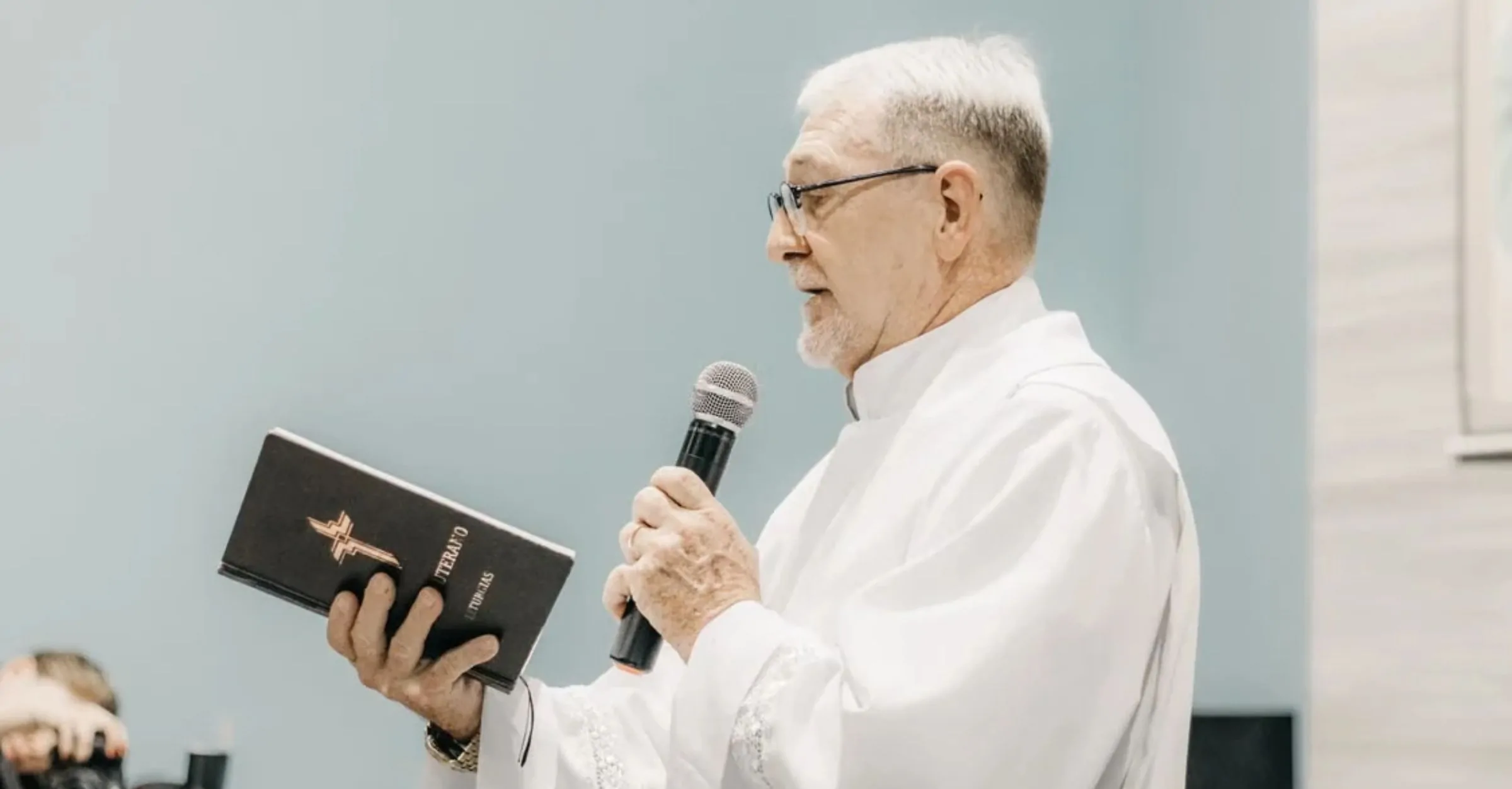
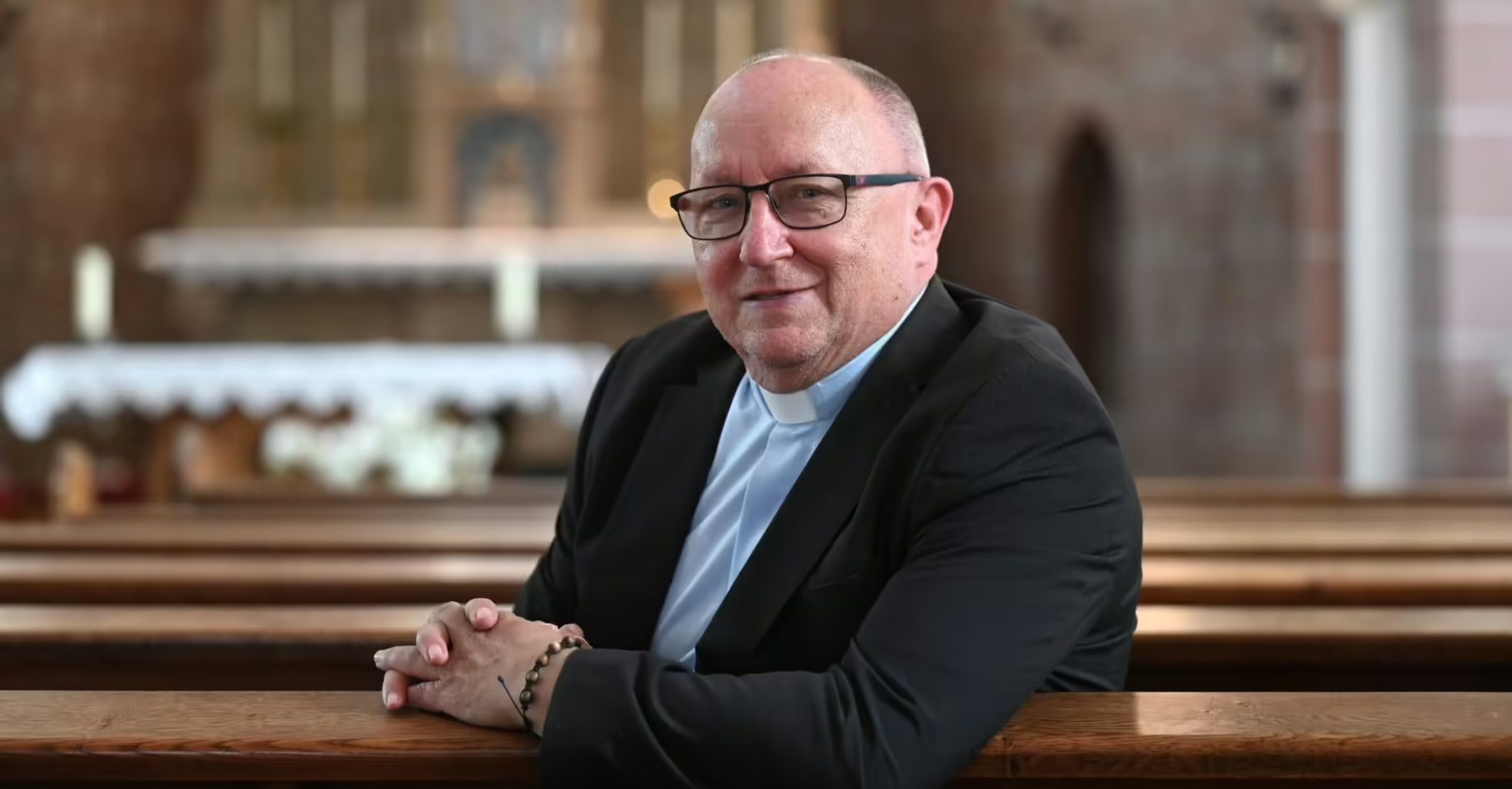
As the clock on the neo-Gothic St. Margareta Church tower in Libur strikes 12, deacon Christian Gawenda, 68, sits in front of his residence, just a few steps across the street.
Gawenda can clearly see his workplace, the church, from his residence, where he has lived with his family for the past 20 years.
Yet every few minutes, someone would walk or drive by his residence – an open, inviting property with a table, a few chairs, and flower pots arranged in the garden.


Some would offer a friendly greeting, while others would wave at him with an air of familiarity.
Gawenda, who has served as a permanent deacon for 34 years, was ordained a priest by Cardinal Rainer Woelki at Cologne Cathedral on June 12, the Feast of the Sacred Heart of Jesus.
“Who can claim to have received all the sacraments?” Gawenda laughs as he recalls his path to the priesthood.
But he is alone now. His wife, Therese, died of cancer 18 months ago, and his three daughters have grown up and moved elsewhere.
Path to priesthood
He arrived in Germany in 1977 from erstwhile Hindenburg — now Zabrze in southern Poland — with his parents and sister. He married Therese.
In the mid-1980s, he came across an advertisement in the church newspaper promoting vocations, including part-time training to become a deacon.
“That appealed to me because I wanted to work with people, had a soft spot for liturgy, and loved the Eucharist,” Gawenda says.
He checked the box for deacon after consulting with his wife, “because it was important to me that she support this decision.”
As he is ordained, Gawenda will now have to give up his job as a language mediator for Polish and Russian repatriates. He was previously an office clerk at the Federal Office of Administration.
Before arriving in Porz, Gawenda was first sent to Vogelsang. Since his arrival, he has served as a permanent deacon on the pastoral team in the Porz mission area.
Amid the joy of serving the Church and its people, one of the painful memories he carries is Therese’s cancer diagnosis and her death.
Gawenda recalls, “In the end, she has always had my back over these years and has been a source of strength for me in my diaconal ministry.”
Exhibiting a remarkable Christian sense of fellowship, the parishioners stood with him during his difficult time, he recalls.
People expressed their concern and supported the family, enabling him to care for his wife and be by her side during her final moments.
“We wanted to shape this farewell intentionally. It was a very sad yet deeply fulfilling time,” recalls Gawenda.
Taking the final call
Three months after Therese’s death, Gawenda decided to become a priest, a decision he describes as an “inner impulse” that was “a spectacular rush or surge.”
“Even though it’s not really in my nature, I picked up the phone right then and there and asked Auxiliary Bishop Rolf Steinhäuser of Cologne for a conversation. He, in turn, recommended another conversation with the rector, which took place soon after,” recalls Gawenda.
He says he later expressed his motivation in a letter to Cardinal Woelki out of love for the Church, the Eucharist, and people.
“I now want to share with others the enthusiasm for the faith that I have always had within me and give them a share of what I myself have received,” says Gawenda.
In June 2025, Father Regamy Thillainathan, the head of priestly training in the Archdiocese of Cologne, informed Gawenda that his request had been accepted and that he would be ordained a year later.
“The fact that I was granted admission so quickly was truly moving for me, and it still affects me deeply,” says Gawenda, recalling a sense of “unbridled joy” he felt after the acceptance.
“From now on, I will be able to perform and celebrate what has always touched me at my deepest core: the Holy Eucharist.” – Christian Gawenda
A love for the Church shaped since childhood
For Gawenda, his love for the Church has grown since childhood.
“Faith was, in a sense, instilled in me from a young age. In Hindenburg, we lived right next to the church, and everything related to church life or liturgy completely captivated me,” he recalls.
“I was an altar server—I’m still in touch with my group from back then—and I was involved in youth ministry,” he adds.
Gawenda, who recalls his deep faith as “a grace and a great gift,” says that the priests were his role models.
He believes that walking together in faith does not mean an easy life and feels that his ordination as a priest is “a continuation of his calling in life and to the priesthood.”
Deliberate decision a great joy.
“From now on, I will be able to perform and celebrate what has always touched me at my deepest core: the Holy Eucharist,” he says, expressing a deep conviction that God has always been at work in his life.
“But now I am embarking on another adventure with him,” says Gawenda.
Since Easter this year, he has been living at St. Albert Seminary in Cologne alongside the other candidates preparing for ordination at all levels.
“It was important to me not to be an outsider, but — like my fellow seminarians — to participate in all the seminary’s spiritual programs and to authentically experience the seminary’s sense of community,” Gawenda explains.
In September this year, he is slated to embark on a new adventure, leaving Libur to find his place on a new team and take on new pastoral responsibilities.
“In doing so, I am giving up an important part of my life—and I do so with mixed feelings,” he admits.
“Because I will miss the responsibility of the local church here,” adds Gawenda.
*This feature was first published by domradio.de and is translated, edited and republished by Global Catholic with permission.