





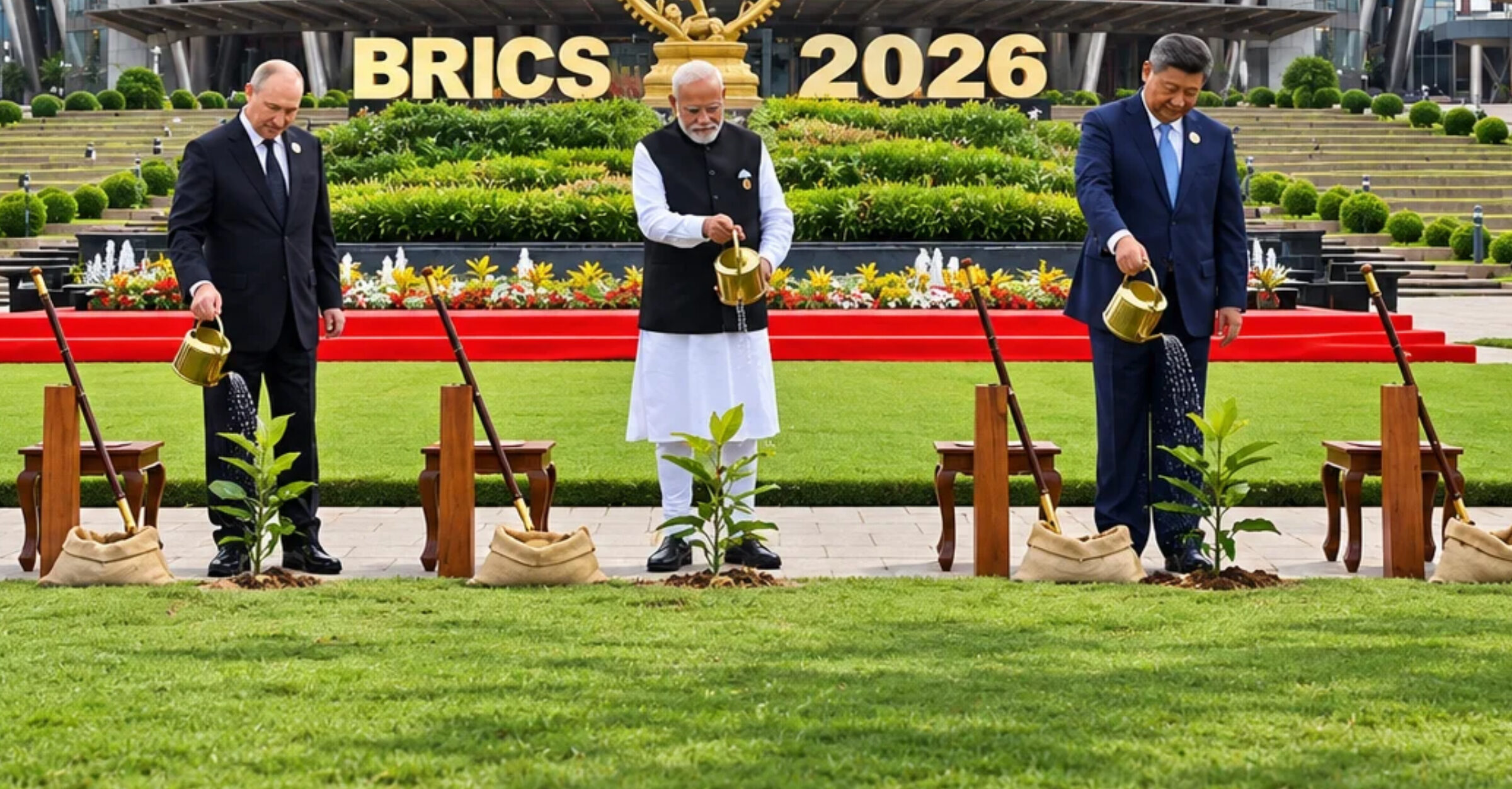
A day before the 18th BRICS summit opened in New Delhi on Sept. 12 under India’s presidency, Hindustan Times ran a scene-setter. The line that gave the piece its headline was relationships over rivalry, substance over mere statements, and people over politics.
The paper attributed it to an unnamed Indian official, who presented it as the pillars of New Delhi’s approach to the summit.
The bloc has a longer pedigree than the slogan: coined in 2001 to describe the emerging economies of Brazil, Russia, India, and China, the acronym became an actual political forum in 2009; South Africa joined in 2010, supplying the final S; and beginning on January 1, 2024, the group took in Egypt, Ethiopia, Iran, Saudi Arabia, and the United Arab Emirates, with Indonesia arriving in January 2025 to bring the roster to eleven members.


The circumstances in which the phrase was spoken were anything but neutral. New Delhi was also hosting Xi Jinping, on his first visit to the Indian capital in seven years, and Vladimir Putin, while Saudi Arabia, a full member on paper, continued its habit of skipping the summit as a state.
The United Arab Emirates and Iran sat in the same room despite standing on opposite sides of the war underway in West Asia — a war that had shut down the Strait of Hormuz and pushed oil above a hundred dollars a barrel.
Abu Dhabi, hit by Iranian missiles, had suspended all commercial and financial dealings with Tehran back in August.
Even the Kremlin’s spokesman, Dmitry Peskov, admitted that the rupture threatened to derail a joint statement. The formula that relationships outweigh rivalry was born, then, not as an abstract proclamation but as an attempt to keep the table from splitting apart in full view of the press corps.
That same unevenness runs through the two conflicts weighing most heavily on the 2026 international agenda. On the Russia-Ukraine war, now in its fourth year, the bloc has never achieved a common voice: Russia is both a belligerent and a founding member; China shares with Moscow a partnership it calls limitless; and India, Brazil, and South Africa have consistently declined to condemn the invasion, preferring to invoke, in the abstract, a peaceful solution that leaves everyone’s position untouched.
On the Palestinian question, the distances are, if anything, wider: South Africa has taken Israel to the International Court of Justice over a charge of genocide in Gaza; Iran remains the region’s most uncompromising opponent of Israel; the United Arab Emirates normalized relations with Jerusalem under the 2020 Abraham Accords; and Egypt, which joined the group in 2024, helped mediate, alongside Qatar and Turkey, the twenty-point deal that produced the October 2025 ceasefire.
To ask that people come before politics, in a gathering that seats the accuser beside the normalizer, is to reckon with one’s own contradiction before reckoning with anyone else’s.
In this triad, there is something that anyone who reads diplomacy through more than a geopolitical lens will readily recognize. Putting relationship ahead of rivalry, substance ahead of statement, and the person ahead of politics as an abstraction of power—these are habits of mind that the Christian social tradition knows well and that Pope Francis, for one, revived insistently throughout his pontificate, from the culture of encounter in Evangelii Gaudium to the universal fraternity of Fratelli Tutti.
Putting two warring countries in the same room and insisting that a shared text emerge rather than a public rupture is a gesture that — however different the instruments and aims may be — resembles what the Argentine Pope Francis asked for when he urged parties in conflict to sit down before demanding reconciliation.
His successor, Pope Leo XIV, moves in the same register. In the weeks before the New Delhi summit, the Vatican’s Secretary for Relations with States, Archbishop Paul Gallagher, traveled to Moscow for direct talks with Russian officials and with the Orthodox Church leadership.
At the Angelus, the pope returns almost every Sunday to calls for hearts to be opened to dialogue and peace in Ukraine; on Gaza, he invokes the inviolable dignity of every person. He welcomed the October 2025 truce as a glimmer of hope and, in the face of violence in the occupied territories, continues to press for a two-state solution.
The Holy See’s diplomacy has no army and no market share, which is precisely why it can afford to seek relationships rather than rivalry without having to choose, as the BRICS countries are forced to do again and again, which side to keep sweet.
❝
The Holy See has never devoted itself to BRICS, either as an institution, an audience, or an official position. An echo of the language used in New Delhi can nonetheless already be found in Francis’ thought.
Putting people ahead of politics, taken seriously, shifts the weight from the state’s interests to the concrete welfare of those who bear the consequences of tariffs, sanctions, and naval blockades—a hierarchy of values that, on paper, aligns with the insistence that economics and diplomacy be measured against the human person rather than the balance of power.
Yet the same triad holds up poorly under pressure: no reference to human rights accompanies the formula, and it risks functioning as humanist vocabulary laid over calculations of power that remain exactly as they always were.
The rivalry the bloc claims to want to transcend has not even disappeared among the hosts: the India-China border dispute remains unresolved. And the very strategic autonomy New Delhi claims for itself — balancing among Washington, Moscow, and Beijing while, at the same time, sitting within the G20, the Shanghai Cooperation Organization, and the Quad — is a technique for managing rivalry, not a way to overcome it.
The summit closed on Sep. 13 with the New Delhi Declaration, a 140-paragraph text, which is not a failed compromise.
On the most feared fault line, the rift between Tehran and Abu Dhabi, the leaders found a common formula, but a vague one — the Declaration speaks only of “exercising maximum restraint” in “Middle East/West Asia” (§28), without naming either party, a sign that agreement on the wording arrived, as it so often does, before agreement on the substance.
On the India-China border, predictably, the Declaration says nothing at all: the bloc’s oldest rivalry stays out of the common text.
What strikes one on rereading the document is an asymmetry that a Roman perspective can hardly miss. On the Palestinian question, the Declaration is among the most detailed the bloc has ever produced: nine paragraphs, 28 through 36, condemning the forced displacement of Palestinians, demanding respect for Jerusalem and its holy places, supporting Palestine’s entry into the United Nations, and citing the International Court of Justice’s provisional measures in “the legal proceedings instituted by South Africa against Israel” (§33).
On the war between Russia and Ukraine, now in its fourth year, the word “Ukraine” never appears—not in a single paragraph, not in an aside, not even in the generic language reserved for the Middle East. It is the clearest confirmation yet of what was observed yesterday: a bloc that counts Russia among its founders and China as its partner cannot find, and could not have found, a common language for that war.
The very Declaration, which claims to prioritize people over politics, chooses silence on a European conflict that has caused tens of thousands of deaths.
For anyone looking from Rome, there are genuine points of consonance. The condemnation of “unilateral coercive measures” (§§22, 108), particularly the blockade on Cuba, echoes an objection that popes have repeated for decades: sanctions strike peoples harder than governments.
The alarm over “a critical increase in global military spending” (§24), at the expense of development, echoes almost the same words with which Pope Leo, addressing the Reunion of Aid Agencies for the Oriental Churches (ROACO), spoke of merchants of death growing rich while hospitals and schools go unbuilt.
The invocation of nuclear-weapon-free zones in the Middle East (§25) aligns with the direction Francis pointed to when he went so far as to call even the possession of nuclear weapons immoral. The defense of Jerusalem’s holy places “for all” (§34) touches chords that papal diplomacy has always treated as non-negotiable.
But the Declaration remains, in the end, a declaration: a catalog of conditional verbs, with no mechanism to enforce its own implementation, and silent exactly where silence costs the most. For the priority of people over politics to be credible, it would have to hold even when the politics in question belongs to a founding member.
The Holy See has never devoted itself to BRICS, either as an institution, an audience, or an official position. An echo of the language used in New Delhi can nonetheless already be found in Francis’ thought.
In 2024, Fides, the agency tied to the Pontifical Mission Societies, read the bloc’s expansion as an application of the polyhedron image proposed in Evangelii Gaudium — a geometric figure in which each face remains distinct while together they compose a single form, describing a BRICS-plus that seats Catholic, Orthodox, Hindu, Confucian, and Muslim traditions at the same table.
The Holy See has also proposed, to the great debtor nations of the Global South, an architecture of justice on public debt, invoking the 1997 Charter of Sant’Agata de’ Goti, that explicitly looks to the BRICS countries as possible interlocutors.
These remain scattered intuitions, not a doctrine; but they are enough to suggest that the question New Delhi has posed — relationships before rivalry, substance before announcement, people before politics — is not foreign to a magisterium that has spent years reflecting on the world’s plurality without abandoning the unity of the human family.



1 Comment
Dr.Cajetan Coelho
September 16, 2026Tree planting is a meaningful initiative. Watering and greening Mother Earth and keeping it ready for future generations is a beautiful sight. Long live Planet Earth.