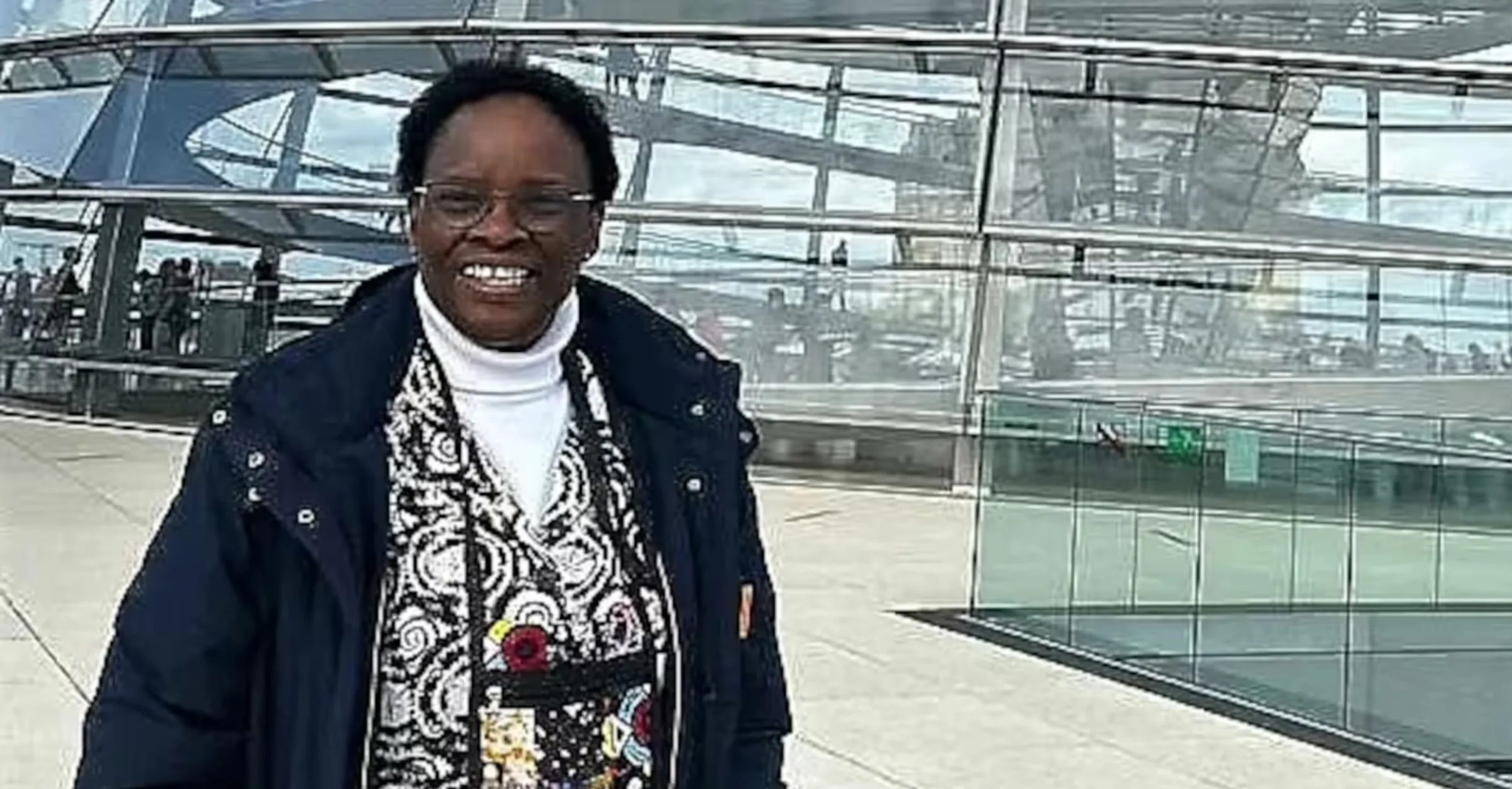
After a presentation on safeguarding, a parish priest in a Kenyan community takes Sister Jacinta Ondeng aside.
He wants to know when she and her fellow campaigners are finally going to stop talking about this subject. The religious sister replies that they are only just getting started.
Safeguarding means protecting all people from sexual violence, exploitation and abuse of power. Sister Jacinta knows that some people in the Church do not like it when she lifts the veil of silence.


Clergy and Church leaders also abuse their positions of power, not only in relation to children and young people, but also to adult women, including ordinary believers and religious sisters.
From the Classroom to a Women’s Prison
Education is the key to everything, says the 58-year-old. She was born in Kisumu, a port city on Lake Victoria in western Kenya. Both her parents were teachers and made sure their six children received a good education.
At just 21, Jacinta was already teaching at a Catholic girls’ high school. In her mid-20s, she decided to enter religious life.
She joined the School Sisters of Notre Dame, an international religious order founded in Bavaria in 1833, with a charism centered on education and now active across dozens of countries. There, she was able to continue working as a teacher.
She continued her studies, earning a Ph.D. in counseling psychology from Kenyatta University in Nairobiand worked with inmates at a women’s prison. The inspiration came from the film Dead Man Walking, in which a religious sister helps prisoners on death row.
She offered individual and group therapy sessions in the maximum-security section and wanted to help the women make a fresh start without carrying a lifelong stigma.
When one of the women she supported was pardoned after 27 years in prison, Sister Jacinta temporarily took her into the convent.
Abuse of religious sisters: ‘we must not overlook this either’
Initially, safeguarding work focused primarily on children.
In 2019, Jesuit Father Hans Zollner — a pioneer of child protection work in the Catholic Church who founded what was then Rome’s Centre for Child Protection in 2012; the center became the Institute of Anthropology: Interdisciplinary Studies on Human Dignity and Care (IADC) in 2021 — invited Sister Jacinta to Rome as a scholarship recipient for one of the first safeguarding courses at the Pontifical Gregorian University.
There, a religious sister wrote about the abuse of religious women in her project paper, and the discovery came as a great surprise. After returning to Kenya, Sister Jacinta was convinced that the issue had to be addressed.
She tells the story of a young religious sister who was abused by a priest and expelled from her religious order after becoming pregnant. The woman is doing reasonably well today, partly because Sister Jacinta provided psychological support and helped her find a job.
Most survivors, however, do not want to make their cases public because of shame, guilt and fear.
Young religious sisters and women discerning a vocation are particularly vulnerable. In Kenya and elsewhere in Africa, they need a letter of recommendation from a parish priest.
Sister Jacinta repeatedly hears that they had to provide sexual favors to the priest in return. She emphasizes that this does not apply to every priest, just as not every religious sister is affected.
She also points to poverty as a contributing factor. When religious communities cannot even provide their sisters with basic necessities, they are more likely to find themselves in compromising situations.
Spiritual abuse is another problem. In such cases, perpetrators manipulate victims’ freedom in their relationship with God and their faith.
Training, e-learning and looking to Rome
The Safeguarding Initiative for Catholic Sisters was established in 2023 with support from missio — the Catholic mission and development organization missio Aachen, based in Germany — and the Hilton Foundation.
Since 2026, Sister Jacinta has headed the initiative at Tangaza University in Nairobi, a Catholic university college affiliated with the Pontifical Urbaniana University. It primarily serves religious sisters in Kenya and Uganda, but its impact is intended to reach far beyond those countries.
The network offers training, advises and encourages survivors, and provides psychological and legal assistance. It now also reaches seminarians, priests and male religious communities.
In September, an e-learning course developed in part by Sister Jacinta was launched at Tangaza University. It forms part of the training for young women preparing to enter religious life.
Johanna Streit heads the safeguarding office at missio. She sees the greatest progress in the increased awareness of the issue: people are now talking about the abuse of religious sisters. Many recognize abusive behavior and no longer look the other way. She would like to see more from the Vatican.
Sister Jacinta has also been invited to a Vatican conference addressing the abuse of adult women and religious sisters. She hopes it will lead to clear protective provisions under canon law. A strong voice from Rome, she believes, would strengthen efforts on the ground.
This is a translated and edited version of the interview from the“Echt. Unglaublich!” podcast — German for “Real. Unbelievable!” — that first appeared on Domradio.de and is republished with permission. The podcast is produced by Missio, kontinente magazine and Domradio.de.