Urban diversity and village-like familiarity coexist, and much of daily life unfolds in public spaces in Germany’s Südstadt, centered around Chlodwigplatz, Severinstraße, and Bonner Straße, in Cologne.
International restaurants stand alongside small theaters, cafés, wine bars, and traditional neighborhood pubs.
At the heart of this neighborhood lies Rolandstraße, a broad, tree-lined avenue built during Cologne’s late nineteenth-century expansion.


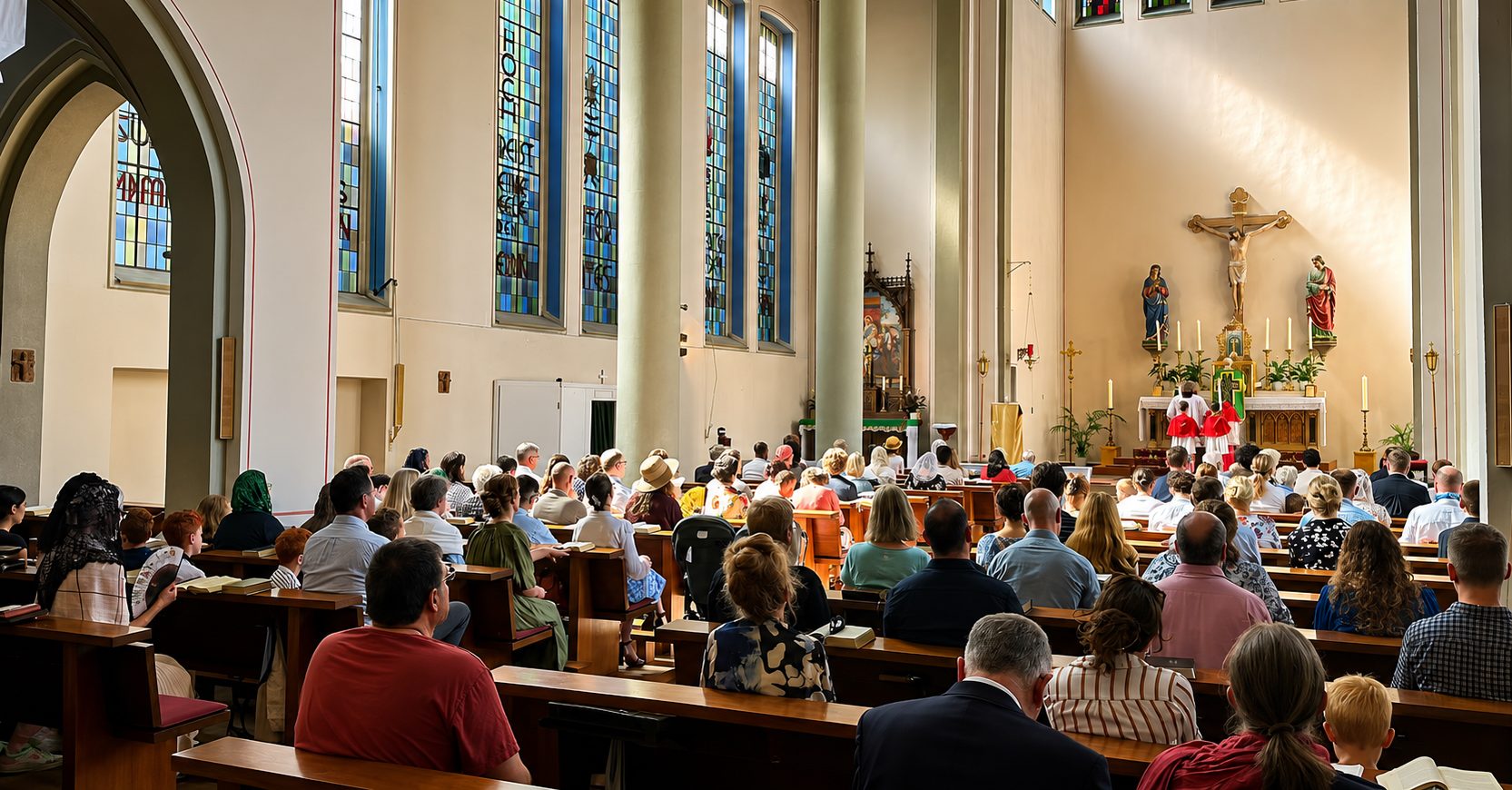
On Sunday morning, July 12, around 300 people make their way to the Maria Hilf Church to celebrate the TraditionalLatin Mass (TLM) according to the 1962 Roman Missal.
The manner in which this congregation worships has been a subject of discussion within the Catholic Church for years. Because of the current controversy surrounding the Society of St. Pius X (SSPX), the topic has again entered the spotlight.
Unlike the SSPX, however, the faithful here remain in full communion with the Roman Catholic Church.
The parish is served by the Priestly Fraternity of St. Peter (FSSP). Nevertheless, critics sometimes label those who attend these Masses as “traditionalists,” “Tradis,” “dark Catholics,” or “reactionaries.”
A different form of the Mass
The liturgy at Maria Hilf differs in several respects from the Mass celebrated in most Catholic parishes in Germany today.
In most churches, Mass is celebrated in German, the priest stands behind the freestanding altar facing the congregation (ad populum), and the liturgy follows the post-Vatican II Roman Missal.
At Maria Hilf, however, the liturgy follows the 1962 Missal.
The church itself was built in 1896 as the chapel of the neighboring Mariahilf Asylum, which once housed a residence for working women, a childcare facility, and a home for half-orphans.
Today, much of the former complex is occupied by the German Catholic Scout Association of St. George (DPSG), including its diocesan offices and the St. George Conference and Guest House. Another section is used by a language school.
Since 2005, the church has served as the worship center for the FSSP.
A young community
“We are a community that is growing,” says Father Bernhard Gerstle, FSSP, who heads the Cologne apostolate of the fraternity and celebrates this Sunday’s Mass.
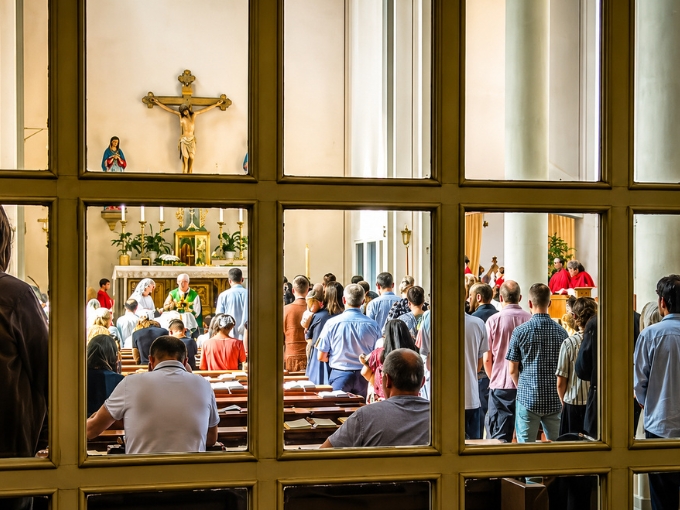
Nearly 300 worshippers, many from the surrounding region, gathered for Mass on Sunday and filled the church.
One of the striking features of the gathering is its relatively young age profile. The rear of the church is filled with young families, strollers, and small children.
According to Father Gerstle, many newcomers have joined in recent years. During the Easter Vigil of 2026, five adults were baptized.
He says that many young people and converts first encounter the fraternity through the internet and social media. The Cologne FSSP Instagram account (fssp.colonia) now has more than 23,000 followers.
Gerstle also pointed out that a young man from Jordan had expressed hopes of entering the fraternity’s seminary in Wigratzbad and eventually being ordained for the Diocese of Augsburg.
Worship in the Traditional Rite
First-time visitors require some time to adjust to the TLM liturgy. While many elements resemble a typical Catholic Mass, several aspects are noticeably different.
Except for the homily, all the prayers are in Latin. The Eucharistic Prayer is recited almost entirely in silence.
Throughout most of the liturgy, the priest stands before the high altar with his back to the congregation. This posture, known as ad orientem, is often misunderstood.
According to the community’s understanding, the priest is not “turning his back” on the faithful. Rather, priest and congregation together symbolically face east—toward Christ.
The shared orientation emphasizes that the liturgy is not primarily a dialogue between priest and congregation but a common turning toward God.
Holy Communion is also distributed differently from the practice common in many parishes today. The faithful receive the Holy Communion on the tongue while kneeling.
The congregation sings and prays using the Catholic hymnal Laudate Patrem, supplemented by a locally printed Cologne appendix. The standard German hymnal known as Gotteslob is not used.
❝
There is an undeniable historical connection between the FSSP and the SSPX. Without the events of 1988, the FSSP likely would never have existed in its present form.
On this Sunday, the community celebrates the Mass XI (Orbis Factor) from the Gregorian repertoire.
The community also follows the pre-conciliar liturgical calendar.
While most Catholic parishes celebrate the 15th Sunday in Ordinary Time on July 12, Maria Hilf observes the Seventh Sunday after Pentecost. As a result, the Scripture readings are different.
The Gospel proclaimed is Matthew 7:15–21, in which Jesus warns against false prophets who outwardly appear as sheep but inwardly are ravenous wolves.
In churches following the post-Vatican II lectionary, the Gospel that Sunday instead comes from Matthew 13, which is the Parable of the Sower.
Readings in Latin and German
After the readings are first proclaimed in Latin, Gerstle reads them again in German before beginning his homily.
In his sermon, he reflects on Christ’s warning about false prophets. He argues that ideological movements from both the political left and right continue to seek influence within both Church and society.
He also addresses current developments in the Church, discussing both traditionalist and reform-minded movements.
Specifically, he comments on the recent episcopal ordinations carried out by the SSPX in Switzerland, which the Roman Catholic Church considers a schismatic act.
The relationship between FSSP and SSPX
There is an undeniable historical connection between the FSSP and the SSPX. Without the events of 1988, the FSSP likely would never have existed in its present form.
After Archbishop Marcel Lefebvre ordained four bishops without obtaining permission from Pope John Paul II, some priests who wished to preserve the traditional liturgy while remaining in full communion with Rome founded the FSSP.
Father Gerstle views the recent developments with concern. “A great wound has been created,” he says of the recent schismatic episcopal ordinations.
He believes the fraternity’s mission now includes welcoming Catholics seeking a new spiritual home following the turmoil within the SSPX.
“I think it is very important that we are able to offer this alternative,” he says.
The Archdiocese of Cologne has likewise pointed Catholics attached to the 1962 Missal toward the FSSP as a place where they may participate in the traditional liturgy while remaining in full communion with the Catholic Church.
Community life beyond the liturgy
The Mass concludes with the Marian hymn “Segne du, Maria” (“Bless Us, O Mary”).
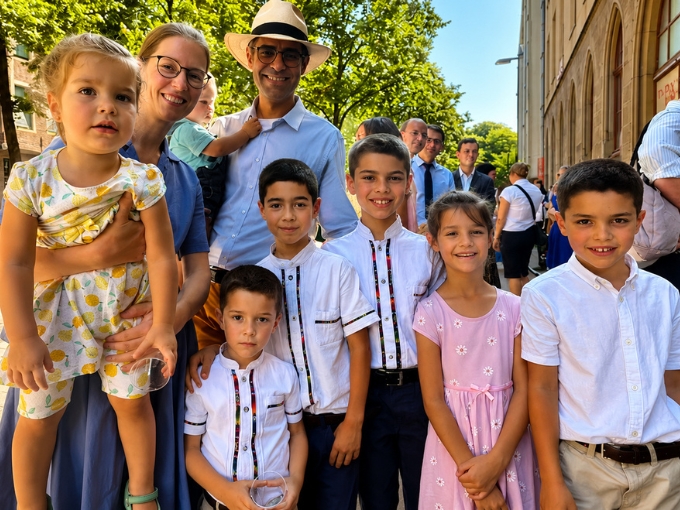
After the procession leaves the church, the congregation spills out onto Rolandstraße.
The community has neither a parish hall nor a modern parish center. Aside from the aging church building itself, there is little indoor space for fellowship. As a result, much of parish life unfolds outdoors.
The members jokingly refer to this as “curbside ministry.” Most remain long after Mass, talking with friends and greeting familiar faces.
The Monroy family from nearby Rösrath, who have seven children, are among those attending. The parents say they especially value the sense of community.
Initially, it was the beauty of the traditional liturgy that drew them, but now it is above all its spiritual depth that continually brings them back.
“We find here something that we cannot find in the world,” they explain. “The liturgy lifts people toward God.”
Unlike in some parish communities, they say, the vitality of spiritual life here depends less on the personality of an individual priest than on the stability of the liturgy itself and the continuity of the Church’s tradition.
The Mass, they note, is celebrated substantially as it has been for centuries. Saints such as Teresa of Ávila, they add, prayed according to this same liturgical tradition.
Even more than an hour after the final blessing, many parishioners are still seen beneath the shade of Rolandstraße’s old plane trees. Later in the day, the church will host a catechetical session.
Gradually, people begin making their way home, dispersing once again into the streets of Cologne’s Südstadt—a neighborhood well known for its diversity and openness.
The scene seems almost symbolic of the district itself: people with very different ways of life, each following their own path.
Or, as Cologne’s famous saying puts it: “Jeder Jeck es anders” (Every fool is different). The German expression means that everyone is different.
This is a translated and edited version of the feature that first appeared on DOMRADIO.DE and has been republished with permission by Global Catholic.