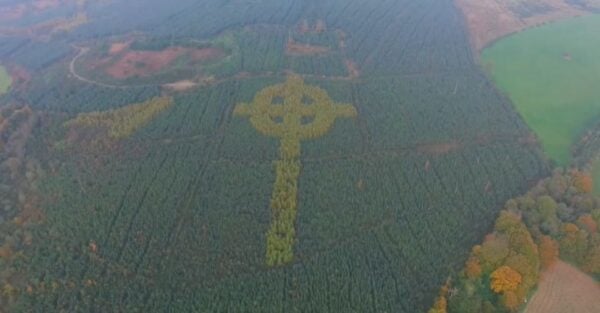
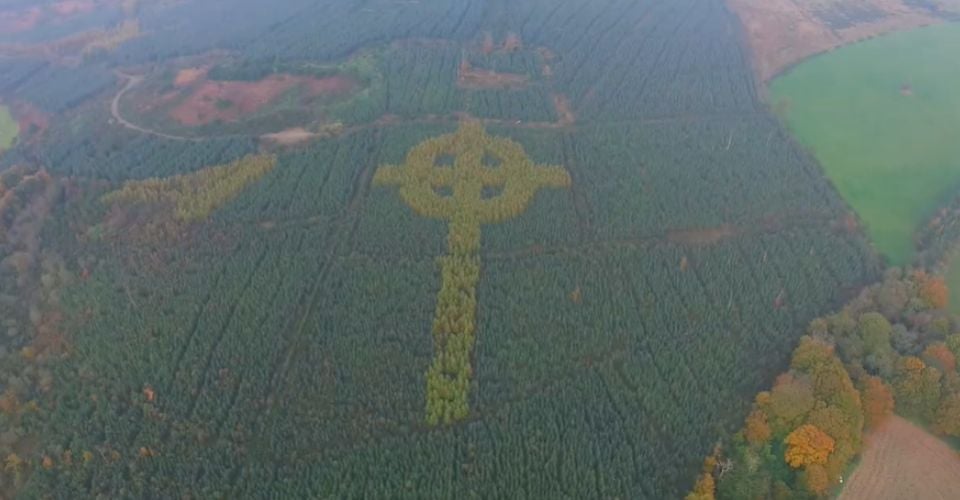
On a hillside in County Donegal, in northwest Ireland — a county that juts into the Atlantic along the Irish border with Northern Ireland — autumn reveals a golden cross among the trees.
It is neither a recent installation nor an unexplained phenomenon. It is the result of a carefully planned planting by forester Liam Emmery, sometimes also rendered in media reports as “Emery.”
It is a Celtic cross laid out with Japanese larch trees, whose needles change color before falling, surrounded by evergreen trees. The contrast makes the design appear against the green backdrop of the forest.


Where it stands, and how big it is
The work is located on Bogay Hill, near the village of Killea in Donegal, close to the border with Northern Ireland.
Local sources describe it as approximately 125 by 70 meters, though widely circulated reporting gives its length as roughly 100 meters (about 328 feet) — for scale, longer than a standard soccer pitch.
Although it can be seen from the road between Killea and Newtown Cunningham, the aerial perspective offers a far better view of the whole design, including the arms of the cross and the ringed circle that identifies its Celtic form.
It was first spotted in autumn 2016 by passengers on flights approaching City of Derry Airport, the regional airport serving Northern Ireland’s second-largest city, located a short distance from the forest.
A work that took years to reveal itself
Emmery conceived the planting in the early 2000s. His work required him to imagine something that could not yet be seen, from the size the trees would eventually reach to the spacing between them and the effect that different species would create on the hillside.
Local tourism information describes the project as a planting of more than 3,000 trees of two types, with the Japanese larches forming the cross.
Japanese larch (Larix kaempferi) is a fast-growing conifer native to Japan that was introduced to Ireland and Britain in the 19th century and has since become a staple of commercial forestry there, prized for both its timber and its distinctive golden-to-red autumn color before its needles drop — unusual among conifers, most of which stay green year-round.
He did not work with stone or paint, but with growth, seasons and patience. The design needed time to take shape in the landscape.
In fact, its creator did not live to see the attention it would receive.
Emmery died in 2010, at the age of 51 — several years before the cross was ever publicly noticed.
In the autumn of 2016, passengers approaching Derry Airport noticed the enormous cross in the forest. Images began circulating, and the forester’s story became associated with that natural design.
The work came to be known as Emmery’s Celtic Cross, although some publications also spell his name “Emery.” Behind the striking image was a person and a decision made many years earlier.
Autumn makes the design visible
The effect depends on the behavior of the trees.
Japanese larch is a conifer that sheds its needles. Before they fall, they turn shades of yellow and gold. The surrounding evergreen trees retain their green color, providing the backdrop against which the design stands out.
That is why the cross is especially striking in autumn, although its appearance changes as the season progresses. It does not appear out of nowhere, but the change in color makes it possible to recognize a design that has been there all along.
This annual transformation explains part of its appeal. The same hillside offers a different view depending on the time of year, and the work remains connected to the rhythm of the forest.
An Irish symbol made of trees
The chosen shape evokes one of the most recognizable images of Ireland’s religious heritage: the Celtic cross, characterized by the circle surrounding the intersection of its arms.
Celtic crosses of stone date back to early medieval Ireland, with surviving examples from roughly the ninth century onward; the ring is often interpreted as representing eternity or, in some traditions, as a halo.
The island’s great stone crosses are part of its medieval Christian heritage. Emmery brought that shape into the landscape through a planting.
Without a direct account from its creator, it would be unwise to attribute a more specific religious message to the work. What can be said is that he chose a symbol closely associated with Irish history and identity and turned it into a living work of art.
Its permanence is also different from that of a stone monument. The trees grow, change and age. The cross is not fixed once and for all; it depends on the life of the forest that sustains it.
The name behind the image
Aerial photographs have turned the cross into a widely circulated image of Donegal.
Photographer Gareth Wray — an Irish landscape and aerial photographer known for his work documenting the “Wild Atlantic Way,” the scenic coastal touring route along Ireland’s west coast — is among those who have documented and brought attention to its presence in the landscape.
His images make it possible to appreciate the scale of a work that is difficult to take in from the ground.
But the story accompanying those photographs ensures that it does not remain merely a visual curiosity.
Liam Emmery left behind a work whose best-known result emerged after his death. He did not get to witness the amazement of those who discovered it from an airplane or the spread of his name alongside the cross.
Every autumn, the changing colors bring that decision back into view. On the hillside of Bogay Hill, the forester’s legacy continues to grow with the trees he planted.
ˆThis is a translated and edited version of the feature that first appeared on Religion Digital and has been republished with permission.