
On Thursday morning, June 12, at the jetty in Arguineguín on the southern coast of Gran Canaria, Pope Leo XIV made a gesture no speech could have replaced. He cast a wreath of flowers into the sea in memory of the thousands swallowed by the Atlantic along the Canary route, and he blessed a blue cross, its color long since faded, carved from the wood of a cayuco.
Then he lifted his eyes from the water to the faces before him — a rescue captain, a Caritas volunteer, and a woman who had survived trafficking — and spoke the words that captured the morning: “Human dignity carries no passport, and it loses none of its worth in crossing a border.”
There is a paradox at the heart of this June 6-12 journey, made at the invitation of King Felipe VI and the Spanish Church, the fourth of his pontificate. The chosen motto was “Lift up your eyes,” taken from the fourth chapter of John’s Gospel (John 4:35).


And yet, for a week, the Pope did very nearly the opposite of what the motto seems to counsel: instead of raising his eyes to heaven, he lowered them — to the jetty, to the boats, to the cells, to the faces of those without a voice.
The key to it all lies precisely there. To lift up one’s eyes, in Leo’s grammar, does not mean to look away from reality but to look into it more deeply.
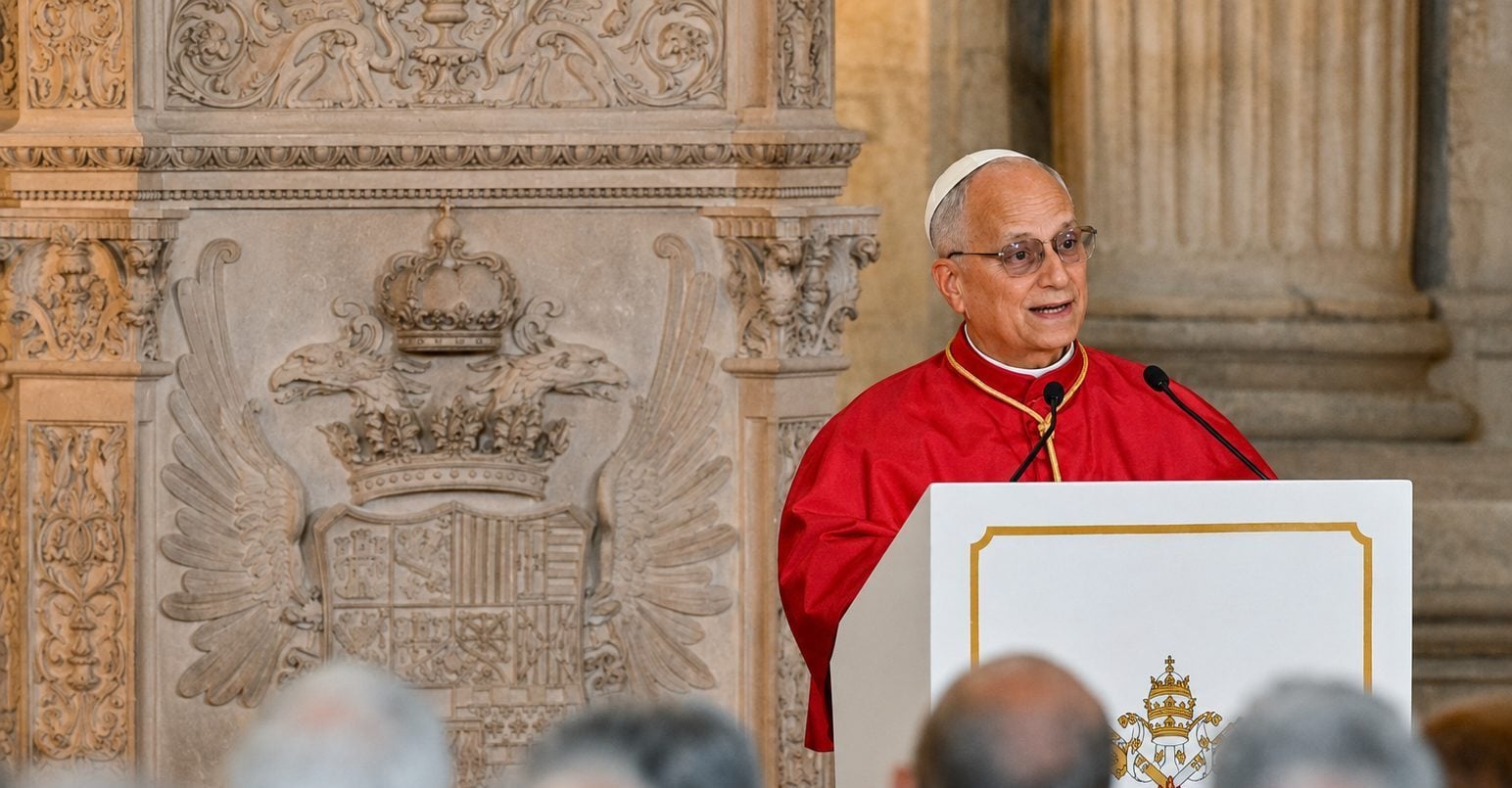
The journey began in Madrid on June 6 at the Royal Palace, before the authorities, civil society, and the diplomatic corps. There, Leo read Spain through its mystics, choosing as his opening image not light but night: the “dark night” of John of the Cross, whose jubilee year is now being observed, understood as the time when the soul strips itself of what it presumed to know and possess.
“What frightens us most,” he said, “is the unknown” — the sense of being left without maps, the loss of one’s bearings. It was at once a diagnosis of the crisis we are living through and its antidote: what is needed are men and women able to make out, in the dark, a light. This is a mysticism “with open eyes,” he was careful to add—not a flight from history but a descent to the root of things.
Alongside John, he set Teresa of Ávila and her “interior castle,” where, as one advances from room to room, the space widens, and the contradictions dissolve.
From this diagnosis follows the appeal that Leo would repeat at every stop: to abandon divisive narratives, to move “from sterile simplifications to the fruitful appreciation of complexity.”
He summoned the Spain of the three cultures — the school of translators under Alfonso X, Córdoba and Toledo as places of mediation among Christians, Muslims, and Jews, Averroës and Maimonides — as a reminder that security is not born of arms and walls but of learning to walk beside the other.
And he named the stone guest who shadowed the whole trip: the new technologies, now become “an artificial environment” in which prejudice is inflamed and critical thought grows weak. This is the heart of his recent encyclical, Magnifica Humanitas, published on May 25.
The following evening, at the Movistar Arena, before the worlds of culture, art, business, and sport, that appeal took the shape of a metaphor.
The meeting was titled “Weaving Networks.” Weaving: not moving pawns across a chessboard but interlacing threads. The question the Church, “an expert in humanity,” keeps asking—recalling Paul VI and his encyclical—remains the same: “What does it mean to be truly human?”
To weave networks, then, means a dialogue among institutions centered on dignity: that the university not turn its back on the world of work, that business not regard the employee as a variable, and that technological progress reckon with the elderly, the poor, and those without a voice. “Be new threads,” he asked, “to weave new networks.”
“Leo drew a distinction between two twin rights: the right to seek refuge and the right ‘not to have to migrate’ — to remain in one’s own land without hunger, war, or persecution.”
The densest address took place on June 8 at the Congress of Deputies. Before Parliament, Leo performed a masterstroke: he traced the most contemporary questions back to a lecture hall five centuries old, Salamanca, where Francisco de Vitoria and his school intuited the totusorbis, a human community wider than any particular power, and held that reason cannot be invoked to legitimize what force presents as expedient.
From there to our own hour is a short step: “The new worlds opening before us are no longer drawn on maps—they unfold in technology, in the economy, in biomedicine, in the digital universe.” Artificial intelligence “is not neutral, for it takes on the face of those who conceive, finance, regulate, and put it to use.”
And the thesis on which everything rests: the dignity of the person “precedes any concession of the State” and cannot be made to hang on shifting majorities. Hence the sharpest words of the journey—against the throwaway culture, in defense of life from conception to its natural close; against the rearmament now presenting itself once more “as an almost inevitable answer”; in favor of a language capable of “disarming itself.”
Then a writer’s touch: he pointed to the skylight crowning the chamber, where light entered from above, and explained that lifting one’s eyes means “to look with greater depth at what is at stake in every public decision,” because every law touches people of flesh and blood.
The afternoon of June 10 offered the image destined to endure. In the Sagrada Família basilica, on the exact centenary of Gaudí’s death — he died on June 10, 1926 — Leo blessed the 560-foot-tall tower of Jesus Christ, making that temple the tallest church in the world.
The cross had been raised in February; the work, begun in 1882, remains unfinished. And it is precisely this unfinishedness that the Pope chose to preach about. “We do not inhabit a finished work but a temple still under construction. Its imperfection is not a flaw, for it bears witness to a longing; it is not a lack but a promise.” Taking the basilica as a figure of a society building itself, living stone upon living stone.
Once more, the double movement: as we lift our eyes toward the Risen Crucified, let us commit ourselves to “raise the face of those who lie in the dust.”
That face, on the same day and in the same city, had already been given a name. That morning at Brians 1 prison, Leo had addressed the very same word to the inmates: “lift up your eyes” toward the One who never ceases to show you his love.
“God loves you as you are,” he said, “but he dreams of you better.” A person’s mistakes do not define his identity; no physical barrier can keep anyone from reaching the horizon. Dignity, he repeated, quoting the encyclical, belongs to every person simply by the fact of “having been willed, created, and loved by God.”
It was with this same conviction that, on Gran Canaria and then on Tenerife, the journey returned to the sea. In biblical language, the sea is chaos and menace: Leviathan and Rahab dwell there, and today the mafias that traffic in desperation.
But faith, Leo said, “is not left paralyzed before the power of the sea.” Holding up the Fisherman’s ring, he recalled that the promise made to Peter—“you will be a fisher of men”—takes on “a literal and painful force” here.
He spoke directly to Blessing, a victim of trafficking: “If others have put a price on your body, God has never stopped seeing you as beyond price.” He drew a distinction between two twin rights: the right to seek refuge and the right “not to have to migrate”—to remain in one’s own land without hunger, war, or persecution.
On the final day, at the Las Raícescenter on Tenerife, the synthesis: “All of us, in some way, are migrants, all pilgrims on the road.” And in nearby La Laguna, which he called “a city without walls,” the observation that closed the circle opened on the jetty: “The hardest barriers to bring down are not always of stone. Sometimes they stand in the gaze, or in fear, or in indifference.”
Here, then, is the thread that holds together twelve addresses, five homilies, and four cities. Leo came to Spain to propose, in a time he explicitly called “night,” a conversion of the gaze. Not facile optimism, which he refused (“we do not bless naïve enthusiasms”), nor fear, which he defused (“we do not feed sterile anxieties”), but attention: the capacity to look more deeply at the person—the prisoner, the migrant, the unborn child, the political adversary—until a face comes into view. The net holds; the unfinished tower promises.