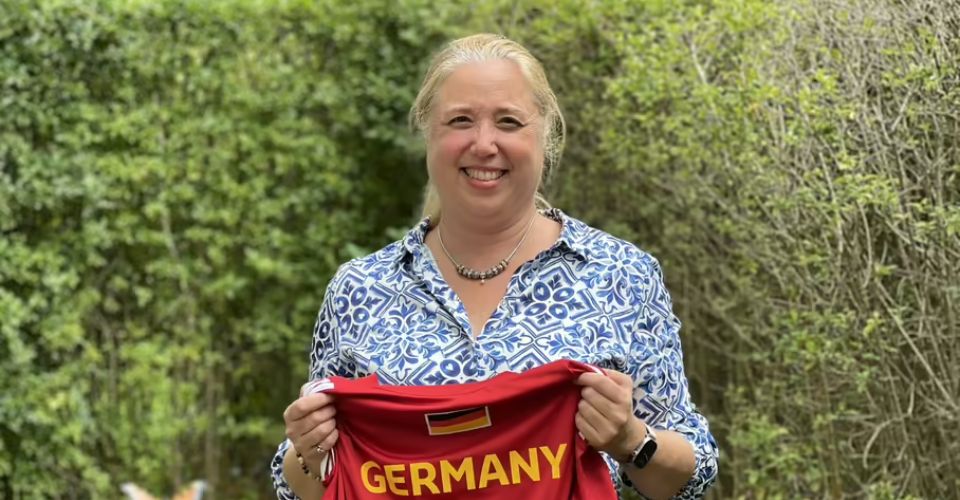
In her small garden in Cologne-Porz, in western Germany, Stefanie Neuhäuser has plenty to do these days.
Rain and sunshine alternate constantly. As soon as the rain stops, she rolls out her black awning again and puts up the parasol. She loves her little garden — these are the kinds of things that can once again be taken for granted today, without her illness setting the pace of the day.
For a long time, things were different. Neuhäuser was diagnosed with IgA nephritis, a kidney disease, in 2011.


IgA nephropathy, also called IgA nephritis or Berger’s disease, is a condition in which an antibody called immunoglobulin A builds up in the kidneys, gradually impairing their ability to filter blood; it is one of the most common causes of kidney failure worldwide.
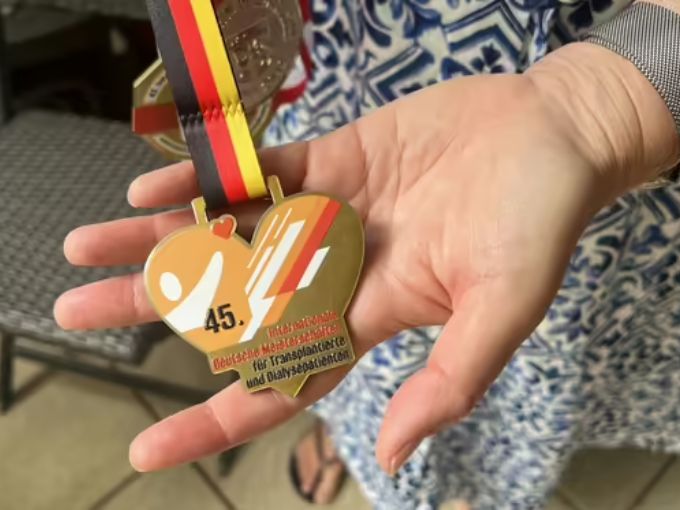
It became so severe that she began undergoing dialysis from 2014. It would take more than 10 years before a donor kidney was found for her.
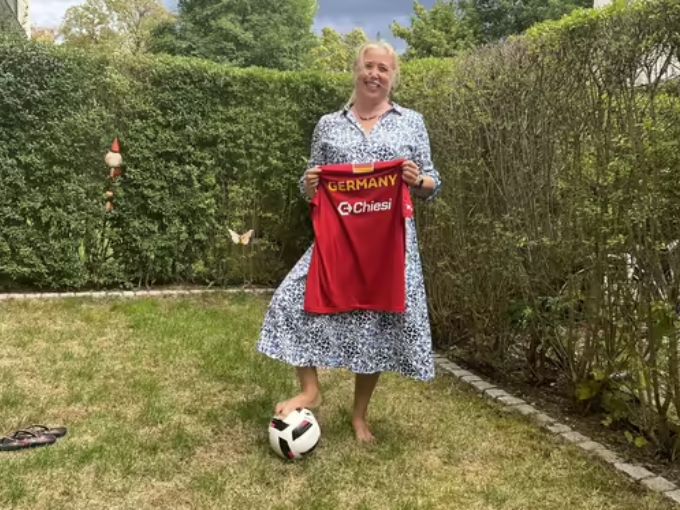
Soccer and jogging — possible again today
This week, Neuhäuser is playing for the German national soccer team at the Transplant Football World Cup in Frankfurt, held Sept. 13-18, 2026, and hosted by Germany after its team won the football tournament at the 2025 World Transplant Games in Dresden.
For the first time, there is a women’s team of its own. When people with transplanted organs from all over the world come together, she wanted to be there.
For the 52-year-old, sports are more than exercise. For her, the community in sports works like a medicine. It shows her what can once again be possible after a transplant. Not everything will be as it was before, but there is a little more self-determination.
Diagnosis: kidney disease
A self-determined everyday life was not possible for her for years. In 2011, Neuhäuser was diagnosed with a congenital kidney disease. She waited 10 years for a donor organ.
During this time, she had to learn to live with the disease, which repeatedly set limits for her. At the same time, she fought to prevent the disease from completely determining her life.
“I wanted to regain my freedom so that I would not be determined solely by the disease and the system,” she says.
Thailand, one last time
In 2012, after the diagnosis and before dialysis, Neuhäuser traveled to Thailand one more time. She knew that her life would change fundamentally.
“I was very aware during the trip to Thailand that this would probably be my last trip in this form,” the 52-year-old says today.
Then there was no other way: Neuhäuser’s kidney was no longer working sufficiently. Her parents were not eligible to serve as living donors. She had to start dialysis.
“I thought I would somehow manage to fit the treatment into everyday life,” Neuhäuser recalls.
Setbacks and compromises
At the time, she would have preferred peritoneal dialysis.
With this method, a fluid is introduced into the abdominal cavity through a permanent catheter to filter waste from the blood via the lining of the abdomen, allowing patients to perform the treatment at home rather than in a clinic.
But this did not work for Neuhäuser. If she did not want to go to the clinic three times a week, the only option left was conventional home hemodialysis.
For this, her blood was pumped into a machine outside the body — the more familiar form of dialysis, using a filtering machine rather than the body’s own abdominal lining.
The machine removes toxins and water and pumps the blood back.
Seeing what is still possible
It was a compromise for Neuhäuser. She received extensive training, learned to puncture herself and operate the machine.
But because this form of dialysis takes hours, she now had to adapt her everyday life to the treatment.
The shunt in her arm — the surgically created connection between an artery and vein that allows a dialysis machine repeated access to the bloodstream — repeatedly caused problems.
She had to cancel vacations. “Ultimately, I also became a bit of a control freak,” she says today.
Nevertheless, Neuhäuser tried to preserve as much as possible of what belonged to her life: theater, travel, yoga. She tried not only to look at what was no longer possible, but at what was still possible.
Over the years, the complications increased. She had to undergo surgery on her shunt several times.
“Over time, you become more nervous,” the 52-year-old says.
“I’m not getting any younger either,” and complications could have resulted in her being classified as “not transplantable.” That would have ruled out a transplant at that point, adds Neuhäuser.
‘We have a kidney for you’
After ten and a half years on the waiting list, her cellphone rang on March 29, 2025, a Saturday morning at 5 a.m.
“Somehow, I immediately knew: This must be it. Who calls at 5 in the morning?” says Neuhäuser.
It was Cologne University Hospital. “We have a kidney for you. How are you doing?” recounts Neuhäuser, who has since received a kidney transplant.
She called her parents and a friend, packed her things and drove to the hospital. After numerous examinations and checks, she waited in a small room.
At some point, she says, someone came in with a transport box and put it in the refrigerator in her room. “Then I knew: That’s the kidney. It was completely surreal.”
The new kidney needed time before it began working. Within half a year, a virus put the transplanted organ at risk. Rejection threatened her prospects for a normal life.
In the end, the doctors managed to get it under control.
A candle for the donor
Neuhäuser says she feels an overwhelming gratitude for her new organ.
Whenever she talks about it, tears come to her eyes again and again.
When she was able to walk a little again after the transplant, she went to the chapel at the university hospital first. There, she lit candles for the donor.
She has taken this ritual home with her. She says she is not particularly religious today, but churches are places of strength for her — especially Cologne Cathedral.
There, she can come to rest. She regularly lights a candle, remembers and gives thanks to her donor.
Germany’s organ donation debate: presumed consent or not?
More than 8,200 people are currently waiting for a donor organ in Germany. Organ donation figures have stagnated.
That is why almost 250 members of the Bundestag, Germany’s federal parliament, submitted a cross-party motion for “presumed consent” in August 2026, backed by lawmakers from the Christian Democratic Union/Christian Social Union (CDU/CSU), Social Democratic Party (SPD), Alliance 90/The Greens (Greens) and The Left (Left Party), with a first reading in parliament expected this September.
They suggested considering adults as organ donors if they have not expressly objected during their lifetime. Until now, explicit consent is required to become an organ donor.
The Catholic German Bishops’ Conference rejects presumed consent.
Its then-chairman, Bishop Georg Bätzing, put it this way in January 2025: “Organ donation must be a voluntary donation.”
Bätzing stepped down as chairman of the German Bishops’ Conference in February 2026 and was succeeded by Bishop Heiner Wilmer of Hildesheim; the position from January 2025 reflects the conference’s stance at that time and remains its position today.
An act of charity
From a Christian perspective, organ donation can be an act of charity — but precisely as a conscious, informed and voluntary decision. Silence does not automatically mean consent.
The churches therefore advocate first making better use of the possibilities offered by the existing system: more information, simpler documentation, better structures in hospitals and strengthening trust.
Supporters of presumed consent argue, by contrast, that if people can object at any time, self-determination is preserved. At the same time, they say, the new regulation could help encourage more people to engage with the issue of organ donation.
‘Doing nothing is not an option’
Neuhäuser knows how precious a donor kidney is. But she does not want to reduce the issue to a simple “yes” or “no.”
She understands when people find the question difficult. At the same time, she says: “Doing nothing is not an option. We have to get the numbers up.”
Presumed consent could be one possibility, but one should not put everything on a single card.
“What if the motion does not win a majority? What then?” asks Neuhäuser, who expressed fears that the debate could then come to a standstill again for years and that time would be lost — too much time for people on the waiting list.
For the 52-year-old, the donor kidney came just in time. After ten and a half years, it gave her back a piece of freedom.
When she plays at the World Cup for transplant recipients, her donor will always be there with her, she says.
This is a translated, edited, and expanded version of the feature that first appeared on DOMRADIO.DE and has been republished with permission by Global Catholic.