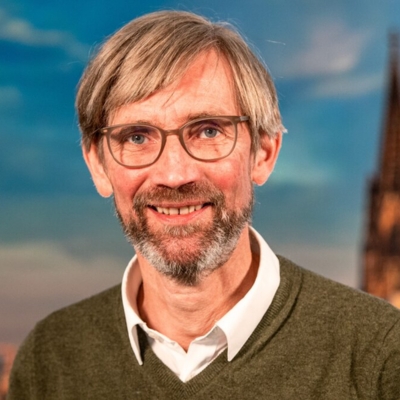
In the following interview, Michael Zichy, a professor of Fundamental Questions of Theology and Social Philosophy at the University of Bonn, discusses his new book, Being Important to Others: A Philosophy of Life’s Meaning.
When asked about the meaning of life, AI responds: “Biologically speaking, the meaning of life lies in survival and reproduction. Philosophically and psychologically, however, there is no universal answer. Life has no predetermined meaning; you give it your own meaning.” Doesn’t that basically say it all?
No. Those are answers that have been given throughout history and that can also be found in philosophy, but in my view, they should not simply be accepted as they are.


Is there such a thing as an objective meaning? Isn’t finding meaning a subjective matter that cannot be answered objectively?
The tide has turned in philosophy. It is true that for a long time philosophers held the view that there is no objective meaning of life.
But in the 2010s and 2020s, that began to change. An overwhelming majority of philosophers working on the subject now conclude that there is an objective meaning of life, or at least objective criteria by which we can measure whether we are living our lives meaningfully or less meaningfully.
What are those criteria?
The classic criteria are truth, goodness, and beauty. These are objective values. According to many philosophers, a life that strives to realize objective values is a meaningful life.
Why is the question of life’s meaning important not only from an individual existential perspective but also from a political and social one?
Because the question of life’s meaning is such a powerful human need, we are very susceptible to manipulation in this area.
The meaning of life can be manipulated by those who seek to mislead.
If we treat the question of life’s meaning as an exclusively private matter, we fail to develop the resources for reflection in the public sphere that are needed to address it.
That means I can no longer address the question properly, even in my private life.
More fundamentally, why is meaning such a relevant dimension of a good life?
We know this from our own experience because something very important is missing when we feel our lives are not meaningful.
Since the meaningful life was rediscovered as something that can be philosophically analyzed, philosophy has worked with three dimensions. A fully good life must be a pleasant life. It should be a morally good life. And beyond that, it should also be a meaningful life.
Looking at the current situation, one can understand when people say that the world cannot be saved anyway: Trump and Putin are driving the world into the ground, there is climate change, and democracies are nearly finished. So why not simply enjoy oneself in the here and now?
Yes, that would be the hedonistic response to the disappearance of the great meaning-giving narratives—for example, the narrative of humanity’s progress.
I think that is wrong. Even if everything around us is going badly, we can still strive for objective meaning and, as I do in my book, attempt to provide an answer to it.
To approach the meaning of life, let’s look back. What do philosophers from the ancient Greeks to the existentialists say about the meaning of life?
In my book, I tried to divide these answers into four major families. First, there are the metaphysical answers, which hold that life has something to do with a divine reality.
Second, there are answers that deny this and say, “No, there is no such divine reality, and therefore life is meaningless.”
Third, some answers say that the meaning of life lies in the subjective experience of fulfilling one’s desires and achieving self-realization.
Finally, there are the objectivist answers, which hold that the meaning of life largely consists in realizing objective values.
Which of these four positions do you agree with?
I would say that the objectivists come closest to being right—that the realization of objective values does indeed play an important role. But that answer is not sufficient, so I developed my own.
“Churches are traditional institutions where the question of meaning is kept alive and reflected upon”
Does it even make sense to answer the question of meaning objectively if, as AI logically says, each person ultimately gives life their own subjective meaning?
It is similar to ethics. For a long time, people thought we could not make any binding statements about moral rules—that everything was subjective and in the eye of the beholder.
But from the 1980s onward, it became clear that there are other plausible answers, because we have rational criteria that allow us to determine whether one rule is better than another.
The same applies to the question of meaning. We have rational criteria to test whether a proposed answer to the meaning of life—such as the hedonistic answer—can ultimately stand up.
Historically speaking, what led to this change in thinking about meaning?
Several factors played a role, including the abandonment of the grand metaphysical question of meaning.
We no longer ask about the meaning of the universe; instead, we ask about meaning in our individual human lives. I do not think the question of the meaning of the universe can be
Now we come to the crucial point. In your book A Philosophy of Life’s Meaning, you write that you have found the meaning of life, and you call it the “participation theory of meaning.” What do you mean by that?
Let’s begin again with objective values. According to a major theoretical tradition, the meaning of life lies in realizing objective values—for example, creating a work of art.
But if I create a work of art and nobody can admire it, if nobody can take joy in it, then it is essentially meaningless. What I create only becomes meaningful because someone else can benefit from it in some way.
I believe this pattern lies at the core of every meaningful life. Ultimately, it is about being important to others—for one’s own sake. It is about not turning oneself into an instrument, but realizing and feeling that one is important to others as the person one truly is.
According to your theory, if life becomes meaningful only when we are important to others, does that mean the life of someone living alone on a deserted island is meaningless?
No. Even life on a deserted island is not necessarily meaningless, because it still offers opportunities to be important to others—for example, by creating things that might benefit future generations or by doing something beneficial for the natural world.
During the construction of cathedrals in the Middle Ages, people defined the meaning of life very differently. Back then, everything was done for the glory of God, not because it pleased other people.
But the glory of God is exactly that. There is the great Other to whom we are important, and of whom we Christians believe we are important as the people we are.
There may be no obligation to adopt your participation theory, yet you write that there is an obligation to engage with the question of life’s meaning. Why so?
Because questions of meaning are so profound, we are very easily misled in this area.
Just as we learn arithmetic and writing in school without being obliged to use them constantly, we should likewise be required to engage seriously with questions of life’s meaning at least once, so that we develop a basic competence and do not eventually fall prey to great deceivers.
What role can institutions such as the Christian churches play here?
Churches are traditional institutions where the question of meaning is kept alive and reflected upon—in theological faculties and in the many discussions that take place in church forums. That is incredibly valuable for society.
Is your participation theory also meaningful because it protects us from other pathological sources of meaning?
At the very least, it provides an answer that people can engage with and challenge when they ask: “Well, I may have a different answer, but how does the answer I have given myself compare with another answer that has at least been scientifically considered?” That is important.
So, have you found the meaning of life?
In a way, yes. But I am also certain this is not the final answer. Science will continue to produce other answers, and there will be responses to my theory. Nevertheless, I am confident I have contributed an important building block.
Interdisciplinary research also plays an important role, doesn’t it? Not only philosophy but also psychology, in order to view the human person as a whole?
Exactly. We expect the meaning of life to affect us existentially, to move us deeply. Imagine that the meaning of life weresimply human beings serving as entertainment for some pantheon of gods.
That might be an objective meaning in some sense, but it would do nothing for us. What matters is grasping the essence of human existence. In that regard, psychology is very helpful.
What personal conclusion have you drawn from your participation theory?
Personal relationships play a very important role in my meaningful life. That naturally applies to my relationships with my beloved wife, my children, my family, and my friends. I give these relationships a much higher priority than I used to.
This is a translated and edited version of an interview that was first published by DOMRADIO.DE, and has been republished with permission by Global Catholic.