Six years after the devastating Beirut port explosion, Israel’s war against Hezbollah continues to wear down the people of Lebanon.
Amid the widespread destruction and hardship, the selfless commitment of local aid workers remains a source of hope, says Miriam Hartwig, Lebanon program officer for Caritas Internationalis, the Catholic Church’s humanitarian arm.
Caritas Internationalis is a confederation of 162 national Catholic relief, development and social service organizations operating in more than 200 countries and territories worldwide.


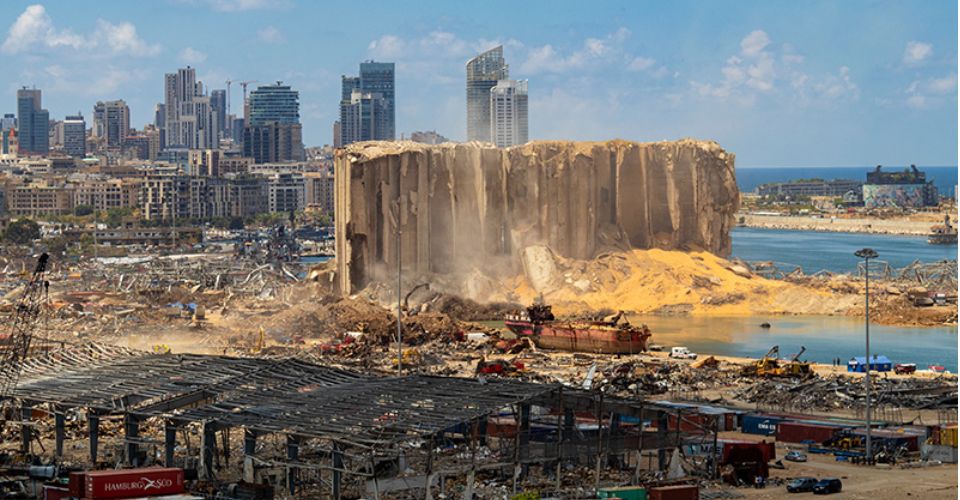
The Beirut explosion of Aug. 4, 2020, was one of the largest non-nuclear blasts in history, caused by the improper storage of ammonium nitrate in a port warehouse. It killed 218 people, injured about 7,000, displaced roughly 300,000 and sparked political unrest in the city.
According to the United Nations, since March 2, more than 4,200 people, including 253 children, have been killed, more than 12,000 have been injured, and one million people have been displaced in Lebanon amid armed fighting between Hezbollah and the Israeli Defense Forces.
To what extent are the consequences of the Beirut Port explosion still being felt?
The explosion happened six years ago at a time when Lebanon was already facing an extremely severe political and economic crisis.
The healthcare system was—and still is—in a state of collapse. People had lost their savings because of rampant inflation. The explosion profoundly shook the country and further worsened the humanitarian crisis.
On the day of the explosion itself, that is Aug. 4, 2020, more than 200 people were killed, and more than 300,000 people were forced to leave their homes.
When I walk through Beirut today, I still see buildings with shattered windows and doors that simply cannot be repaired because people lack the financial means.
Entire apartment buildings near the port are still uninhabitable. There is a deep sense of despair. Unfortunately, Lebanon is a country in a permanent state of crisis.
What has the Israeli action against Hezbollah on Lebanese soil meant for the people of Lebanon?
The humanitarian consequences have been enormous.
Over the past two years, Lebanon has experienced several waves of displacement.
At the beginning of this year alone, more than one million people were internally displaced, fleeing either from the south of the country to the capital, Beirut, or to northern Lebanon. Others left Beirut’s southern suburbs for other parts of the city.
❝
We continue to hope that all sides have the will to work together toward finding a solution.
Emergency shelters quickly became overcrowded, forcing many families to spend weeks living in their cars or in tents along roadsides and in parks in Beirut and the coastal region. I have even heard of babies being born alongside highways.
Our colleagues on the ground have also been directly affected. One of our project coordinators, who lives in a southern suburb of Beirut, was awakened one night by an emergency alert.
After an evacuation order was issued, she quickly woke all her neighbors and barely managed to escape into the street wearing only her pajamas and carrying her smartphone. Shortly afterward, the blast wave from an airstrike completely destroyed her apartment.
How is Caritas Internationalis responding to the humanitarian crisis, which includes death and injuries in the Israeli military action in Lebanon?
Caritas Internationalis works through local partners, which means we can provide assistance within hours or days.
Our partner, Caritas Lebanon, has supplied people with drinking water, food, blankets, mattresses, and medicine. It is equally important to provide psychological support so families can begin to process their trauma.
We focus especially on people with disabilities and older adults—those who have fewer resources to help themselves or who are no longer mobile.
For example, one of our partners reaches elderly people in southern Lebanon who have no family members to care for them, helping them manage daily life.
All of this work is carried out under great danger. Sadly, we have already lost colleagues who were providing humanitarian assistance.
What gives you hope in such a difficult situation?
My colleagues on the ground give me hope.
Even though they themselves have been affected by these many crises, they continue to find the strength and motivation to help others.
I think of one colleague who had to flee Beirut with her family for the second time. Even so, she still managed to work with us to develop a project providing cash assistance to 350 families in southern Lebanon who were unable to flee, helping them secure their basic survival.
Given the severity of the situation, what is Caritas Internationalis’ appeal to the international community?
International law must be respected. Human dignity must be respected.
We continue to hope that all sides have the will to work together toward finding a solution.
This is a translated and edited version of the interview that first appeared on DOMRADIO.DE and has been republished with permission by Global Catholic.