More than 100 students stood firm at the entrance of the Werner Heisenberg Secondary School in Germany’s Cologne-Buchheim, with a common goal in mind – to save their 15-year-old friend Ruhaim Rouf from deportation to Sri Lanka.
The children were fighting alongside Marianne Arndt, holding placards with slogans such as “Graduation, not deportation!” “Living together instead of separating!” and “No human being is illegal.”
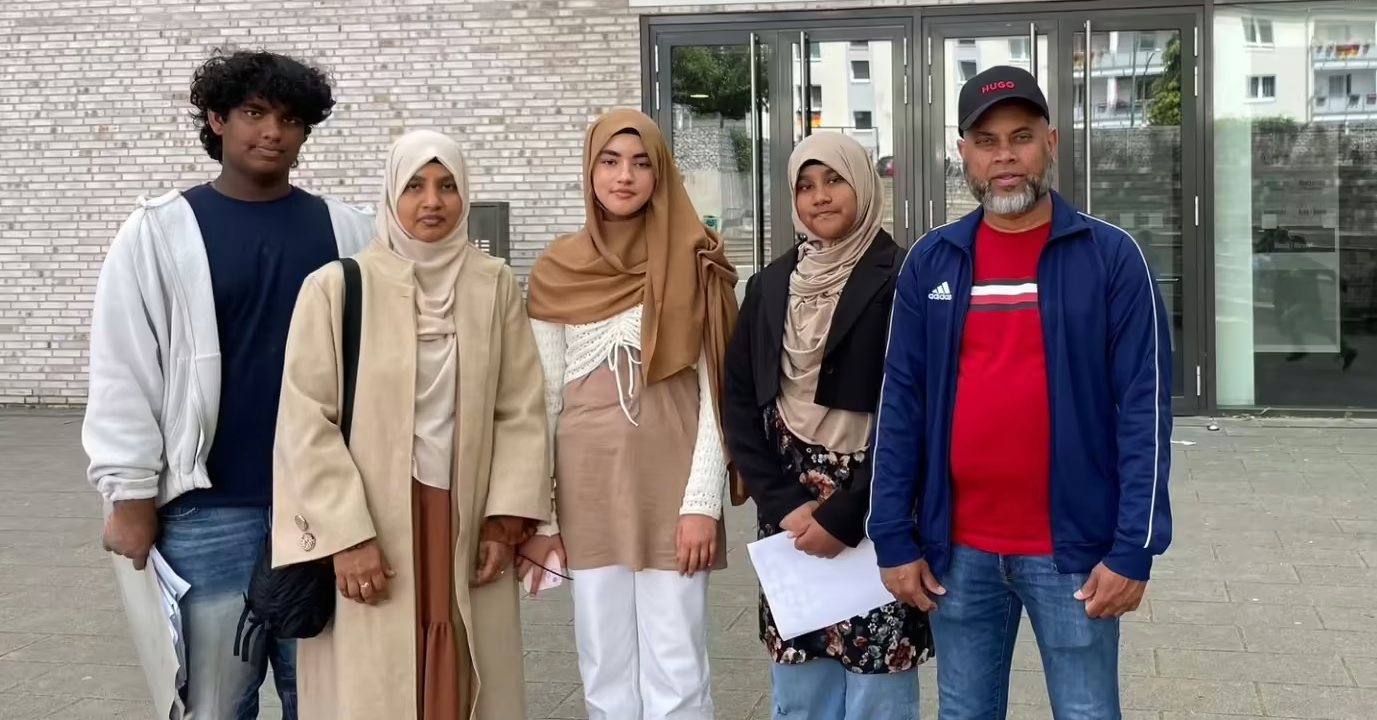
Ruhaim has lived in Germany with his parents and siblings for the past eight years, having fled a deadly arson attack in 2018.


Today, the Rouf family is facing deportation back to the place they left.
“We wouldn’t be safe in Sri Lanka,” says Ruhaim, “and this is our home!”
A well-behaved student
Mau-Wai Lau, Ruhaim’s class teacher, says he is a good student who causes no problems.
A class nine student, Ruhaim, has taken responsibility for the school kiosk as student representative and has organized improved meal vouchers for everyone, says Lau.
“Ruhaim and his family are extremely well integrated here. They have done everything right,” Lau emphasizes.
The entire school community, teachers and students alike, is disturbed and can no longer make sense of the situation, which Lau says is “enough to make you question the system!”
But Lau is not the only one supporting Ruhaim.
The students repeatedly approaching him during the solidarity gathering and consoling him by patting his shoulder and hugging him, show how much he is loved and accepted in the community.
A collective show of support
The gathering and demonstration during the lunch break was organized by the association Mosaik Köln Mülheim e.V.,represented by Arndt, a Catholic parish pastoral worker.
Other support activities include language courses and meetings, exchange opportunities, and job coaching provided by Mosaik, which operates under Aktion Neue Nachbarn, the refugee assistance initiative of the Archdiocese of Cologne.
It also stands by refugees who have fallen into severe hardship.
The Rouf family’s asylum application was rejected in 2018, and their appeal against that decision was dismissed at the end of 2023.
Since 2024, the family of seven has only held temporary tolerated status (Duldung) because they were initially unable to present passports.
In Germany, a tolerated status (Duldung) is a temporary suspension of deportation rather than a formal residence permit.
It is issued to individuals who are legally obliged to leave the country but whose departure is temporarily impossible due to practical obstacles (such as lacking a passport) or legal reasons (such as severe illness).
Obtaining Sri Lankan travel documents for the parents and the three older children proved extremely difficult and time-consuming. However, it was impossible for the two younger children, who were born in Germany.
When the parents were finally able to submit the required documents to apply for residence permits under the German Residence Act — which governs residence, employment, and integration of foreigners in Germany — the immigration authority of the city of Leverkusen, where the Roufs live, withdrew their tolerated status.
That tolerated status, however, is one of the requirements for obtaining a residence permit.
Not an isolated case
Anna Magdalena Papadopoulos of the Leverkusen Refugee Council calls the withdrawal of tolerated status a move by the immigration authority that creates conditions that prevent the family from qualifying for a residence permit.
“We have observed this practice very frequently recently; the Rouf family’s case is not an isolated one,” Papadopoulos claims.
These actions result in well-integrated people ultimately being subject to deportation, even though they have fulfilled all obligations regarding cooperation and integration.
“The Leverkusen immigration authority has therefore done everything possible to create conditions for deporting a well-integrated family instead of granting them a permanent prospect of remaining, as also envisaged in the coalition agreement,” says Arndt.
Motivated by her Christian convictions, she has long been committed to supporting refugees and views her volunteer work with Mosaik as a form of pastoral care.
Last glimmer of hope
In the Rouf family’s case, Arndt has long since contacted the responsible authorities in Leverkusen. However, they politely yet firmly told her that all the documents needed for their deportation were ready.
Arndt was advised to contact the Hardship Commission of the state of North Rhine-Westphalia (Härtefallkommission NRW) to pursue their case.
“If any aspects emerge from this that could positively affect the residence status of the Rouf family, I will, of course, have them examined,” states a letter Arndt received from the Social Affairs Department.
She has since submitted a petition to the Hardship Commission.
Arndt and her fellow campaigners are now fervently hoping that they can still turn the situation around and that the family will ultimately be allowed to stay.
Supporters like Arndt believe that the health condition of Ruhaim’s father might be a factor that helps their case.
Despite being less than 50 years old, his father has undergone several major heart surgeries. He has also been suffering from depression due to the uncertainty surrounding the family.
Other family members also suffer from various illnesses that would likely not receive adequate treatment in Sri Lanka, Arndt and the others say.
“Eight years of integration efforts wasted”
Arndt strongly believes that the children’s exceptionally successful integration strongly supports granting the entire family the right to remain.
Ruhaim’s older sister, Ramla, completed secondary school and was preparing for the Abitur, Germany’s university entrance qualification. She wants to become a psychologist.
To improve her chances of staying in Germany, she postponed her Abitur plans and instead began vocational training. She could have started working immediately but was not granted a work permit.
Amid the often-cited shortage of skilled workers, Arndt alleges that the deportation scenario faced by successfully integrated families is “a complete catastrophe.”
“If they deport young people who have integrated over the course of eight years, they are simply throwing eight years of teachers’ and kindergarten educators’ commitment into the trash,” says Arndt.
She considers this irresponsible.
Meanwhile, Ruhaim beams with joy at the many people who showed solidarity with him and his family in the schoolyard: “I am so grateful, and I definitely want to give something back.”
This is a translated and edited version of the feature that was first published by Domradio.de, and has been republished with permission by Global Catholic.