




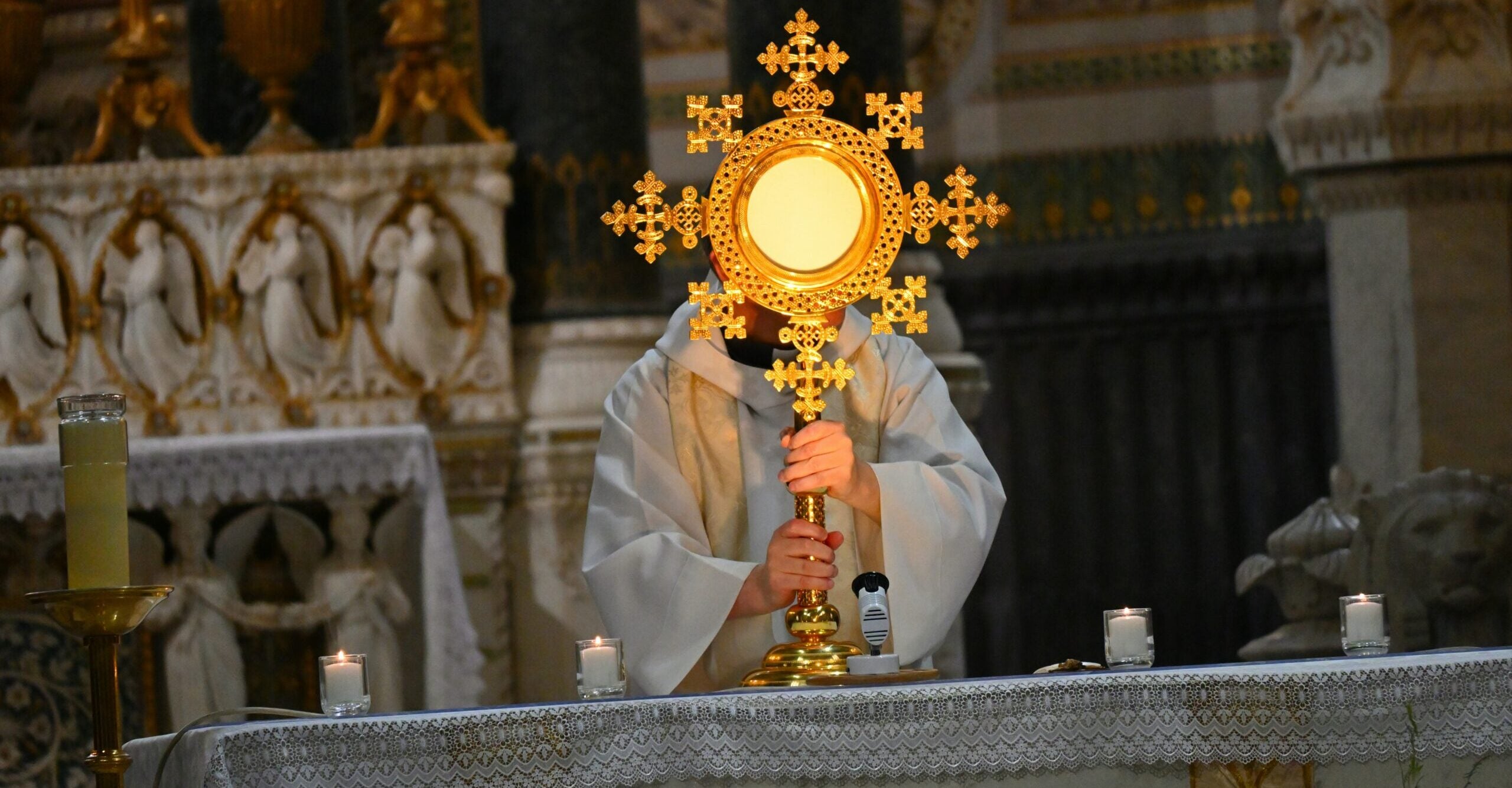
The Eucharist is where Catholics should discover most profoundly what it means to belong to the One, Holy, Catholic and Apostolic Church.
Every Sunday, Catholics across the world gather around the same altar. They may hear Scripture proclaimed in different languages, sing different hymns and worship according to different cultural traditions, yet they come to celebrate the same mystery: the Body and Blood of Christ.
This diversity reveals a profound truth about Catholicism: The Church has never been united because everyone speaks the same language. She has been united because she shares the same Lord.


This is why the recent discussion surrounding the traditional Latin Mass deserves deeper reflection. In a recent interview with The Tablet, Cardinal Arthur Roche, Prefect of the Dicastery for Divine Worship and the Discipline of the Sacraments, stated: “No, Pope Leo is not going to change Traditionis Custodes, and he’s not going back to Summorum Pontificum.”
Speaking about the celebration of the older form of the Roman Rite, Cardinal Roche described it as “a very complex area,” but also “a very important area because the Eucharist is the sacrament of unity: it’s the place where we should all be able to be together to celebrate Mass.”
His words point beyond the immediate controversy. The deeper question is not simply whether Catholics worship in Latin or the vernacular, but whether the way we discuss liturgy leads us closer to Christ and to one another. The Eucharist was never given to the Church as a weapon in arguments between Catholics. It is the sacrament that creates communion.
Jesus did not celebrate the Last Supper in Latin
A common misunderstanding in discussions about liturgical language is the assumption that Latin was the original language of Christian worship. Historically, this is not the case.
Jesus lived in first-century Judaea, a region where several languages existed alongside one another. His everyday language was almost certainly Aramaic. Hebrew remained the sacred language of Jewish worship, while Greek was widely used across the eastern Roman Empire for administration, commerce and communication between different peoples.
Latin was the language of Roman authority, used by officials and the military, but it was not the ordinary language spoken by most people in Judaea.
The Last Supper, therefore, was not celebrated in Latin. The earliest Christian communities also did not begin their worship in Latin. In Rome itself, Greek was initially the dominant liturgical language before Latin gradually became more widespread.
This transition did not happen because Latin was considered a holier language. It happened because the Church used the language that best communicated the Gospel within its historical and cultural context.
Latin itself was once the language of ordinary people. Over centuries, as spoken Latin developed into different European languages, the liturgical Latin of the Western Church became increasingly distinct from everyday speech. What was once a common language gradually becoming a sacred liturgical language associated with tradition, continuity and solemn worship.
For centuries, Latin also served an important role in uniting Catholics across different nations and cultures. It provided a common language of prayer, theology and worship throughout the Western Church.
Latin remains a treasure of the Church
Recognising the development of liturgical languages does not mean dismissing the beauty and importance of Latin.
The Second Vatican Council did not abolish Latin from Catholic worship. The Constitution on the Sacred Liturgy, Sacrosanctum Concilium, affirmed that “the use of the Latin language is to be preserved in the Latin rites.” At the same time, the Council permitted wider use of the vernacular so that the faithful could participate more fully and consciously in the liturgy.
The Council was not presenting Latin and local languages as opposing choices. It sought to preserve the Church’s tradition while allowing the faithful to enter more deeply into the mystery being celebrated.
Latin continues to have an important place in Catholic life. Gregorian chant remains a treasured part of the Church’s heritage, and the ordinary form of the Mass can still be celebrated in Latin.
❝
The question is not simply how we celebrate the liturgy, but whether the Eucharist is transforming us into the people God calls us to become — one Body in Christ.
Why Pope Francis issued ‘Traditionis Custodes’
To understand Traditionis Custodes, it is necessary to move beyond the idea that it was simply a restriction on Latin.
The document concerns the celebration of the 1962 Roman Missal, often called the traditional Latin Mass or the Extraordinary Form. Pope Francis stated that, after consulting bishops throughout the world, he had concluded that in some places the use of this form of the liturgy had become associated with opposition to the Second Vatican Council and had contributed to divisions within the Church.
For many Catholics attached to the traditional Latin Mass, their attachment is not political or ideological. They are often drawn by a love of sacred silence, reverence, beauty, traditional hymnody and a sense of continuity with previous generations of Catholics. These spiritual aspirations should not be dismissed.
At the same time, Pope Francis expressed concern that in certain contexts liturgical attachment had become connected with rejection of the Church’s authority and had weakened ecclesial communion.
The concern was therefore not about a particular language. It was about whether a liturgical practice was strengthening unity within the Church.
What ‘Traditionis Custodes’ does — and does not do
A great deal of confusion exists about what Traditionis Custodes actually changed.
The document does not ban Latin from Catholic worship.
The Ordinary Form of the Roman Rite, commonly known as the Novus Ordo, can still be celebrated entirely in Latin without restrictions. The Church continues to value Gregorian chant, and priests may celebrate the post-Vatican II Roman Missal in Latin.
The restrictions introduced by Traditionis Custodes concern the celebration of the 1962 Roman Missal and require greater oversight from bishops regarding its use
This distinction matters. The discussion is not simply about Latin versus the vernacular. It concerns how the Church preserves liturgical unity while respecting legitimate traditions.
One bread, many languages
St. Paul’s warning to the divided Christian community in Corinth remains a challenge for the Church today: “Because there is one bread, we who are many are one body, for we all partake of the one bread” (1 Corinthians 10:17). The Corinthians gathered for the Eucharist, yet divisions and rivalries existed among them. St. Paul reminded them that receiving the Body of Christ while failing to live as one body contradicted the very mystery they celebrated.
The same challenge faces Catholics today. The Church has always contained different cultures, languages and spiritual traditions. Diversity is not the problem; the danger comes when those differences become reasons for contempt.
We can defend tradition while failing to practice humility. We can argue for reverence while speaking without charity. We can receive the Body of Christ while failing to recognise Christ in our brothers and sisters.
Every Sunday, Catholics throughout the world gather around the same altar. The languages of worship may differ, but the mystery remains the same: one Christ, one sacrifice, one Eucharist.
The Eucharist does not speak the language of ideology. It speaks the language of unity.
The question is not simply how we celebrate the liturgy, but whether the Eucharist is transforming us into the people God calls us to become — one Body in Christ.









2 Comments
Marie Pierre
August 10, 2026This is a brilliant article. Keep up publishing such in-depth commentaries. I came across Global Catholic today, and it is a refreshing site. Best wishes
Rosemarie MALAOS
August 12, 2026The article’s points are shallow, not remotely “in depth”. I’m not aware of anyone who prefers the traditional liturgy because they think Christ celebrated the Last Supper in Latin, or that the Latin language is intrinsically holy. Latin versus the vernacular is not the main issue, but rather which liturgy best expresses the faith of the church in what actually happens on the altar during the sacrifice of the Mass, the representation in an an unbloody manner of Christ’s death on the cross. Read both Missals in English and compare, not to mention what appears as actual hostility to traditional expressions of reverence, such as kneeling to receive Holy Communion. Also, please don’t refer to the practice of the Eastern churches. They are extremely reverent and for them kneeling represents contrition, not adoration.