Yes, why are we, women of the 21st century, progressive — or at least that is how we have considered ourselves throughout our lives — so enthusiastic and wholeheartedly supporting the beatification of Pilar Bellosillo?
We can say that we are on the threshold of it — of the beatification — and we are enthusiastically pushing for it. And, by the way, who is Pilar Bellosillo y García Verde (1913–2003)?
These questions may surprise anyone and prompt them to say: “Those things aren’t done anymore today! Today, people seek other kinds of ‘advancement,’ not advancement to the altars. But pushing for the beatification of a person can seem so old-fashioned!”


Fine — but we support her, and very strongly at that. Yes, we are enthusiastic about this cause. Not only because Pilar deserves it, which she does, but because the world needs witnesses, models like her.
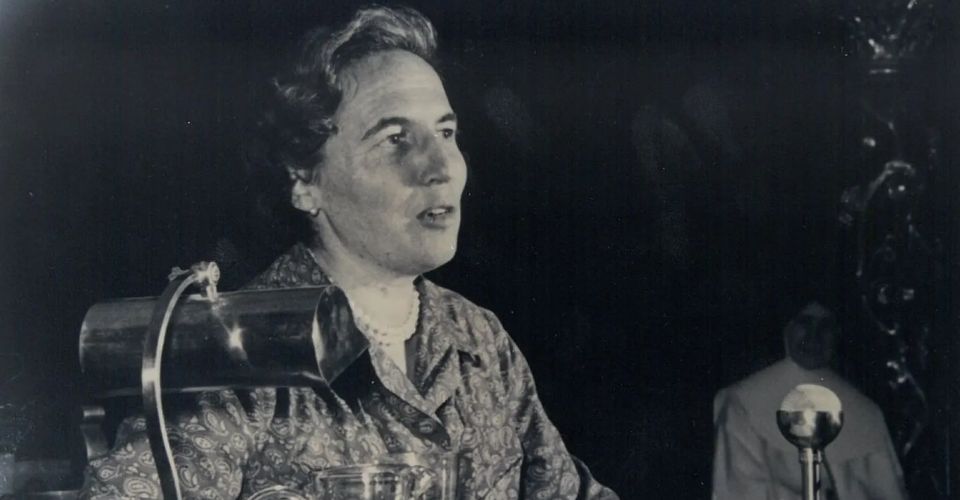
But who is she? It is true that many people do not know her, and that is precisely why we want to make her known, because she is worth knowing. I will try to offer a few brief and quick brushstrokes about her.
A pioneer for women in the Church
In very few words, we can say that Pilar was a woman of her time, of the 20th century, to whom the entire Church, but especially women, both then and now, owe a great deal.
Pilar was an influential pioneer in society, yes, but above all in the Church — or rather, among women in the Church. She was one of the first Catholic women to address this issue with a critical and constructive perspective, both at once.
I like the subtitle placed on the pamphlet published by Manos Unidas(the Catholic development and anti-poverty NGO Bellosillo helped found) in 2023: “Pilar Bellosillo. Prophetic Woman of the 20th Century.” That is what she was. She radiated an authentic prophetic spirit.
Pilar was born in Madrid and devoted her long life unconditionally to the Church, but she devoted it especially to women.
She deeply believed in the power of human and spiritual formation for the laity, and particularly for women, and she devoted all her energy to this; this was a very high priority. And we, in one way or another, participated in it and, to a certain extent, are the fruit of this important objective.
From Catholic Action to a global platform
Pilar was born into a large, traditional and deeply Christian family. She received a good education and, from a very young age, belonged to Catholic Action (a lay Catholic movement active across Spain and much of the Catholic world), of which she became president of the young women at just 27 years of age, and later national president.
Already during these years, Pilar, together with others, especially her vice president Mary Salas, launched a Catholic Action that was valuable for its level of formation.
The personal and family formation centers of Cultura Popular, Semana Impacto, the beginnings of what later became Manos Unidas — that is, the “Campaign Against Hunger” — and so on made this Catholic Action organization active, with an important religious and social outreach. People received substantial formation.
Furthermore, in 1952, Pilar was called to join the International Council of the World Union of Catholic Women’s Organizations (WUCWO), being appointed its general president in 1961, which enabled her influence and activity to extend throughout the world. At that time, the number of women enrolled in WUCWO was 36 million.
❝
Pilar’s spirituality was very deep and committed. It was profoundly nourished by the environment and ideas of the Council.
A voice at Vatican II
Because of this appointment and position, Pilar was appointed by Paul VI as an auditor during the third session of the Second Vatican Council, together with 22 other women from around the world, and shortly afterward two Protestants joined them as a gesture expressing the Church’s desire for ecumenism also with women.
It was a small thing, but better than nothing, and so there were women there, at the Council. At that time, they were a great novelty in the Catholic Church.
But, in addition, the presence of Pilar and the other women at the Council had an enormous resonance throughout Christendom, although in reality they were asked to do very little: to attend as genuine auditors, that is, without an official voice or vote in the great assembly.
Though, truth be told, their influence was great, very great, both in small groups and in the corridors, and in the end, they counted in the results.
They were taken into consideration; they were listened to at those levels; they were called “the mothers of the Council,” and they were able to influence certain council fathers in particular, as well as other circles, on certain issues that more directly concerned marital morality or opened avenues for their concrete application in the future.
For example, their influence was clear on issues relating to equality between men and women, human rights, and so on, which could later help advance the issue of women in the Church, questions concerning social equality, the radical equality of all the baptized — that is, ecclesial equality — promoting the exercise of freedom, raising awareness of a better distribution of global resources, enhancing the dignity of the laity in the Church, issues relating to ecumenism and other matters.
They have been spoken about since then and, certainly, their presence did not go unnoticed, despite the fact that they did not receive equal treatment and that the period of their presence was very short. It was later extended, and the result was that, yes, they had an influence and their contributions were taken into account because they acted with wisdom.
During the Council, Pilar underwent a significant inner transformation, and possibly more than one of the other women did as well. She often told us how, during the Council period, she felt that the Spirit was working within her.
There were nights when she could not sleep because she felt God’s “work” within her.
She remembered how she felt pain as she shed the old, her more traditional ideas, and how she rejoiced as she received the new ideas of the Council. And all of this was transforming her from within.
How beautiful it is to hear, in detail, about this work of the Spirit in a person. The most beautiful part of this experience — or rather, this privilege — was the inner experience that Pilar described.
All of this marked her profoundly, and we benefited from it; it permeated all her subsequent work. To know this period of Pilar’s life is to know the ecclesial, international and ecumenical work of women in the 20th century.
Building an ecumenical legacy after the Council
Pilar and the other women continued working together after the Council, not only as Catholics but also ecumenically. They wrote, and others have written about them.
Some of them, more than others, were clearly aware that they were there to offer another vision of women in the Church. Pilar did a great deal; she knew how to work very well as part of a team. The Council addressed women for the first time in the long history of the Church.
On the one hand, they began important joint ecumenical work. The first meeting of the women auditors was held immediately after the Council ended, in Vicarello, near Rome, and they established lines of immediate work in this direction of collaboration and the search for new paths around the issues mentioned above.
The first ecumenical meeting of women was held in 1965, also immediately after Vatican II had ended. They organized themselves to continue the work.
The Women’s Ecumenical Liaison Group (WELG)appointed by the Holy Seewas very active. It was established in 1968 and its mandate ended in 1972, but it was not renewed.
She was also part of the Council of the Laity founded by Paul VI on Jan. 6, 1967, and established with the specific purpose of expanding and making visible the action of laymen and laywomen in the Church.
On the other hand, Pilar continued her work, and an important fruit of these relationships was the Ecumenical Forum of Christian Women of Europe, and she was one of the “mothers of the Forum” because she helped at its beginnings, which were forged in Switzerland and formalized in 1982, and whose impact in Spain was also partly her work.
❝
The world needs models today of committed, consistent women, with open horizons, with the courage to help create and love “the world that does not yet exist” and the Church we dream of.
In 1988–89, she invited the then Coordination Committee and, the following year, the Theological Commission of the same Ecumenical Forum.
It was also then that the Women’s Studies Forum (FEM) began to operate enthusiastically, also founded by Pilar, Mary Salas and a small group of us, which had begun its intellectual and ecumenical activity in Spain, at the national and international levels, in 1985.
It was the first organization of Catholic women in Spain oriented primarily toward supporting, studying and promoting awareness of the issue of women in the Church, also from an ecumenical perspective.
The Pontifical Commission and the “Minority Note”
Furthermore, the Council had called for a mixed commission to conduct studies concerning women, primarily in the Church, which was created and appointed by Pope Paul VI in 1973.
The commission’s explicit mandate was: “women in the Church.” There, a minority group of five women distinguished itself, including Pilar, Belgian Claire Delva, Dutch Rie Vandrik and two other women.
This minority experienced difficulties with the rest of the Commission; the two groups thought differently. They worked diligently and resisted with courage and perseverance.
They seriously expressed their desire to resign, something the Pope did not allow. They wrote a “Minority Note,” a testimony that remains is commendable.
A legacy worth canonizing
We could continue unfolding this broad range of places, tasks, foundations and various works of this tireless woman.
She died in Madrid in 2003; the legacy she left is indelible. She was faithful to the moment in the life of the Church and society in which she lived and devoted herself completely to the cause of the Church.
She was especially sensitive to the cause of women and to the promotion of the laity, all of this with an admirable and emulable activity and spirit.
We feel, in one way or another, that we are heirs to her work, but above all to that vital force, that spiritual and creative energy that she bequeathed to us and to which we want more people to have full access.
The world needs models today of committed, consistent women, with open horizons, with the courage to help create and love “the world that does not yet exist” and the Church we dream of.
We need to follow the legacy and work of women of faith, committed to work that crosses borders, such as Pilar Bellosillo. That is why we believe she should be recognized and proposed as an ecclesial model, as a light that can help us in this task of building a more just and humane world, a universal Church that allows the Spirit to shine through and communicate itself.
Pilar’s spirituality was very deep and committed. It was profoundly nourished by the environment and ideas of the Council.
For all these reasons, we want Pilar to be canonized; we want her to be recognized as that woman who devoted herself to the Church, who helped awaken consciences.
She sought what she called her utopia, that is, “a more humane, more just, more livable, more fraternal society, the society to which we all aspire,” and she did so from the Gospel, from the breath of the Spirit by which she allowed herself to be led and from which she always knew how to nourish herself and others.
Pilar Bellosillo’s beatification cause opened in the Archdiocese of Madrid in 2019 and is still in progress — she has not yet been beatified or canonized.
This is a translated and edited version of the feature that first appeared on Religion Digital and has been republished with permission by Global Catholic.