



The Society of St. Pius X (SSPX) is preparing to consecrate bishops for the second time in its history on July 1.
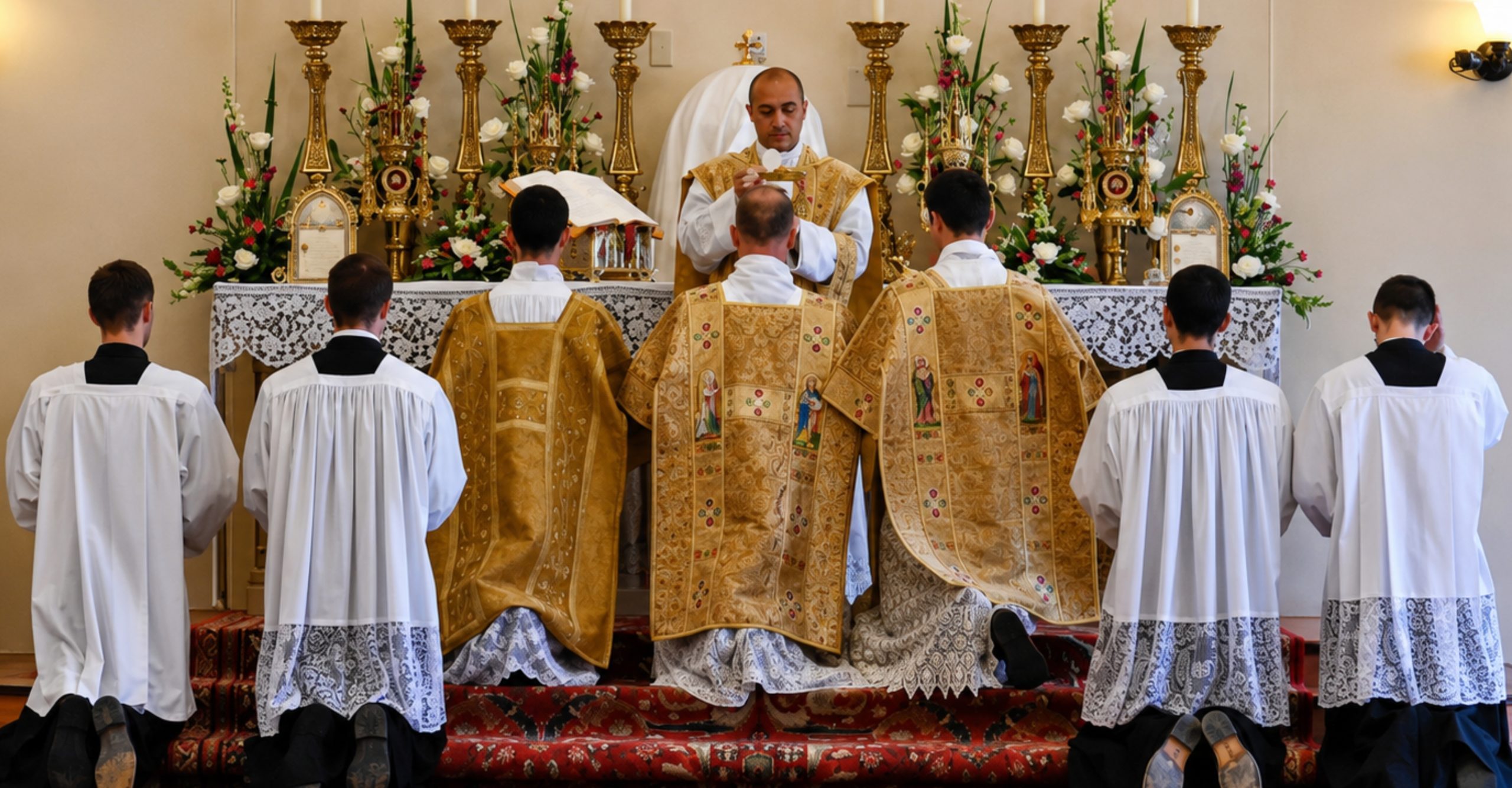
The SSPX celebrates the Traditional Latin Mass, in which the priest faces away from the congregation.
The group rejects religious freedom, interreligious dialogue on equal terms, and other reforms introduced by the Second Vatican Council (1962–1965).


Has time stood still for the SSPX?
Concerning Church teaching, that may well be the case. But the priestly fraternity, founded in 1970 by French Archbishop Marcel Lefebvre, is currently focused above all on its future.
On Wednesday, July 1, four priests of the Society are to be consecrated as bishops in Écône, Switzerland.
The Society justifies this canonically prohibited step as necessary for its survival, since, according to Catholic teaching, only bishops can validly confer the sacrament of Holy Orders.
The reasoning is straightforward: without bishops, there can be no priests, and without priests, there can be no pastoral care for the faithful.
The SSPX currently has two bishops, both of whom are 68 and 69 years old.
To ensure the fraternity’s long-term future, the episcopal consecrations are absolutely necessary, says Father Stefan Pfluger, the Society’s district superior in Germany.
He adds another reason: “Two bishops are no longer enough today because the Society and the number of faithful under our pastoral care have grown.”
Why, then, do they not ask other Catholic bishops to perform these ordinations, as is customary for religious orders that do not have bishops among their own members?
Pfluger himself acknowledges that no bishop of the Catholic Church would likely agree to perform such a service for the Society.
The reason lies with the SSPX itself—and its decades-long conflict with Rome.
Founded 56 years ago
Archbishop Lefebvre established the Society 56 years ago because he and his followers firmly rejected the Second Vatican Council’s renewal of Church teaching and practice.
Although the Society was not authorized to ordain priests, Lefebvre conferred Holy Orders in 1971 at the SSPX seminary in Écône, Switzerland.
From the Vatican’s perspective, these ordinations were illicit because Lefebvre was neither a diocesan bishop nor the superior of a Church body authorized to incardinate priests.
Other canonical requirements for lawful ordination were likewise absent, as canon lawyer Stephan Haering demonstrated in 2009.
Nevertheless, the ordinations were sacramentally valid.
Lefebvre, however, stopped short of making a definitive break with the Vatican.
Instead, he hoped to convert what he called the “neo-modernist and neo-Protestant Rome,” a goal he ultimately failed to achieve.
Escalation with Rome
Over the years, the conflict between the Vatican and the SSPX intensified.
In 1975, the Society lost its canonical recognition.
A year later, Pope Paul VI prohibited Lefebvre from exercising priestly ministry.
In 1988, despite extensive efforts at reconciliation by Cardinal Joseph Ratzinger, then Prefect of the Congregation for the Doctrine of the Faith, Lefebvre proceeded with four unauthorized episcopal consecrations.
In short, the Vatican tolerated the Society for many years, allowing it to exist in a canonical gray area.
The traditionalists, however, increasingly positioned themselves in opposition to Rome, escalating the conflict through actions such as unauthorized ordinations.
Following the illicit episcopal consecrations, the Vatican declared both the newly consecrated bishops and the bishops who ordained them excommunicated, thereby excluding them from full communion with the Catholic Church.
Lefebvre died in 1991 while remaining excommunicated.
In 2009, Pope Benedict XVI lifted the excommunications of the surviving bishops as an act of mercy—not because the causes of the schism had disappeared.
As pope, Benedict sought reconciliation with the SSPX and hoped to integrate it fully into the Church’s canonical structure.
Reconciliation efforts fail
What was intended as an act of ecclesial unity instead became one of the greatest controversies of Benedict’s pontificate.
One of the Society’s bishops, Richard Williamson, was a Holocaust denier who triggered an international scandal.
“Either we are wrong, or the Church authorities have gone astray.”
– Father Stefan Pfluger, SSPX district superior, Germany.
At the same time, although the SSPX repeatedly insisted that it desired unity with the Church, it never substantially changed its doctrinal positions.
The episcopal consecrations scheduled for July 1 represent a new low in the fractured relationship between the traditionalist fraternity and the Vatican.
Excommunication looms again
As in 1988, excommunication is once again a possibility.
The Vatican has made clear that, following the automatic canonical penalty incurred by those participating in the consecrations, it intends formally to declare the excommunications.
The SSPX remains unfazed.
“From our point of view, a declaration of excommunication would have no validity,” says Father Pfluger. The Society considers itself entirely justified.
“We are simply remaining faithful to what the Church taught consistently for centuries,” Pfluger says.
He adds, “An excommunication would be an overreach by the Church authorities—I know that is a strong expression.”
He also expresses concern that the penalty could extend beyond those directly involved in the consecrations.
Pfluger accuses the Vatican of being excessively harsh toward the Society and insists: “By consecrating bishops, we are not attacking the Church.”
Yet viewed outside the internal logic of the traditionalist movement, a different picture emerges.
Ahead of the meeting of the College of Cardinals in Rome, the Society published a 154-paragraph “Profession of Faith” criticizing what it calls the Catholic Church’s “modern errors.”
Pfluger says he is “grateful for the text’s clear statements.”
“Dogmatic cherry-picking”
Munich dogmatic theologian Michael Seewald sees the document very differently.
“It once again demonstrates that the Society of St. Pius X is unwilling to move toward present-day Rome,” he told the Catholic News Agency (KNA).
Seewald argues that the Society regards itself as orthodox while remaining intellectually rooted in “an anti-modernist magisterium that gradually came to an end in the mid-1950s.”
He goes further and describes the Society as heretical because it selectively chooses which elements of Catholic doctrine it accepts.
“This is precisely the kind of dogmatic cherry-picking practiced by the Society of St. Pius X,” he says.
Austrian theologian Jan-Heiner Tück was even more critical in an article for Die Zeit, a German national weekly newspaper.
He described the Society as having become “sect-like,” called the planned consecrations “an affront” to the Pope, and said they represented “an absolute worst-case scenario” for Pope Leo XIV, whose office is dedicated to preserving the unity of the Church.
Tück also pointed to what he described as the Society’s “permeability to the political right.”
He noted that Alternative for Germany (AfD) politician Maximilian Krah managed the Society’s assets for years and is personally connected to traditionalist circles.
According to Tück, these overlaps become especially problematic when they contribute to antisemitism or ideologies opposed to democracy.
A fundamental divide
Pfluger dismisses such criticism. He insists that the Society fundamentally desires unity with the Pope.
“However, there are points in the Church’s teaching after the Second Vatican Council that simply cannot be reconciled with Sacred Scripture,” he says.
As an example, he cites the Abu Dhabi Declaration signed by Pope Francis in 2019, which states that religious diversity is part of God’s will.
From the Society’s perspective, it is therefore the Pope—not the SSPX—who should return to unity with the fraternity.
Yet according to current Roman Catholic teaching, the Pope possesses “supreme, full, immediate and universal ordinary power over the Church,” which he “is always free to exercise.”
Within that framework, the Society’s demand is fundamentally incompatible with Catholic ecclesiology.
Everything indicates that the Society of St. Pius X will proceed with the planned episcopal consecrations.
A formal response from the Vatican is expected shortly afterward—and that response is likely to be excommunication.
“Either we are wrong, or the Church authorities have gone astray,” Pfluger says, summarizing a conflict that has lasted for decades.
From the perspective of the Catholic Church, however, the answer is unequivocal.
This is a translated and edited version of the column that first appeared on DOMRADIO.DE and has been republished with permission by Global Catholic.












2 Comments
TAKITO PILI FIDO
June 30, 2026Well, down under in our Pacific Ocean, this is very sad in the Messianic witness of Faith brought by the european missionaries in the cool blue moanaloa. We thank the contribution of those blessed missionaries in those 200 years ago. Finally we came to know the Holy Name of the true living God, worshipped unknowing by our elders from the start of Age.
This event of disobbedience of the Econe is totally the reversal of what they claimed of our Indigenous communities as Pagans with their Doctrine of Discovery.. We conserve the respect of the human rights but this european event is the neopaganism answer coming back to bit thier nationalist obsession in europe of the lie that they brought to our shores. We stand with the Messianic Church of the Jewish Messiah that was prophesied but despiced by the silly modern world. MAY OUR BLESSED MOTHER INTERCEDE FOR US ALL. FA’AFETAI LAVA
George
July 3, 2026Very well commented