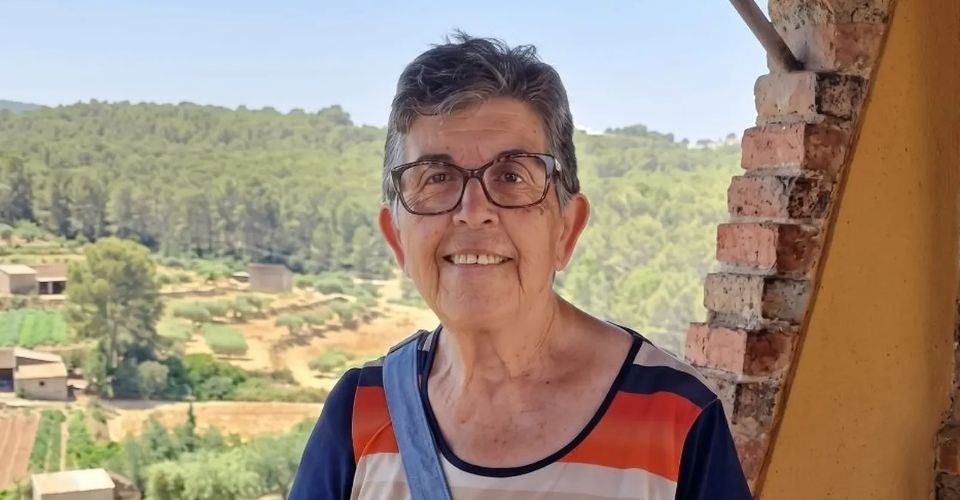
Some problems cease to be a statistic when they have a face in front of them. For Carme Lleyda, a religious sister from the Vedruna community in Tarragona, housing is one of these problems.
She has known it up close for years, first through her perspective on social reality and, since 2014, also through her involvement with the Platform of People Affected by Mortgages, or PAH (Plataforma de Afectadospor la Hipoteca, Spain’s largest grassroots movement for housing rights, founded in 2009 amid the foreclosure wave of the financial crisis). ”
As long as they had the problem, I would have it too,” she explains to Flama (Agència Flama, a Catalan news outlet).


Her reflection comes on Oct. 5, World Habitat Day, at a particularly intense moment.
In Spain, the housing issue has moved to the center of political debate and public discontent, with demonstrations and encampments in several cities following the eviction of Maricarmen Abascal, an 87-year-old woman, from the apartment where she had lived since she was a teenager (the case that triggered the current wave of tent protests nationwide).
This same say, Pedro Sánchez announced that early general elections would be held on Nov. 29, after Congress rejected two government decrees related to the issue.
A campaign born from the bicentennial
It is in this context that the Vedruna schools are concluding a campaign that, in reality, began before housing made the headlines.
The initiative is part of the commemoration of the bicentennial of the founding of the Carmelite Sisters of Charity Vedruna(the congregation Lleyda belongs to, founded by St. Joaquina de Vedruna in Catalonia in 1826) and originated with the Justice, Peace and Integrity of Creation commission, of which Lleyda is a member.
The intention was to look at the surrounding reality through the eyes that, according to the religious sister, Joaquina de Vedruna also had: attentive to the needs of her time.
The housing issue thus emerged as a shared social emergency. “We saw that it was a hot topic,” acknowledges Lleyda, who points out that the problem is repeated, with different degrees of intensity, in different parts of the country.
The proposal was taken to the different areas of the Vedruna mission and, in the case of the schools, found a natural fit in the work the centers carry out around the United Nations Sustainable Development Goals, especially SDG 11 (Sustainable Cities and Communities, which includes a target on access to adequate housing).
From the desk to the streets
In Catalonia, the educational work unfolded throughout the past school year. Several schools selected classes from different educational levels — primary school, secondary school and high school — to explore the reality of housing, analyze its consequences and turn reflection into proposals.
The process also led to the “A Roof to Dream” contest, held in Vic in May, with the aim of highlighting the students’ perspective and creativity.
But for Lleyda, education cannot remain confined to the classroom. The right to housing, she argues, “is better understood when you look at it from the street and when you relate it to people’s concrete lives.”
“A house is not simply a roof: it is protection, privacy, rest, security and a place where children can play, study and grow,” she continues.
Tarragona, at the neighborhood level
In Tarragona, this reality has a specific geography for Lleyda. Born in Manresa, she has lived in the city for 25 years and is part of a community of four sisters based in Campclar(a working-class district of Tarragona).
From there, she says she has come to know the realities of Campclar, Bonavista, Torreforta and other neighborhoods up close.
Her understanding of social commitment, she emphasizes, “is not about arriving somewhere to explain to others what they have to do, but about being there, listening and sharing spaces with the people who experience these situations.”
This proximity also explains her involvement with the PAH.
When she retired in 2014, she began getting involved after seeing the green shirts throughout the neighborhoods (green T-shirts are the PAH’s visual trademark at demonstrations and evictions) and the mobilization of people affected. Over time, that initial contact became a sustained presence.
When having a home is no longer secure
From this experience, Lleyda describes a situation that she considers increasingly difficult to resolve. She speaks of mortgages, rents and eviction proceedings, but above all of people trapped in prolonged precarity.
“It is increasingly difficult to solve this problem with dignity,” she says. And she emphasizes a dimension that is often left in the background: the psychological and family consequences of not having a secure place to live.
Children are, in this regard, one of her main concerns.
The pressure generated by the possible loss of housing, family uncertainty or having to share a single room can also end up affecting the education and well-being of children.
A response that goes beyond assistance
The congregation has also tried to respond to this reality through practical action. During 2024 and 2025, 11 Vedruna communities shared their daily lives with people experiencing housing vulnerability, temporarily welcoming families and children, young people, women and others.
At the same time, residential spaces have been made available to social organizations and accompaniment projects have been maintained.
It is an approach to social action that Lleyda contrasts with a purely charitable response. The institutional Church, she acknowledges, “is a long way away” from certain realities, but she maintains that communities must continue seeking concrete forms of accompaniment and, at the same time, denunciation.
Because offering one-time assistance can alleviate a situation, but addressing the causes also requires awareness, civic involvement and political will.
Young people are no longer watching from a distance
At this point, the religious sister is closely observing the demonstrations led by young people these days.
The encampments and gatherings that have appeared in different cities as a result of the housing crisis have introduced new energy into a conflict that, for years, had been treated almost as just another fact of social reality.
In Madrid, Puerta del Sol has become one of the epicenters of the protest, with a mobilization that has grown rapidly around the right to housing.
Lleyda does not yet know what significance this movement will have, but she considers it important that young people are present.
“It is worse to say that young people are not moving,” she points out. She also sees in it an expression of generational awareness: those protesting today are, in many cases, the same people who tomorrow will have to face rents they consider unaffordable and a market in which finding a home of their own seems increasingly distant.
The question she raises is as simple as it is uncomfortable: “A €700 room? That is clearly outrageous,” she says.
“Being there for others”
The same congregation defines its commitment to housing as a combination of small gestures, networks and projects.
Across Spain and Italy, the organizations with which it works accompanied more than 10,800 people during 2024 and the first half of 2025, providing support in various areas and more than 100 residential places.
The figure is significant, but for Lleyda the essential value remains something else: being alongside people when vulnerability ceases to be an abstract word.
In this regard, when asked what Joaquina de Vedruna would do in the face of the current housing crisis, the answer comes down to looking. Listening. Being there.
“In our lives, we have chosen to be there for others,” the religious sister sums up. And it is from this choice, more than from the walls of a school or a community, that the Vedruna sisters want to make housing a matter of dignity.
This is a translated and edited version of the column that first appeared on Religion Digital and has been republished with permission by Global Catholic.