



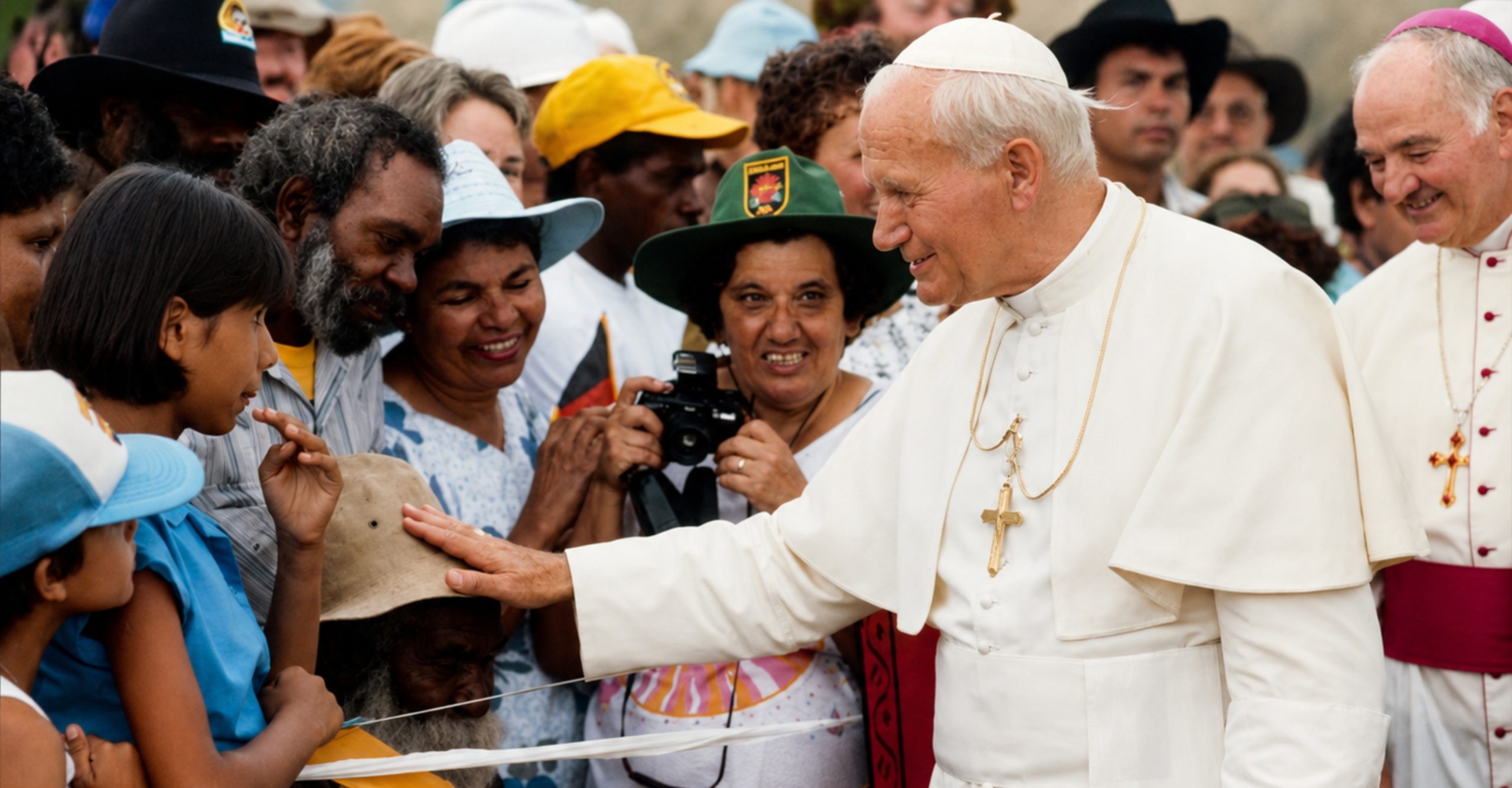
In Alice Springs, forty years ago, Pope John Paul II spoke powerfully to Indigenous Catholics.
The National Aboriginal and Torres Strait Islander Catholic Council (NATSICC) in Australia commemorates the anniversary in its annual celebration on July 5.
Pope John Paul’s speech, groundbreaking when it was made 40 years ago, is worth revisiting for the light it casts on current Australian attitudes to our Indigenous peoples.


The Pope’s response to Indigenous cultures and aspirations differed markedly from that of many politicians today who deny the distinct claim that Indigenous Australians make on all Australians.
In Victoria, the Liberal Party has committed itself to repealing the Statewide Treaty with Indigenous Australians.
Pauline Hanson, playing alongside other roughneck politicians who put the boots to, wishes to exclude Welcome to Country ceremonies from Parliament and has turned her back on them there. Others question their frequency.
This is a legitimate point of view in the abstract, but it amounts to dog whistling in the present climate.
Wonder at indigenous cultures
In contrast to these demeaning views of Indigenous people from outside, John Paul II sought to represent Indigenous cultures from within and expressed wonder at what he saw. Their communities and culture are a continuing gift to be nurtured, not an inconvenient relic to be tolerated or gradually forgotten.
In entering the Indigenous world, the Pope also appealed to a worldview shared by Christian and Indigenous cultures but not by contemporary Australian culture.
Both Christians and Indigenous Australians inherit a belief in a reality beyond the boundaries of our universe. This reality is present and shapes our lives.
Respect for the land in Indigenous culture mirrors Christian respect for God’s presence in creation. It has much to say to a world threatened by the consequences of its unbounded trust in technology.
The Pope develops the implications of this vision: “Through your closeness to the land, you touched the sacredness of man’s relationship with God, for the land was proof of a power in life greater than yourselves. You did not spoil the land, use it up, exhaust it, and then walk away from it. You realized that your land was connected to the source of life.”
In so endorsing the importance of Indigenous respect for the land and the natural world, the Pope may seem today to have been timid.
Forty years later, we have learned much more about global warming, its causes in human economic systems and destructive actions, its projected effects on the world our children will inherit, and how we must change to meet those effects.
In this cross-cultural conversation, Indigenous peoples are not only our teachers but also our judges.
The effects of colonization
When surveying the effects of European invasion on Indigenous peoples, Pope John Paul considers them from both the Indigenous peoples’ and the colonists’ perspectives.
He avoids seeing them as enemies. “The culture which this long and careful growth produced was not prepared for the sudden meeting with another people, with different customs and traditions, who came to your country nearly 200 years ago. They were different from Aboriginal people. Their traditions, the organization of their lives, and their attitudes to the land were quite strange to you. Their law, too, was quite different. These people had knowledge, money, and power, and they brought with them some patterns of behavior from which the Aboriginal people were unable to protect themselves.”
The Pope, however, is unsparing in listing the effects of colonization on Indigenous cultures – dispossession of traditional lands, loss of customs, migration to towns with no space for kinship practices, inability to find work, restricted access to education, and the daily experience of discrimination.
“Politics is about winning people, not winning arguments, and needs to focus on the human consequences of policies.”
“For how long a time Aboriginal people were transported from their homelands into small areas or reserves where families were broken up, tribes split apart, children orphaned and people forced to live like exiles in a foreign country,” he recalls.
An early support for indigenous land rights
Although the Pope spoke a decade before the Mabo case was heard, his speech forthrightly supported land rights: “Let it not be said that the fair and equitable recognition of Aboriginal rights to rights is discrimination. To call for the acknowledgment of the land rights of people who have never surrendered those rights is not discrimination. Certainly, what has been done cannot be undone. But what can now be done to remedy the deeds of yesterday must not be put off till tomorrow.”
If a well-informed Pope were to write today, he would certainly have noted the positive outcomes of the Mabo case, the tireless work of Indigenous community leaders to preserve culture and secure justice, and the benefits of access to higher education for future leaders.
He would also have deplored the persistence of racial prejudice in Australian society and the ways politicians deepen division. He would certainly have defended Welcome to Country ceremonies as both a human and a Christian response to the dehumanizing effects of European settlement on Australia’s Indigenous peoples.
The right to pray in native dialects
In Alice Springs, the Pope addressed the Indigenous Catholic community. His speech was also radical in affirming the community’s right to pray in the words and images of their communities:
“The Church invites you to express the living word of Jesus in ways that speak to your Aboriginal minds and hearts. All over the world, people worship God and read his word in their own language, and color the great signs and symbols of religion with touches of their own traditions. Why should you be different from them in this regard? Why should you not be allowed the happiness of being with God and each other in Aboriginal fashion?”
This question is heartfelt. It continues to hang in the air today. One strand of the Catholic Church, under both Pope John Paul and his successor, Pope Benedict, was a fear of innovation in the liturgy and Church organization.
Any effective conversation about these areas in a hierarchical Church had to be initiated by the Pope and the bishops and carried out by the clergy.
The liturgy used by Pope John Paul had been approved for use in Broome by the local bishop and was subsequently extensively revised.
But only last year did the Australian bishops approve its use throughout Australia. Confirmation from Rome is still pending. There is clearly unfinished business here.
A challenge posed to today’s Australia
The Pope’s speech continues to challenge Australia today.
In response to a political culture that encourages hostility and the blanket dismissal of people and positions with which we disagree, it proposes that we attend to those who differ from us and to the sources of their hostility.
Politics is about winning people, not winning arguments, and needs to focus on the human consequences of policies. To do that, we need to seek to understand our opponents and allies from the inside.
The Pope’s speech also invites us to reflect on the values of our culture and on where they are expressed in our society.
The emphasis on individual choice and the right of individuals to shape their own goals and lives can encourage the view that all technological advancement is inevitable and that individual advancement in society is necessarily conflictual.
It inevitably leads to an unequal society characterized by conflict in which the weakest lose most.
In contrast to that dystopian view, the Pope’s appeal to Indigenous Christians sounds universal in scope: “As you listen to the Gospel of Lord Jesus Christ, seek out the best of your traditional ways. Past hurts cannot be healed by violence, nor are present injustices removed by resentment. Your Christian faith calls you to become the best kind of Aboriginal people you can be. This is possible only if reconciliation and forgiveness are part of your lives.”
This column was first published by Eureka Street and is republished by Global Catholic with permission.











1 Comment
Marianne Zeinstra
November 23, 2026I am an Australian Religious sister and I would like to use one of your photos of the Pope in Alice Springs in 1986 for an article celebrating the 40 th anniversary of that significant event. Is that permissible? I am happy to make a donation if you suggest an amount. Gratefully Marianne