
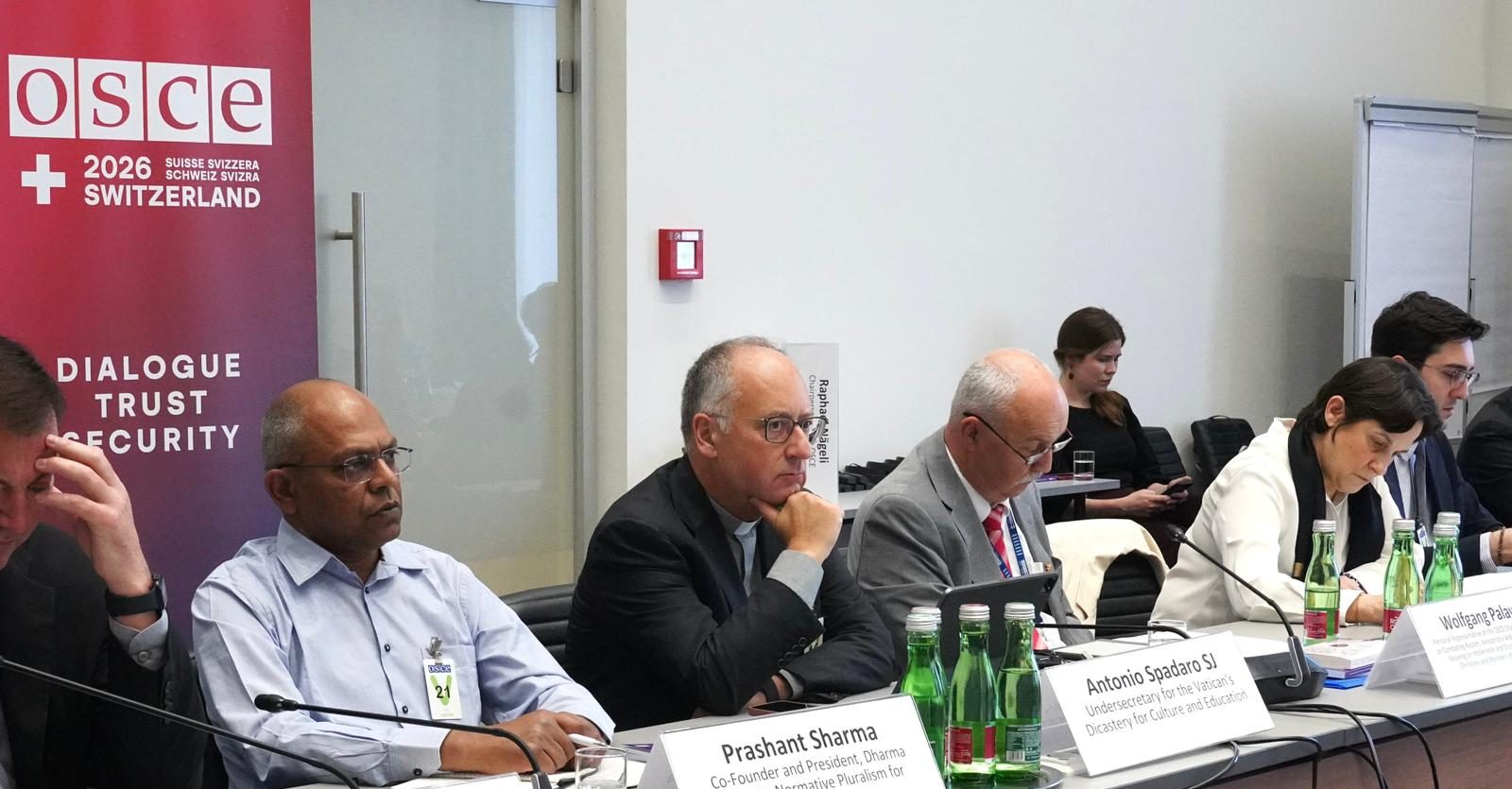
The Organization for Security and Co-operation in Europe (OSCE) hosted an event on June 23 at its Hofburg headquarters in Vienna on the contribution of religious and faith communities to strengthening multilateralism.
The discussion — moderated by Prof. Wolfgang Palaver, the Chairperson-in-Office’s Personal Representative on Combating Intolerance and Discrimination against Christians and Members of Other Religions — explored how spiritual traditions can rebuild bridges and foster dialogue.
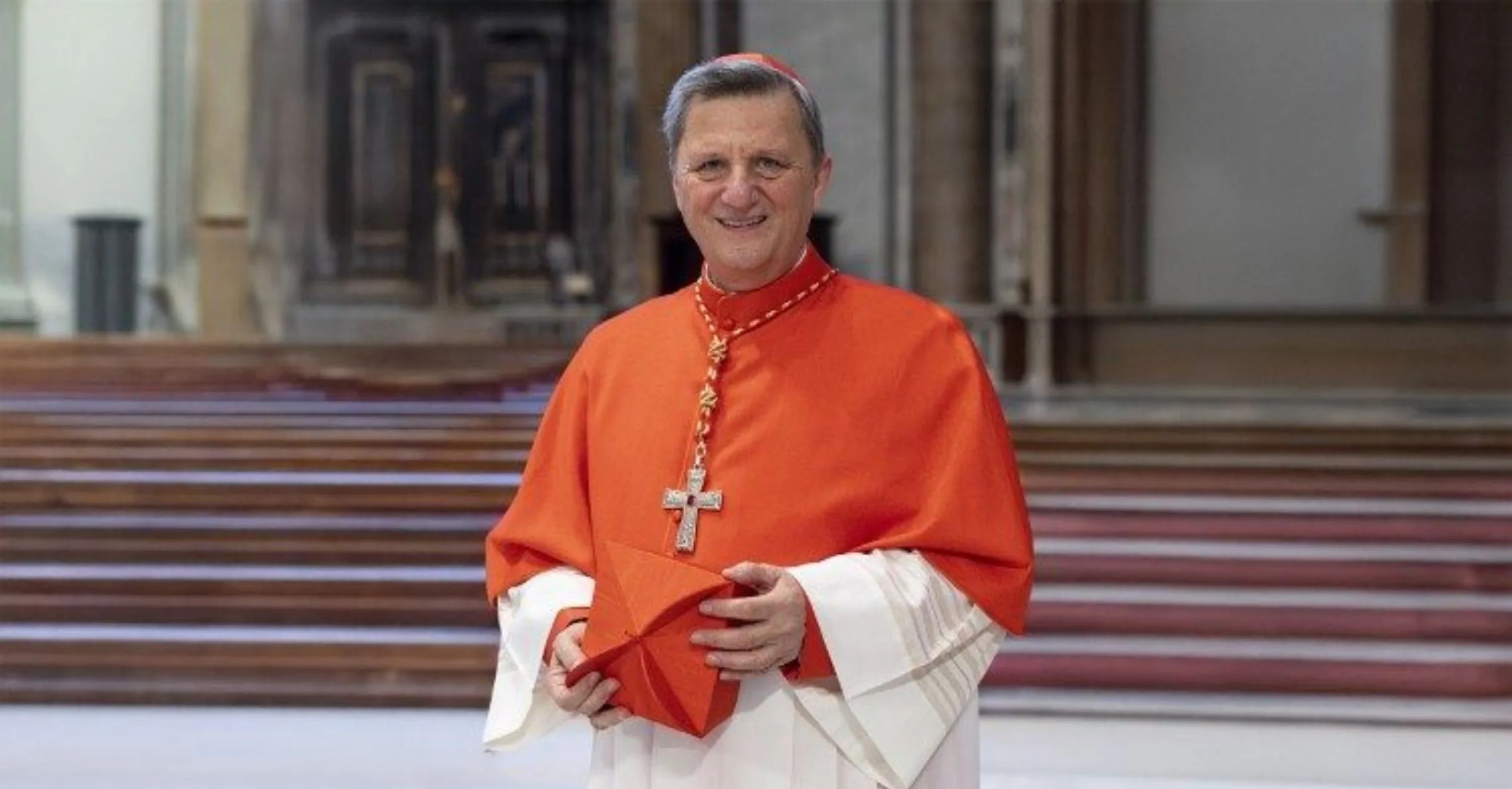
The following is Antonio Spadaro’s address at the conference.


We understand the world through the image we form of it, and on those images we build our solutions. How do we imagine the world? Traveling the world with Pope Francis — sixty-three countries — I learned to see it through his eyes. From those journeys came the conviction that his vision condenses into two opposing images: the chessboard and the fabric.
The place where I bring them is not neutral: the OCSE — Organization for Security and Cooperation in Europe — is a daughter of the Helsinki Final Act of 1975, born of a precise choice to hold the world together.
The chessboard is the logic of domination, politics as a contest of forces: a surface of white and black squares where opposing forces play a zero-sum game. Here, the peoples, nations, and territories are pawns: every move is a calculation, every piece sacrificed for one goal — checkmate, the elimination of the adversary.
Geopolitics becomes a dance of strategies that leads to war, or a diplomacy that is war by other means. Its symbol is Yalta, 1945: the great powers carving up Europe among the victors, each with its sphere of influence.
Peoples are means, not ends — Pope Francis criticized that partition more than once. Every time the world is treated as a chessboard, the peoples pay: Yalta gave rise to the walls, the iron curtains, and the Cold War.
The fabric follows a different logic. Its threads are peoples, nations, and territories — not pawns pushed across a board, but threads knotted together: the warp that resists and the weft that adapts. No thread dominates; each holds because it is held by the others.
Cut one, and the fabric weakens; tear out too many, and it rips — but a fabric, unlike a chessboard, can always be mended. The strongest cloth is born not of uniformity but of a composed tension between opposites. Plato, in the Statesman, drew the lesson: to govern is not to dominate; it is to weave.
Helsinki, in 1975, was exactly this: thirty-five States from opposing blocs that, at the heart of the Cold War, recognized one another as threads of a single cloth and affirmed the equality of peoples against every sphere of influence.
To follow the spirit of Helsinki, Pope Francis wrote, means “to move in the direction opposite to Yalta”: rejecting a politics of spheres of influence and affirming equal rights for peoples and persons within a shared architecture of international relations.
The fabric metaphor is no plea for vague coexistence or blurred sovereignty. But there are lands that are literally fabrics — threads of histories, cultures, faiths, and blood interwoven so tightly that, if pulled apart, they can only tear.
Let us think of the Middle East, where two peoples have woven their lives into a single cloth that no violence can unravel; or of Russia’s war of aggression against Ukraine, where centuries of closeness bind the peoples in an inseparable weave.
Applying the chessboard’s binary logic to these lands — this square mine, that one yours — does not produce order: the shared thread cannot be severed without wounding both sides. The politics of the fabric does not tear but weaves and mends, always honoring sovereign equality, territorial integrity, the peaceful settlement of disputes, and human dignity.
This is why the chessboard/fabric distinction is central to multilateralism. The chessboard reduces multilateralism to a concert of great powers that impose peace by dividing the world: a false multilateralism.
Authentic multilateralism is the loom on which even the thinnest threads sustain the design. In Fratelli tutti, Pope Francis argues that smaller and poorer countries can enter into regional agreements and negotiate as a bloc rather than remain isolated and dependent on the great powers.
International politics is an interweaving of inextricable threads, not a game of chess. This diagnosis is urgent. On Jan 9, before the Diplomatic Corps, Pope Leo XIV denounced the weakness of multilateralism; on June7, in Madrid, he offered the remedy in an image that is also ours: to weave networks of “encounter, listening, dialogue, and respect,” and so a renewed society.
What, then, can communities of faith contribute? They cannot replace states, negotiate treaties, or determine political outcomes. Their task is different yet indispensable: to sustain the moral and social conditions that keep agreements from being fragile.
First, they can defend a moral grammar for international life: the equal dignity of every person and every people; the refusal to treat human beings as instruments; the conviction that no national interest can justify the annihilation of another people.
Second, they can sustain relationships across borders. Religious communities are rooted locally yet belong to networks that span nations, languages, and cultures, keeping channels of encounter open when official dialogue is blocked.
Third, they can resist the instrumentalization of the sacred. Whenever religion is used to bless domination, sanctify violence, or weaponize identity, faith becomes part of the chessboard. At its best, it does the opposite: it disarms language, protects conscience, shelters the vulnerable, and prepares for the long work of reconciliation.
As Pope Francis stated during the Interreligious Meeting in the Plain of Ur, Iraq, on March 6, 2021, “the religious, cultural and ethnic diversity that has characterized Iraqi society for millennia is a precious resource to draw on, not an obstacle to be eliminated. […] Diversity, instead of giving rise to conflict, should lead to harmonious cooperation in the life of society.”
A witness to this attitude is the Document on Human Fraternity, signed in Abu Dhabi in February 2019 by Pope Francis and the Grand Imam of Al-Azhar, Ahmed el-Tayeb. Together, they warn against policies “based on the law of force and not on the force of law.”
The chessboard knows only the law of force; the fabric — like multilateralism — is the patient construction of the force of law. Communities of faith serve multilateralism by reminding the world that no people is a pawn.