



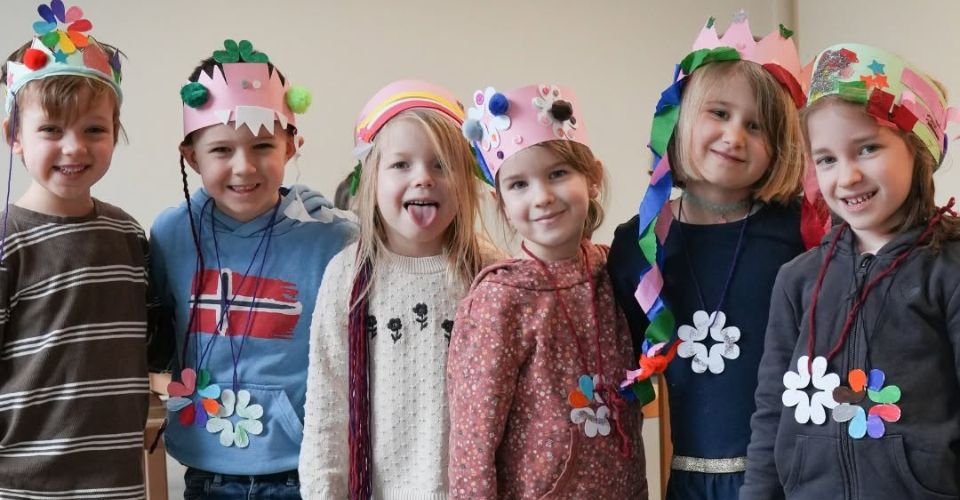
A year after its launch, “Katholino” has grown from 35 daycare centers to 285, making it the largest Catholic daycare provider in North Rhine-Westphalia, Germany, with growth projected to top 500 sites next year.
The venture, run by the Archdiocese of Cologne, set out to lift administrative burdens off individual centers so staff could focus on educational and religious work — but the launch wasn’t without pushback, as critics questioned whether centers would lose their ties to local parishes and their individual character in the process.
Managing Director Agnes Busch says the first year was about proving the model could scale without sacrificing that identity, from centralizing back-office tasks like invoicing to negotiating cooperation agreements that keep each center rooted in its parish.


She spoke to DOMRADIO.DE about that balancing act, and about serving a generation of parents increasingly distant from the church, as “Katholino” prepares for its next phase of growth.
What was the biggest challenge for you in the first year?
The biggest challenge was really the start: could we ensure that the 35 daycare centers that placed their trust in us and transferred to our sponsorship as of Aug. 1 last year would get off to a good start?
We were also focused on making sure they felt well supported and that we, as a provider, would function well. Once that happened and things scaled up and kept growing, the biggest hurdle had been cleared.
How do educators notice, in concrete terms, that they belong to “Katholino” today?
For example, we’ve tried to take the whole issue of generating and managing invoices out of the daycare centers.
That means directors no longer have to spend about two hours a week scanning invoices; instead, the invoices come directly to our central office by email.
The director only has to approve them and confirm the invoice is correct — they’ve been relieved of the duty to manually manage the entire process, from scanning to sending. I think that’s the first added value they notice very quickly.
How do you ensure that each local center retains its identity and doesn’t get lost in the administrative structure?
We’re currently in the process of concluding individual cooperation agreements with all parishes or pastoral units, so that local conditions and pastoral integration are contractually defined. This allows both sides to ensure that the individuality on site is preserved.
❝
We celebrate every feast and observance in the Catholic liturgical year, and through integration with the parish, we try to celebrate religious services together with the community.
What are your plans to make the organization sustainable in the future?
We now have 285 daycare centers, which is projected to exceed 500 next year.
That can’t be managed by a single person, which is why it’s great that we’re now a team of three, each bringing very different skills. This allows us to continue developing “Katholino” from all sides.
What does that mean for everyday life in daycare centers that serve young parents who aren’t closely connected to the church?
We offer religious education programs alongside other services at the daycare centers. At “Katholino,” we have a small team dedicated to religious education that develops ideas for how centers can better serve this area.
We celebrate every feast and observance in the Catholic liturgical year, and through integration with the parish, we try to celebrate religious services together with the community.
We also organize a lot of activities through volunteers. Our Catholic daycare centers are already living out their Catholic identity, and we hope that continues and expands — through “Katholino,” we’re confident we can pass on these good practices.
How do you ensure inclusiveness for those who don’t have a connection to the Catholic faith?
Our Catholic daycare centers are open to people of other religions.
What we expect is that anyone who applies to work with us, or places their child with us, is open to the Catholic faith — because in our Catholic daycare centers, we practice that faith by celebrating Catholic feasts and services.
So there needs to be openness to participate in these celebrations, but no one is forced to become Catholic.
By next August, “Katholino” is expected to grow even further. How do you prevent a strong network from turning into a cumbersome administrative apparatus?
We try to maintain individuality and regional character through decentralization, with regional managers each responsible for about 15 to 20 daycare centers locally.
What we centralize is everything behind the scenes — administration such as accounting, financial management, or recruiting — processes that can be standardized centrally.
Otherwise, through professional advisory services, religious education, and regional managers on site, we try to help shape that individuality.
This is a translated and edited version of the interview that first appeared on DOMRADIO.DE and has been republished with permission by Global Catholic.














1 Comment
Max Ferando
August 10, 2026Well curated article.