




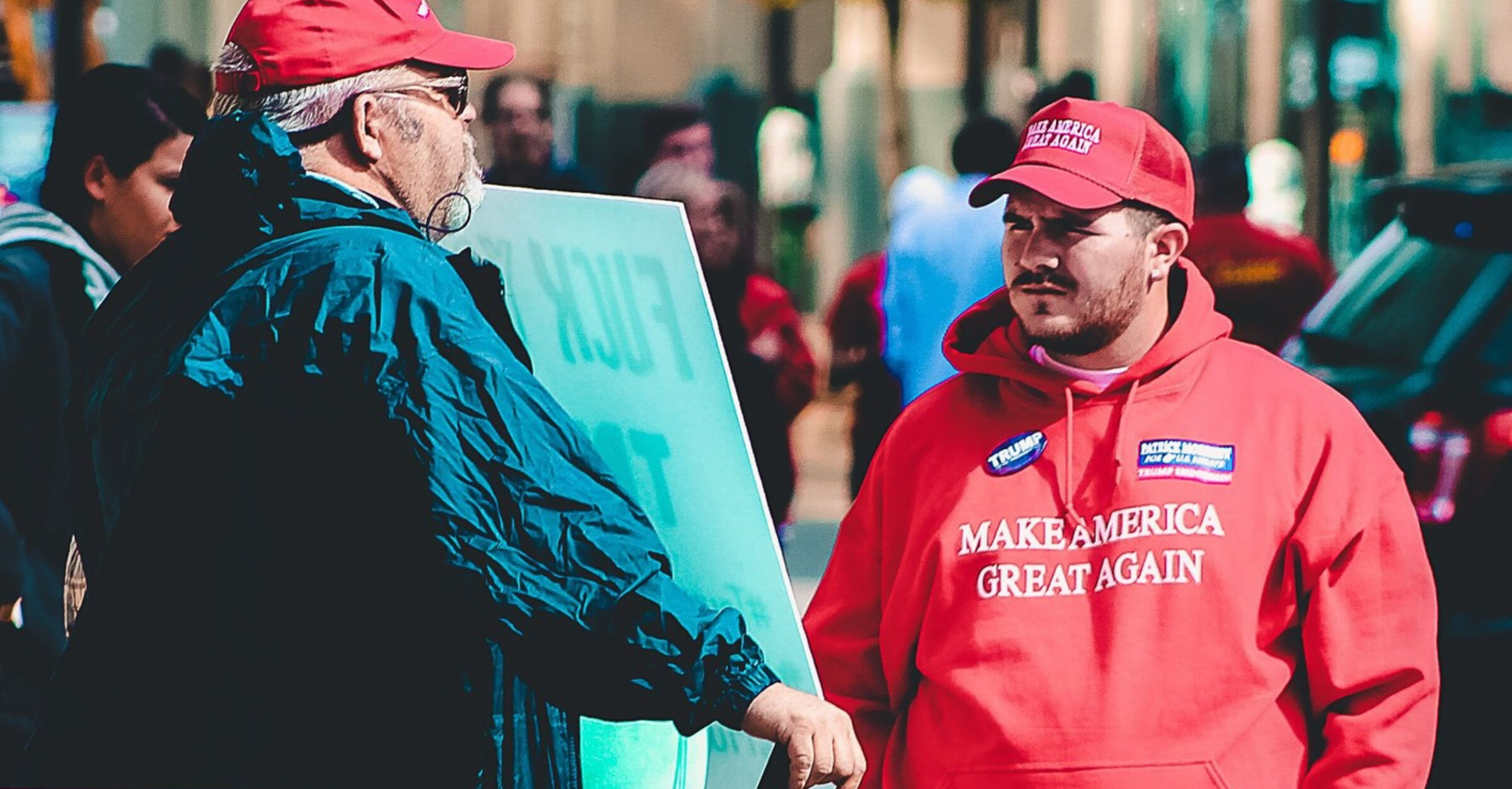
Can a conservative Christian be on the left? Or, better yet, can a Christian be both conservative and on the left? I think so.
I began thinking about this some 25 years ago, in the middle of an election campaign that ended with Lula winning the presidency of Brazil.
Luiz Inácio Lula da Silva, a former union leader and founder of the leftist Workers’ Party, won Brazil’s presidency in October 2002 after three earlier failed bids, taking office in January 2003.


During a conversation, a pastor friend of mine — well known for his struggles on behalf of the poor, especially in the fight against hunger, and therefore seen by everyone as a man of the left, as well as a supporter of Lula’s candidacy — told me something that made me think.
After a meeting about hunger in the country and the election, he and some others were invited to the home of one of the participants to have a drink and continue the conversation. He thanked them but declined.
When the group insisted that he come, he had to explain why, and his explanation made a strong impression on me: he would not go because the conversation would probably move beyond the issue of hunger and turn to discussions about “alternative” sexualities and related topics.
On these subjects, he acknowledged that, as a pastor and theologian, he was conservative and would not feel comfortable there.
In fact, this friend was and still is on the left when it comes to the relationship between “the left and the right.” That is, he is on the left because he advocates greater equality and social justice, whereas the right maintains that social inequality is natural and beneficial, to the point of accepting social Darwinism — the idea, derived from a misapplication of Charles Darwin’s theory of evolution, that social and economic competition naturally and rightly produces winners and losers.
What this means concretely today is that the left advocates a greater role for the state in guaranteeing workers’ economic and social rights, while the right advocates reducing the state to the role of protecting private property, contracts and national security, and handing all other sectors of social life over to the “free” market. In other words, privatization as the solution to everything.
On the other hand, when it came to matters of “private life,” family and sexuality, my friend placed himself, at least at that time, on the side of conservatism, in opposition to progressivism.
Given the dominance of the myth of progress in the modern world, we tend to think that advances in new technologies and cultural innovations are always beneficial and signify the advancement of civilization and humanization.
However, there are sectors of society, especially religious groups, that argue that certain values fundamental to life, such as the family, must be preserved — that is, they must be treated conservatively.
Four possibilities, one framework
To make the discussion easier, we can establish a simplified framework with four possibilities: conservative and right-wing, in favor of neoliberal capitalism; conservative and left-wing, and an advocate of social justice; progressive and right-wing; progressive and left-wing.
In this framework, my friend would fall into the second category, a conservative on the left.
I am bringing up this conversation — to the extent that my memory allows me to reconstruct it — because we are in the midst of electoral processes in Brazil and the United States of America that could shape the course of the continent, and religion has become one of the central issues.
The alliance of neoliberals and conservatives
Without discussing here the separation of church and state, what we actually have is an alliance between authoritarian neoliberals or fascists, who generally do not present themselves publicly as progressives but do advocate technological progress, and right-wing conservatives, who generally use rhetoric rooted in the Christian religion in their political activities and projects.
In this alliance, the right provides the state structures and policies to impose the conservative moral values of patriarchal Christianity on society as a whole, while Christian conservatives provide votes and support for neoliberal economic policies involving privatization and tax cuts for society’s wealthiest members.
The theological and political discourse of this alliance can be summed up in the following thesis: The rich are rich because they deserve their wealth, and that wealth is proof of God’s blessing in recognition of their economic efficiency.
Therefore, they should not be “robbed” by the state through taxation. The poor, on the other hand, deserve their poverty and suffering as punishment from God for their sins of inefficiency, laziness and/or sexual immorality. In this sense, the poor are seen as sinners and criminals.
For this reason, social programs supported or funded by the state to improve the living conditions of the poor are viewed and condemned as “robbery” against the rich and as an attack on God’s judgment.
In this political theology, the God who emerges is deeply insensitive to human suffering, because all suffering is reduced to God’s punishment, leaving no room for compassion or the proclamation of the good news to the poor. In other words, this image of God is completely opposite to the one Jesus presents in the Gospels.
Moreover, this theology justifying the alliance has a problem: the sexual immorality or sexual misconduct of its two major leaders, whom many religious people regarded as messianic figures — Trump and Jair Bolsonaro.
Both men have faced numerous public allegations and, in Trump’s case, civil findings of sexual misconduct, even as they drew strong support from conservative evangelical and Catholic constituencies in the US and Brazil, respectively.
The fact that leaders of Christian churches in the United States and Brazil who support these alliances overlook this moral problem shows that the fundamental criterion and value are not sexual and family morality, but neoliberal capitalism. Neoliberal capitalism has in fact become the absolute value by which Christians are expected to live out their religion.
A God sensitive to suffering
On the other hand, for my Christian friend, a “conservative on the left,” the fundamental criterion was and remains the hunger of the poor, along with access to other social rights that allow them to live with dignity.
This is because the good news of Jesus, which he learned and preaches, begins with the proclamation that Jesus came into the world so that everyone may have life and have it abundantly.
A person who lives in a permanent or constant state of hunger and deprivation of other basic necessities, including the bodily need to be recognized by others as a being of dignity, lives in a constant struggle for life against death, oppression and social contempt.
In this Christian vision, poverty and social suffering are not seen as punishment from God but, quite the contrary, as the sins of an oppressive and unjust social system and of people who use the name of God in vain to justify their power, privileges and oppression of others.
My friend learned this vision of God in an environment generally considered conservative, opposed to liberal theologies but open to the suffering of the poor and engaged in dialogue with social theories.
That is why he stood alongside those who shared his struggle, despite having conflicting ethical and religious interpretations of sexuality and the family, in pursuit of the most fundamental goal: the “right of everyone to eat at least three meals a day.”
This is why Jesus spoke so much about overcoming hunger, disease and social exclusion, and so little about sexuality or family relationships.
Of course, moral questions concerning sexuality and the family are important in people’s lives, but we must not fall into the trap set by those who hold power and wealth and use religious discourse — the sin of taking God’s name in vain — to justify and perpetuate evil, namely oppression and exploitation, in the world. (The subject of the family in the relationship between religion and politics is underexplored.)
In other words, we must not confuse the issue of sexual and family morality in the relationship between conservative cultural values and modern progressive values with the question of ethical, political and economic choices between the left and the right — that is, the question of equality versus the profound social inequality of today’s world.
In theological terms, the main point of convergence or conflict should not be between the premodern conservative vision and the modern progressive vision, but rather between a “heart and mind” that are sensitive to the suffering of the people and one that is insensitive, incapable of being moved by the suffering of others.
It is up to us, who share the same perspective of compassion and solidarity with those who suffer, to take on the challenge of establishing a dialogue — not an easy one — with people who, even though they share the same “spirit,” have different and even conflicting cultural and theoretical backgrounds.
Along this path, we must always remember that, despite our differences, there are vital and urgent challenges — ensuring the lives and rights of the most vulnerable — that must keep us united in the struggle.
This is a translated and edited version of the interview that first appeared on Instituto Humanitas Unisinos (IHU) and has been republished with permission by Global Catholic. The views expressed in this interview are those of the speakers and do not necessarily reflect the official editorial position of Global Catholic.






1 Comment
S.Y.
October 18, 2026Jung Mo, what a very refreshing and insightful article, which brings me to share here that neither you nor your pastor friend, (or even Lula & his supporters) are alone in these heart-felt convictions for I too have for many years held these same interior convictions which are both very personal on a spiritual level as well as publicly relevant in the political sense AND at one & the same time, this unique intersection acknowledges that in a mysterious fashion, the spiritual & political are never mutually exclusive but are in fact, inherently inter-dependent and mutually consequential. You can find many of my ruminations & contemplations, even exhortations on the importance of advocating such an intersection between the conserving of life-honouring spiritual traditions that collaborate in living solidarity with issues of socio-cultural and economic justice in my blog right here:
https://myfaithandlifeblog.com/
I hope you will also enjoy and be blessed by what you read therein.