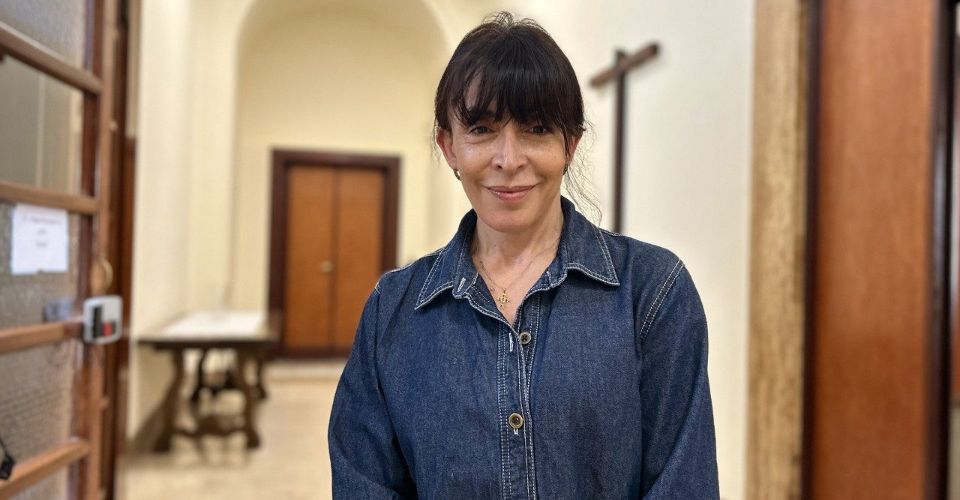
Argentine theologian Emilce Cuda, secretary of the Pontifical Commission for Latin America and a consultant to the Dicastery for Interreligious Dialogue, visited Barcelona this week to inaugurate the new academic year of the Christianity and Justice Study Center (Cristianismei Justícia, a Jesuit-run research and social-action center based in Barcelona) with a presentation on how to speak about God amid the profound transformations of today’s world.
A close collaborator of two popes — Francis, who first appointed her to the Vatican’s Latin America commission in 2021, and his successor, Leo XIV, with whom she worked directly at the commission before his election in 2025 — Cuda is one of the most precise and authoritative voices for analyzing the role of the Holy See, the responsibility of laypeople and theologians in the public sphere, and the challenges facing the global Church.
She holds a doctorate in theology from the Pontifical Catholic University of Argentina and has been described as the first Latin American woman to hold a position of high responsibility within the Roman Curia.


You have worked with two popes, first with Francis and then with Leo XIV, with whom you collaborated during his time as a cardinal. How would you describe this responsibility?
It is a great responsibility to work in the Holy See, which is not a structure of control, but of communication, in accordance with the apostolic constitution Praedicate Evangelium.
The function of all the bodies of the Curia is to connect the particular Churches with the Holy Father. It is a great responsibility that some of us assume now, just as others assumed it at other moments in history.
Each of us gets up every day carrying the weight of this responsibility, but also with the surprise —which never ends— of being able to work and collaborate with a pontiff.
How can the idea of God be conveyed in a context in which there seems to be a growing willingness to search and, at the same time, so much religious illiteracy?
Rather than talking about God, it is about talking about a God. Sometimes it is taken for granted that, when we use the word God, we all understand the same thing. Or that we understand the same thing by Catholicism or Christianity.
We are living in a moment of history shaped by new technology and virtuality, in which people do not take the time to define the categories and concepts they use.
So much so that Pope Leo XIV has once again redefined in his new encyclical all the concepts and principles of the Church’s Social Doctrine. And I think this also applies to the concept of God.
We Catholic Christians speak of a God who is one and triune, and I think this needs to be emphasized more. Because under the umbrella represented by the category of God, terrible atrocities have been committed throughout history.
That is why the function of a theologian is always to manifest the Creed.
We believe in one God, three persons, which entails the incarnation. And the incarnation entails human dignity, mercy, the community organization that is the Church, and the public word that means giving an account of our faith.
You maintain that theology must be in contact with the problems of its time, with the world in which it finds itself. Wasn’t that the case until now?
It has always been that way, since the first Christians. Cardinal Ratzinger explains it in a wonderful text based on a debate he had with Paolo Flores, an atheist philosopher and director of a prestigious European magazine.
He says that Catholicism is not just another religion. In the Roman Empire, for example, religion provided a foundation for the objectives of the empire. And Christianity was born precisely to question this religion, which was ultimately a political theology; that is, it offered theological arguments for a political program.
Theology was born to question this state religion: it goes beyond a system of rules and has the ability to use mediation, for example through philosophy, to give reasons for why we believe in one God, three persons, who died and rose again.
On this basis, it grounds our defense of human dignity, universal access to goods, solidarity and subsidiarity. Theology has always been this.
Catholicism is a public word that, through the mediation of other scientific or cultural fields of knowledge, is concerned with healing and caring for people’s lives, which is what Our Lord Jesus Christ did during his three years of public ministry.
This idea you mention is reflected in the Pope’s proposal in Magnifica Humanitas, and also in Free Under Grace, a work that brings together writings from his time as prior general of the Augustinians, when he advocated for a Church that walks with the people and accompanies them in their deepest aspirations.
Indeed, we are at a moment when the religious fact tends to cancel out the theological fact. And as Catholics, we must be clear about the function of theology as a public word, always, I insist, with the mediation of other fields of knowledge.
On the other hand, among the speeches to which you refer, there is a homily in which he calls for people to accept the responsibility of leading a Catholic institution.
One might think that everyone is eager to become a prior or prior general, bishop or cardinal, but it is a great responsibility and, moreover, it is forever. And it seems that this is not the case; that is, not everyone wants to take on this burden.
It struck me that Prevost emphasized at several points the need to accept it when someone is asked to take on this service, which is public as well as religious.
A good example might be St. Augustine himself, his spiritual father.
Indeed, Augustine’s only dream was to devote himself to studying philosophy, but he had to take responsibility for leading an earthly city during the fall of the Roman Empire, a time of chaos and the loss of political forms that had previously worked but had become insufficient.
This is the responsibility of a bishop, of a cardinal when advising the Pope —which is his function— and it is also the responsibility of the theologian.
A theologian is not simply someone who teaches catechesis —which is no small thing— but someone who must work at the frontier and form critical thought in order to provide answers from the faith that everyone can understand.
This is the task of the theologian and of every Catholic according to the Creed they profess: to be able, from the foundations of faith, to establish ethical regulations.
We must work with the mechanisms of the contemporary world, but always with the guidance of faith, which, of course, places human dignity at the center.
Do you think Pope Leo XIV’s first encyclical has already had enough impact on society as a whole?
Absolutely. Magnifica Humanitas has been a success, but I think there needs to be more discussion of the heart of the encyclical, which is the Social Doctrine of the Church.
I see thousands of webinars and conferences about this letter focused exclusively on artificial intelligence, and in the end everyone ends up giving an opinion about this technology: some with knowledge, others with fear.
I do not hear people talking about the Social Doctrine or the proposal the Pope makes in the text, which directly challenges us in this rebuilding of the walls of Jerusalem.
As secretary of the Pontifical Commission for Latin America, and therefore someone who knows the ecclesial reality of this region well, what do you think those Churches can teach the Churches of Europe, where faith currently occupies a more peripheral place?
Each Church has its own particularity and responds to the circumstances of the moment. In the case of Latin America, what characterizes it, unlike others, is that prophetic Catholicism is stronger than devotional Catholicism. A balance must be achieved between these two dimensions.
Pope Leo XIV himself maintains that the Social Doctrine of the Church goes to the heart of the matter, which is the method of seeing, judging and acting, characteristic of the Latin American Church.
What we call prophetic Catholicism cannot set aside the spiritual and liturgical dimension, because it is precisely this that makes it a discourse from the faith and prevents it from ending up as merely a political or economic solution that any of us could offer.
From the perspective of faith, action must be nourished by the liturgy and prayer. This does not mean, however, falling into devotionalism or canceling the Social Doctrine by thinking that it is politics or left-wing positions, when in reality it is the Gospel.
This is a translated and edited version of the interview that first appeared on Religion Digital and has been republished with permission by Global Catholic.