The water level in Germany’s Rhine region is expected to reach its lowest recorded level this weekend. In earlier times, people were more concerned about flooding. The figure of the Blessed Virgin Mary known to the locals as ‘Boatmen’s Madonna’ is believed to offer protection from both — high water and drought.
The concern is far from abstract: Gauges at Kaub, the river’s critical benchmark for shipping traffic, registered roughly 16 to 17 centimeters in mid-August 2026, breaking the previous record low set in 2018 and forcing barge operators to cut cargo loads or halt runs entirely.
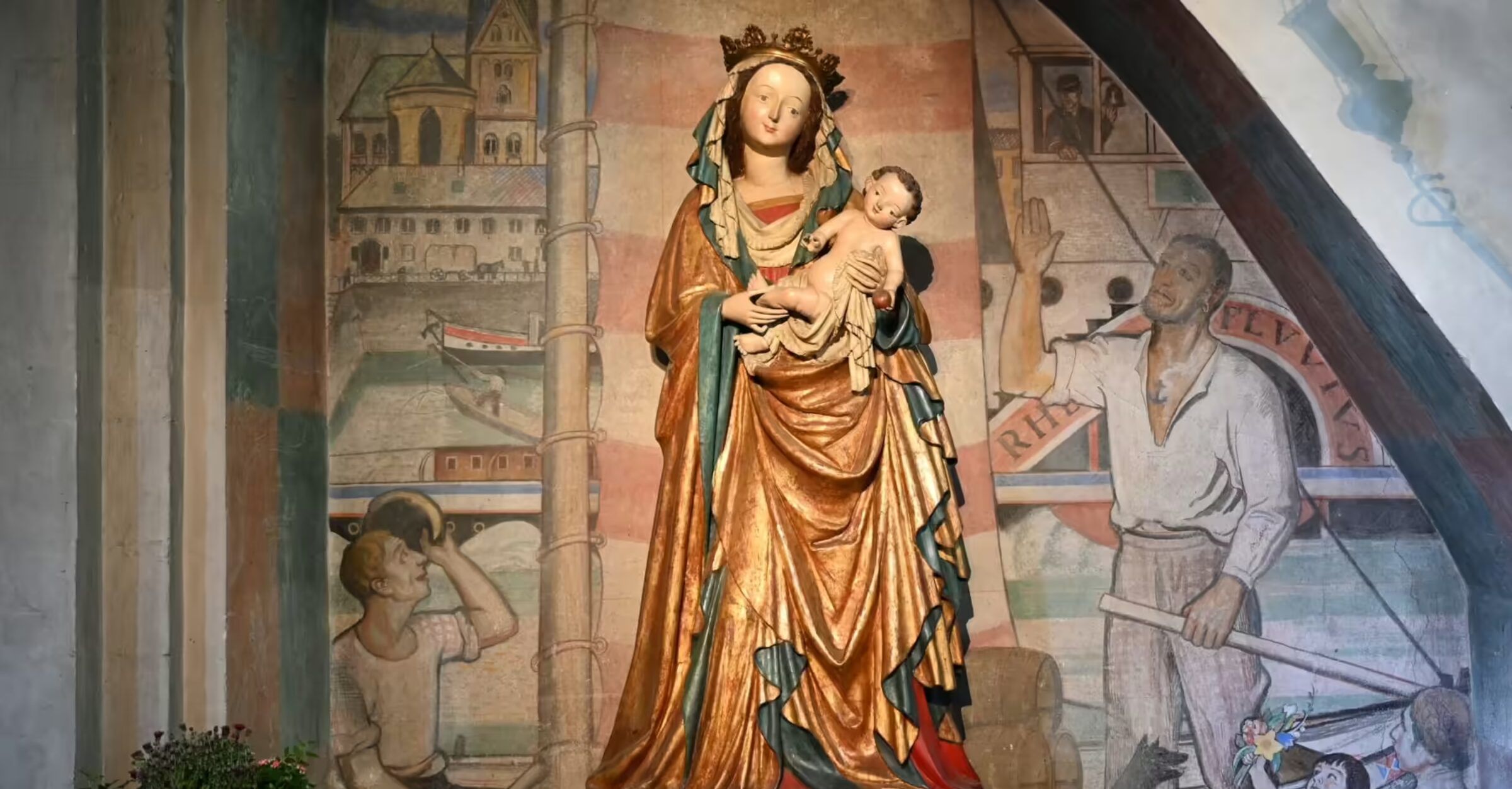
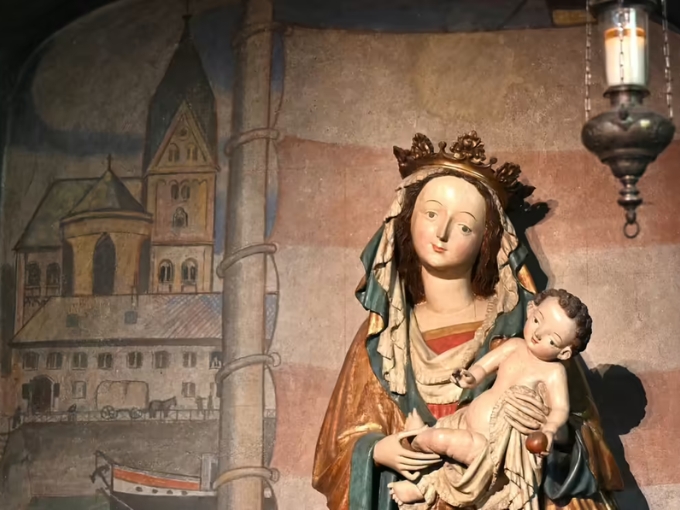
For those who believe, the Blessed Virgin Mary is larger than life, standing about 2.05 meters tall, in a slightly curved pose, wearing a flowing robe and holding the naked Christ Child on her arm.


Art historians date the statue to roughly 1410-1420. In art history, the statue is classified as belonging to the so-called “Soft Style” of the late Gothic art period, a decorative, courtly style of religious art that spread across Europe in the early 15th century, known for its flowing drapery and tender, naturalistic figures.
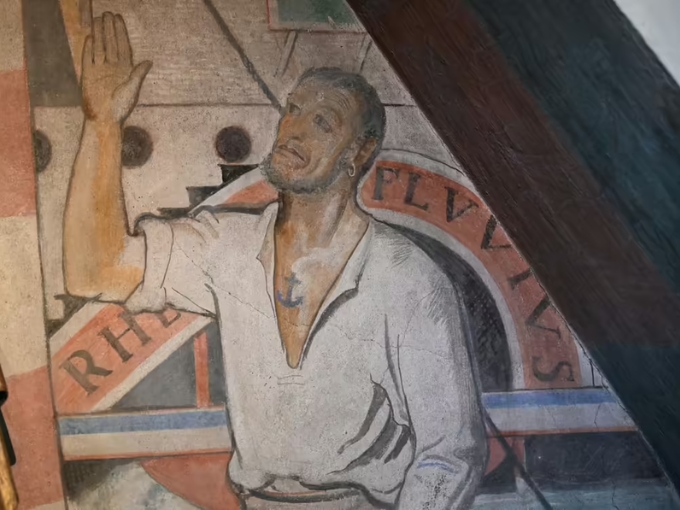
Serving as a contrasting backdrop to the lovingly rendered wooden figure is a fresco by Peter Hecker from 1938, painted in the style of New Objectivity, a German art movement of the 1920s and ’30s marked by sober, unsentimental realism, developed partly as a reaction against earlier Expressionist styles.
It shows a sailor greeting the Madonna, with the church on the Rhine waterfront in the background to the left.
For centuries, a colorful mixture of popular belief and legend has surrounded this medieval depiction of Mary, whose history has been anything but straightforward.
The key story begins with its original location. The statue was probably not originally part of the furnishings of the church of St. Mary in Lyskirchen.
It likely came to Cologne only after the dissolution of a Cistercian convent in Walberberg, southwest of the city, at the beginning of the 19th century.
A few decades later — probably around 1840-50 — it was placed on the exterior wall of the church apse, facing the Rhine, where it remained visible until 1868.
This unusual location gave rise to the idea of Mary as protecting the boatmen on the Rhine — and, in turn, to the legend of drowned boatmen returning to Lyskirchen on Christmas night.
Mary as an advocate watching over people
One particularly vivid version of the story holds that the souls of boatmen who had died on the Rhine during the preceding year would gather on Christmas Eve in a mysterious procession around the high altar, celebrating, in effect, their own Christmas Mass before entering eternal blessedness — a Cologne variation on the “Flying Dutchman” motif, the widely known maritime legend of a ghost ship doomed to sail the seas forever, unable to make port.
In this story, the river is not simply a waterway but marks the boundary between life and death.
The church on the Rhine becomes the place where the drowned come together one last time, while Mary takes on the role of protector and advocate, watching over those who travel the river through wind and weather, unfavorable currents, high waves and the unpredictability of nature.
Since 1890, the Madonna has stood on the church’s inner western wall. But although her original “view across the Rhine” has long since disappeared, the people of Cologne have preserved the titles “Boatmen’s Madonna” and “Guardian of the Rhine” deep in their hearts.
After all, none of the other Romanesque churches of Cologne — the city’s 12 great medieval churches, built largely between the 11th and 13th centuries and still considered some of Germany’s most significant Romanesque architecture— stands quite so directly beside the river.
The connection between the Rhine and the church, which in earlier times also served boatmen as a popular pastoral refuge far from home, and between the Rhine and the Boatmen’s Madonna, therefore remains alive to this day.
From their boats, people could see the large statue of Mary and offer a prayer for a safe journey across the river. For those who lived and worked on the Rhine, such a large statue of Mary standing outside the church directly beside the water must have seemed almost like a protective presence.
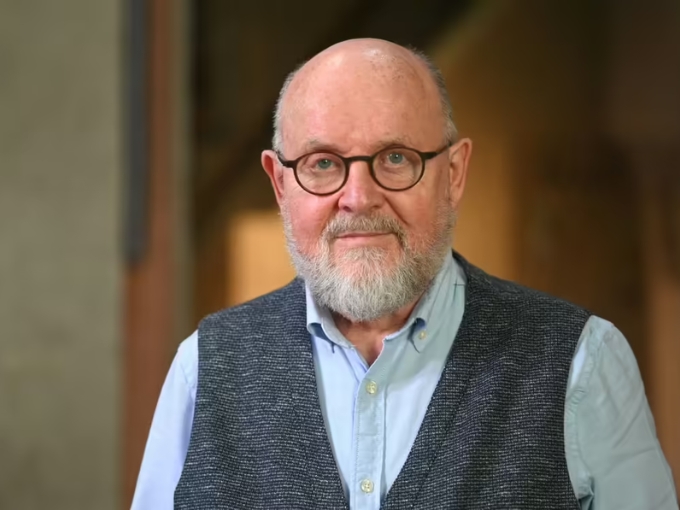
“Legends aside, the fact is that the Boatmen’s Madonna remains an easily accessible spiritual offering that has lost none of its significance even today,” observes Benjamin Marx, a resident of the parish community since 1987 and a member of the parish council for Cologne’s Innenstadt-Mitte district.
Throughout the day, businesspeople, tourists, hotel guests and people from the neighborhood come to Lyskirchen to light a candle before the Virgin Mary in passing.
People come with their concerns
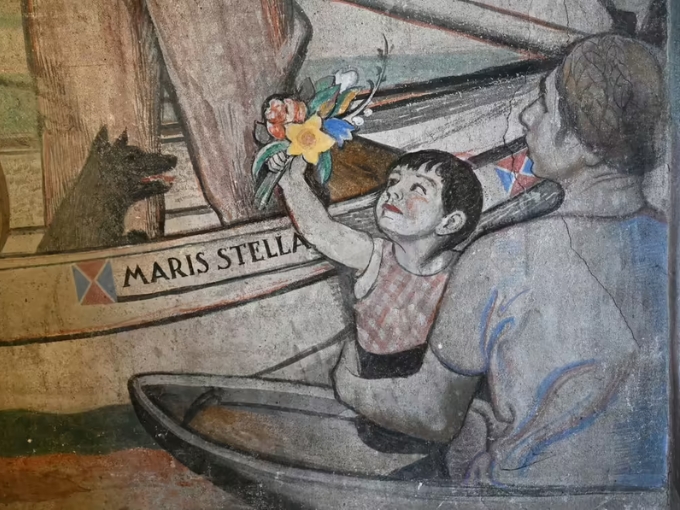
“Just as the people in the painting in the background greet the Mother of the Lord, people here come to greet her; they come with a concern, stay for a short while and then leave again. But they believe that a prayer offered in trust in Mary’s intercession will help,” says Marx.
It’s a constant coming and going. “The Boatmen’s Madonna has her own fan club,” Marx says with a smile, “regardless of whether the Rhine is experiencing high or low water, or whether the climatic conditions are good or bad.”
For Marx, too, Lyskirchen and the Boatmen’s Madonna are something of a spiritual anchorage. “I’m still in love with this church, which is why I’m involved here,” says the former real-estate project developer.
He knows the small church better than anyone else — and with it, the deeper significance of this protective Madonna, how firmly she remains present in the minds of Cologne residents, and how popular she has become again today, this time in the face of prolonged drought and under completely reversed circumstances.
A neighborhood once home to boatmen
“Since this church was founded, there has always been a real fear of flooding and inundation, which has always had destructive effects, especially because in earlier centuries there were no embankments and protective walls like those we have today,” Marx explains.
in the late Middle Ages Rhine and its surrounding areas including Lyskirchen were inhabited largely by boatmen and oarsmen who faced multiple floods after the river overflowed.
It wasn’t until the early 17th century that a separate boatmen’s guild was established, and a St. Nicholas brotherhood of boatmen was mentioned in 1670.
“After all, St. Nicholas of Myra is the actual patron saint of boatmen, sailors and fishermen,” Marx says.
St. Nicholas, a fourth-century bishop from present-day Turkey, is venerated across Christian traditions as a protector of sailors and children, and is the historical inspiration behind the modern figure of Santa Claus.
“It’s no coincidence that a chapel dedicated to St. Nicholas was built at the same time as St. Maria Lyskirchen, at the beginning of the 13th century,” Marx adds.
The church therefore quite rightly bears the nickname “Boatmen’s Church,” which was used even before the installation of the Boatmen’s Madonna.
Marx knows the fear of flooding from personal experience. The 71-year-old will never forget the historic Christmas flood of 1993, when the water rose knee-deep inside the church, followed a little more than a year later by another flood in January.
“In early 1995, the Rhine had risen over its banks again and reached a threatening level, but at the last minute — surely the intercessions to St. Nicholas helped — frost set in, and we narrowly escaped another catastrophe,” he recalls.
When the river rises, the church is generally easy prey, he says, because it lies at one of the lowest points in the city. This has repeatedly exposed it to flooding throughout history.
The most spectacular example is considered to be the so-called Ice Flood of 1784, when Lyskirchen was flooded up to the vaults of the side aisles, destroying much of its furnishings. A marker at the western portal still documents the event today.
Concern over the falling Rhine water level
“What there was often too much of in earlier times is now, to a frightening degree, too little,” Marx says, looking with concern at the Rhine water level, which has been falling dangerously for days outside his home.
“When I was a child, during weeks of drought we still had processions of supplication through the fields when there was no rain for long periods. We prayed for a good harvest, because 50 or 60 years ago people — especially in rural areas — still lived very differently, much more in harmony with nature,” Marx recalls.
“People in the Middle Ages were also existentially dependent on the climate. If the grain couldn’t grow, there was no REWE with full shelves,” he says, referring to one of Germany’s largest supermarket chains, used here as shorthand for modern grocery abundance.
“What the price of gasoline is to us today was the price of bread back then. Food could quickly become unaffordable for entire sections of the population when the climate did not cooperate,” emplains Marx.
The prolonged drought across large parts of Europe, temperatures above 40 degrees Celsius, an emerging threat of crop failures in many places and the danger of forest fires are alarming warning signs that frighten him personally, Marx says.
But in a very different way, they are also bringing the Lyskirchen Boatmen’s Madonna back into focus. She is always at the side of those in need, he says — in even the most seemingly hopeless situation.
“What drought means for people,” Marx explains, “is becoming particularly visible in the so-called ‘hunger stones’ now emerging from the Rhine. These are large rocks in riverbeds that become visible only when water levels are extremely low, but they are like memorials because they show that in earlier times, low water levels meant very concretely poor harvests, food shortages, economic hardship and therefore hunger.”
Similar “hunger stones,” or Hungersteine, have long been documented on other Central European rivers as well — most famously on the Elbe near Děčín in the Czech Republic, where one stone bears a carved warning dating back centuries: “If you see me, weep.”
Often marked with dates or inscriptions, the stones recorded particularly severe drought years for future generations.
“The fact that rivers carry little water, that shipping is severely restricted or even brought to a standstill, has also caused problems for earlier generations,” he says.
“The crucial thing is that we take this warning seriously and understand the preservation of creation not merely as a political and social task, but as a responsibility entrusted to us — human beings — toward God, our fellow human beings and future generations,” adds Marx.
This is a translated and edited version of the feature that first appeared on DOMRADIO.DE and has been republished with permission by Global Catholic.