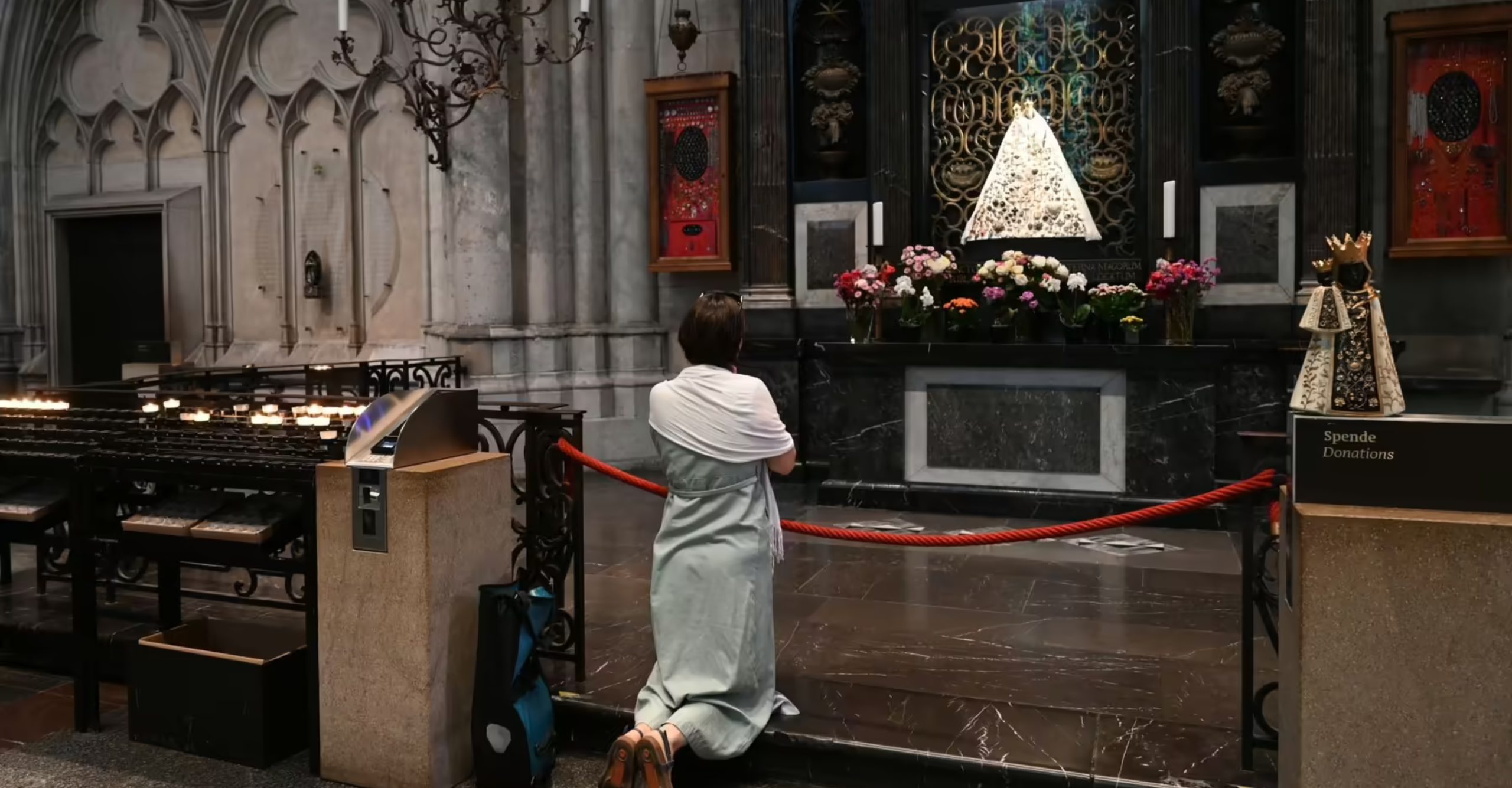
The sunrise in the Achskapelle (axial chapel) at Germany’s Cologne Cathedral is a deeply moving spiritual experience for all who arrive there for prayer.
The construction of the Gothic-style cathedral, which stands tall as a spiritual and geographical landmark, began in 1248 and concluded in 1880, after more than 600 years.
The massive cathedral is open to both tourists and worshippers alike. In July, a ticketing system was introduced to regulate tourist flow, but participants in Holy Mass do so without paying for admission.


The cathedral, which is relatively silent in the early morning hours, gradually gives way to the sounds of worship songs and Holy Mass as the day progresses.
Many worshippers arriving early enter the cathedral through the north entrance, near the railway station. Some are commuters who make a pit stop to refresh their spiritual thirst through the Eucharist.
Claudia Roth, a 45-year-old physician, says she visits the cathedral twice a week before catching her train to Düsseldorf.
“I especially love the peace and quiet—and in summer, the pleasant coolness,” she says. “It’s wonderful when the organ begins to play or when a service is taking place in the background.”
Those few moments of reflection and prayer, Roth says, give her entire day a different quality.
Many of the faithful, before beginning their day, listen to God’s word at one of the four early Masses, celebrate the Eucharist, light a candle, and carry something from the experience into their daily lives.
These visitors include office workers, religious sisters, retirees, and passersby.
Bearing witness through presence
By pausing, praying, and sitting quietly in this magnificent space, these visitors find a reliable foundation for daily life.
The cathedral becomes both a refuge and a shelter where they can lay before God both life’s burdens and its joys. At the same time, simply by being there, they bear witness to their faith and trust in God.
“If they keep silent, the stones will cry out,” Jesus says of his disciples in Luke’s Gospel.
The words seem especially powerful here. At Cologne Cathedral, the stones themselves seem to proclaim a message, while the soaring Gothic architecture inspires humility, reverence, and respect for the place’s sacredness.
Even before the first Mass at 6:30 a.m., a handful of people are already kneeling before the Blessed Virgin Mary statue near the north entrance.
“When I kneel before Our Lady, it’s as if I’m standing on holy ground,” says a young man with a backpack. “People once removed their sandals; today we genuflect,” he says, dropping a few coins into the donation box before leaving.
Many who visit the church pray at the Marian statue, famously known as the “Jeweled Madonna” (Schmuckmadonna).
It is a 17th-century Baroque statue of Mary and the Christ Child located in the cathedral. The venerated statue is heavily adorned with precious jewelry, rings, and votive offerings donated in gratitude for favors received
Richard Delfs, 78, says he has come from Hanover to celebrate his daughter’s birthday in Cologne. Most days, he cares for his elderly mother, who suffers from dementia.
“I never miss the early Mass from Cologne Cathedral, which DOMRADIO.DE streams,” he says. “For me, Cologne Cathedral is the fortress of the Catholic Church.”
He adds that although he regularly visits Marian shrines such as Kevelaer and Altötting, Cologne Cathedral is home. “For most people, it’s a tourist attraction. For me, it’s simply a place of prayer,” Delfs adds.
For others like Robert Exner, 86, visiting Cologne is meant to honor his late wife.
“The Marian altar was always our place,” he recalls. “Since she died three years ago, I’ve promised myself that I’ll come once a month to pray and light a candle for her.”
He remembers serving as an altar boy in Bavaria as a child and later settling in Cologne after military service. “The cathedral is the foundation of my faith.”
“It just keeps drawing me back to my beloved Mary… and it always will,” says Exner, gazing at the statue of the Blessed Virgin Mary in the cathedral.
Efforts towards sustainability
The cathedral, which is among Germany’s most visited attractions, only begins to fill around ten o’clock.
Even then, those who come primarily to pray remain largely undisturbed by the crowds. A new visitor guidance system directs tourists past the cathedral’s principal attractions while protecting those praying before the beloved Marian statue.
Since the beginning of July, a ticketing system has regulated tourist access to Cologne Cathedral. However, anyone who comes to the cathedral as a place of worship—for prayer or to attend Mass—continues to enjoy free admission.
For Cathedral Provost Msgr. Guido Assmann, the Cathedral is a unique place of hope and inspiration: a UNESCO World Heritage Site, one of Christianity’s greatest churches, and the city’s defining landmark.
He has long argued that introducing visitor tickets is necessary because it requires a solid financial foundation for sustainability.
Maintaining such an enormous church—where between 1,800 and 2,000 liturgies are celebrated annually, and six million visitors pass through its doors—is an immense undertaking.
Thanks to the support from the Archdiocese of Cologne, the Central Cathedral Building Association, the State of North Rhine-Westphalia, the City of Cologne, and the cathedral’s own income, that task has remained sustainable for many years.
This is a translated and edited version of the feature that first appeared on DOMRADIO.DE and has been republished with permission by Global Catholic.