
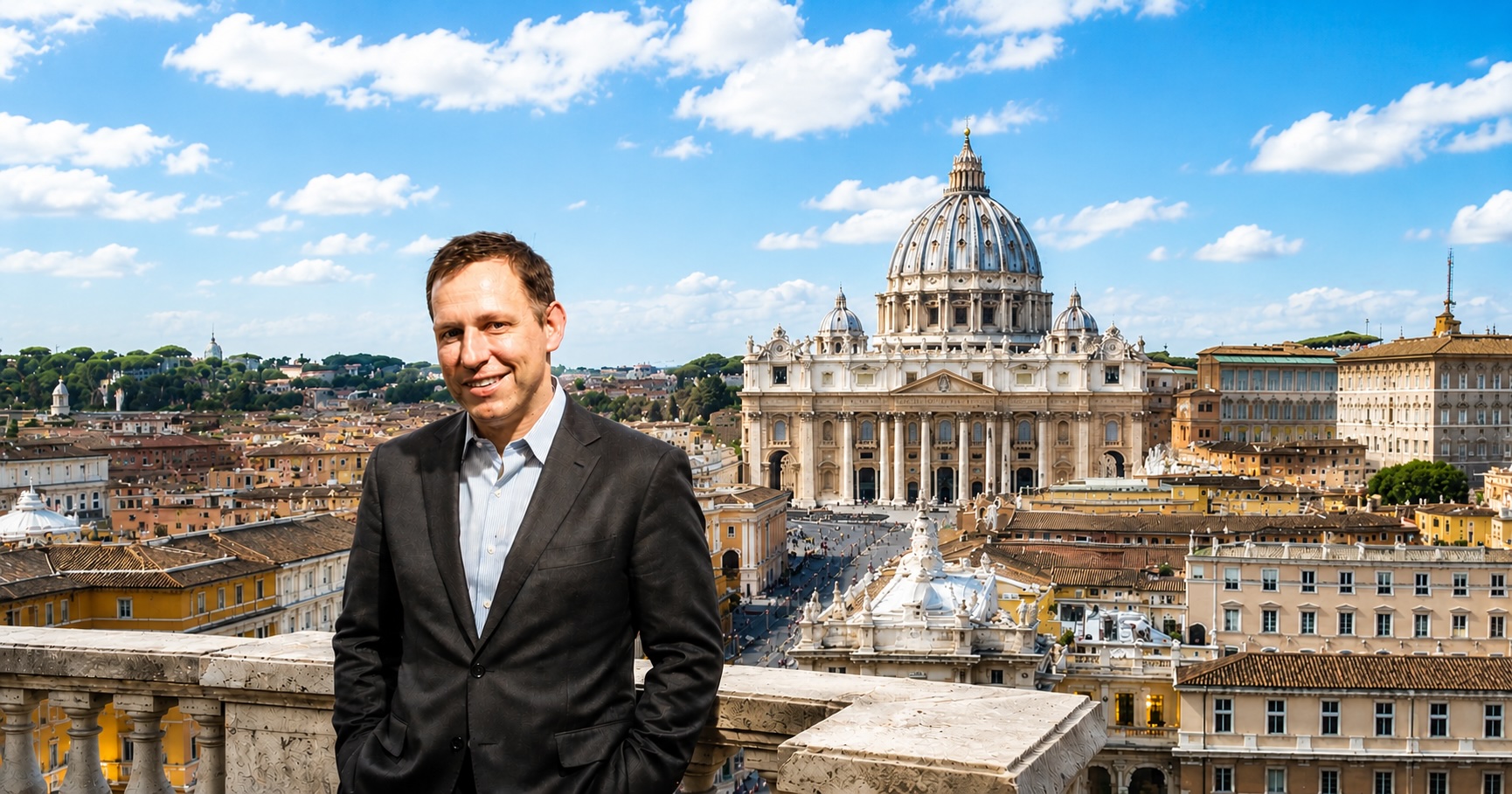
Rome has seen conquerors, saints, reformers, and ideologues. Over two millennia, it has also learned to recognize when power arrives dressed as wisdom. That is why Peter Thiel’s closed-door lecture series in Rome in April on the Antichrist matters. This is not simply an eccentric side project of a billionaire with strong metaphysical interests.
It is a revealing moment when technological power, political influence, and theological language begin to mingle in ways that should alert the Church.
Reuters reports that the lectures were invitation-only, closed to the press, and held at an undisclosed venue, even as Catholic commentators in Rome openly challenged the worldview behind them.


The symbolism is hard to miss. A billionaire associated with Palantir, a company deeply tied to defense, intelligence, and data systems, enters the Vatican’s orbit to lecture on the Antichrist, the apocalypse, and civilizational danger.
The Associated Press reports that Catholic institutions initially linked to the event quickly distanced themselves. The Pontifical University of St. Thomas Aquinas, or Angelicum, where earlier reports said the lecture was scheduled, distanced itself, stating that the event was not organized by the university and would not take place there.
The Catholic University of America also denied sponsoring or hosting it, even as it acknowledged links to an affiliated initiative involved in the gathering. That distancing says something. Rome sensed that this was not an ordinary academic seminar.
Theology without humility becomes ideology
Christians are not strangers to the language of the end times. The Church has long reflected on evil, deception, judgment, and false salvation. Yet in the Christian tradition, such themes are approached with sobriety. They are not tools for magnifying one’s own historical importance. They are certainly not toys for the powerful.
Reuters notes that Thiel has repeatedly warned that an Antichrist could emerge from the promise of a one-world government intended to prevent nuclear, AI, or climate catastrophes.
Bimonthly Wired, examining his earlier Antichrist lectures, shows how this fear is bound up with suspicion of global governance, technological restraint, and institutions “focused single-mindedly on saving us from progress.” In that imagination, the greatest danger is not destruction but regulation, coordination, and moral limits on power.
That is where the issue becomes serious. Theology, in such a frame, risks becoming a shield for ideology. The Antichrist is no longer a figure of spiritual deception but a convenient image for whatever resists the ambitions of technological elites.
Apocalyptic language is then recruited into a political project. It gives grandeur to grievance. It turns power into destiny. It makes self-interest look like prophecy.
Why the Church is right to be uneasy
The Catholic response has therefore been sharper than some expected. Reuters reports that Father Paolo Benanti, an adviser to Pope Leo on artificial intelligence, described Thiel as a “political theologian” and called his broader project a “prolonged act of heresy” against the liberal democratic order.
The Italian bishops’ newspaper L’Avvenire also warned that technology leaders must not be allowed to define their own ethical limits and argued that democratic oversight of digital power is necessary.
This criticism should not be dismissed as clerical irritation. It reflects an old and sound instinct: power must not become its own theologian. When those who control data, platforms, surveillance tools, and defense technologies begin to interpret history in messianic or apocalyptic terms, caution is not hysteria. It is responsibility.
AP’s reporting makes the concern even more concrete. Palantir’s work with U.S. immigration enforcement, together with Thiel’s closeness to major political actors, means it is not merely a man privately musing about the Book of Revelation.
It is a public figure, linked to real systems of state power, speaking in the language of existential struggle, civilizational crisis, and final enemies. The Church has seen this pattern before. History is littered with rulers and movements that borrowed sacred language in order to clothe ambition with transcendence.
Silicon Valley’s spiritual temptation
What we may be witnessing is not merely Peter Thiel’s personal obsession but a broader temptation among technological elites. For years, Silicon Valley spoke the language of progress, disruption, efficiency, and innovation.
Now, increasingly, some of its most influential figures speak the language of apocalypse, collapse, civilizational survival, and final conflict. The tone has shifted, but the temptation remains the same: to imagine oneself among the few who truly understand history and are therefore entitled to shape it.
That is why this Rome episode deserves attention far beyond the Vatican. It reveals what happens when immense wealth begins to seek not only influence, but metaphysical significance. It is one thing for wealthy people to read theology. There is nothing wrong with that. It is another thing entirely for wealth, technology, and political ideology to start speaking as though they are custodians of the final drama of history.
Christianity should firmly resist that temptation. The Gospel does not glorify exceptional people who believe they can save civilization through superior insight. Instead, it speaks of humility, repentance, truthfulness, limits, and care for the vulnerable. It is suspicious of those who gather power while speaking of destiny. It knows that fear can become idolatry and that grand visions of order often end by reducing the human person.
A faith older than venture capital
Rome, then, is the right setting for this dispute. Not because the Church must answer every provocation, but because Rome remembers what the modern world often forgets: power passes. Theological language outlasts empires, parties, and fortunes. The Church should not be overawed by billionaires who borrow apocalyptic imagery. It should ask a simpler question. Does this language serve truth, humility, and the common good, or merely sanctify power?
That is the real issue at Rome’s door. Not whether a billionaire may speculate about the Antichrist, but whether theology will remain a path to wisdom or become yet another instrument in the architecture of control. The Church has every reason to answer clearly. It has, after all, been here before.