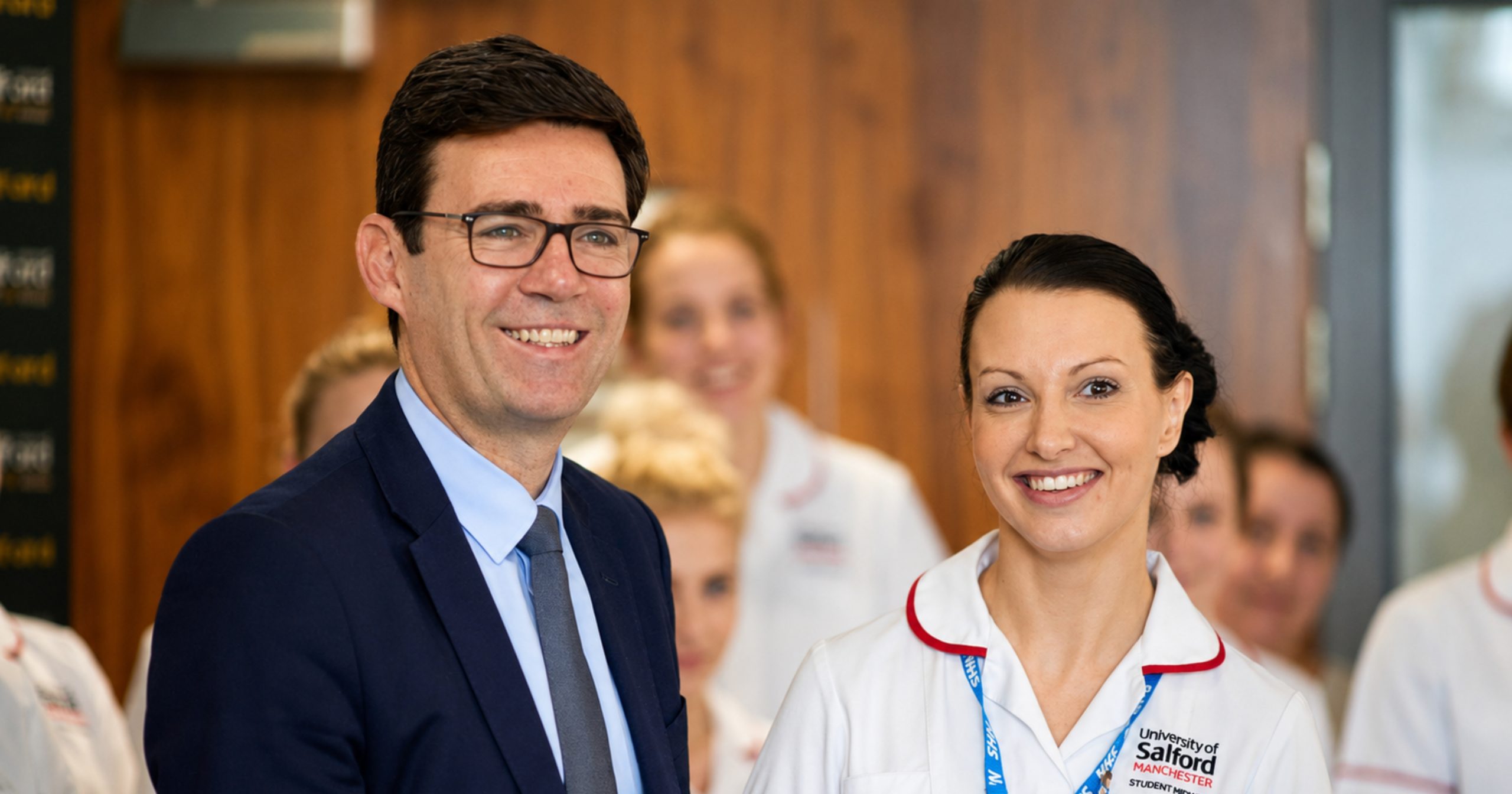
Andy Burnham, widely seen as the Labour Party’s most likely successor to Prime Minister Keir Starmer, could become Britain’s first widely recognized practicing Catholic prime minister.
But according to Fr. Andreas Blum, pastor of the German-speaking parish of St. Boniface in London, the more important story is not Burnham’s religion itself, but how his Catholic upbringing, rooted in Liverpool’s Irish Catholic community and its tradition of social justice, has shaped his political outlook and public service.
Why is Burnham projected as Britain’s first “real” Catholic prime minister?


There have been prime ministers who were Catholic in a normal sense. The best-known example is certainly Tony Blair.
Everyone knew that, largely because of his wife Cherie Blair, who is a committed Catholic. Catholicism strongly influenced him. He regularly attended Catholic Mass with his family throughout his time in office.
However, he did not formally become a Catholic until immediately after leaving office.
For that reason, people regarded him as essentially Catholic, but he officially entered the Catholic Church only after stepping down as prime minister.
The situation was quite different with Boris Johnson. Although his mother had him baptized as a Catholic, he was later confirmed as an adherent of the Church of England.
For a long time, it was unclear what his religious identity actually was. I’m not even sure whether he knew that himself.
His third marriage took place in Westminster Cathedral according to the Catholic rite, which caused considerable public discussion at the time. Yet, no one would describe Boris Johnson as a Catholic prime minister.
Andy Burnham is genuinely different in that respect.
Is it true that Burnham grew up in a Catholic family and was raised in that tradition because of his Irish mother?
His family was not entirely Catholic. His father, Roy Burnham, was Protestant and not particularly religious.
His mother, Eileen, on the other hand, came from an Irish Catholic family, whose ancestors most likely arrived in England during the large waves of Irish immigration in the 19th and 20th centuries.
In fact, Irish immigration largely revitalized the Catholic Church in England. Irish, English, and Catholic became closely connected. It is therefore no surprise that Andy Burnham grew up within that Catholic environment.
Does the fact that Burnham was an altar server during his childhood days bring up the memorable quote by his mother?
Actually, another remark came first. In a newspaper interview, Burnham described himself as Catholic but added—with a well-known Liverpool expression—that he “didn’t lick the altar steps.”
In Liverpool, the expression “licking the altar steps” describes someone who is overly showy, zealous, or performative in their Catholic faith.
To say “we don’t lick the altar steps” means a person was raised with a strong but “unshowy” or practical connection to their religion
The phrase attracted quite a bit of attention and made many people laugh. His mother then gently corrected him. She said that wasn’t entirely true. Andy and all his brothers had served as altar boys.
Every Sunday, she recalled, they would argue because Andy always wanted the job of holding the Communion paten beneath people’s chins during Holy Communion.
It offered the public a charming glimpse into the Burnham family—showing Andy’s own humorous recollection and his mother’s equally humorous correction.
Has Burnham spoken publicly about his Catholic faith in other ways?
He is generally quite reserved and doesn’t make his faith a central part of his public image. He usually speaks instead about his Catholic upbringing and Catholic identity.
At one point he said that the Church made him the person he is today. What he seems to mean above all is its influence on his concern for social justice.
He describes growing up within a remarkably cohesive community: his school, teachers, parish, priests, sports clubs, and the Labour Party all belonged to the same world.
❝Catholicism is part of his personal background and identity. People acknowledge it, but it is not likely to determine elections.
Burnham once said that, apart from his family, the three most important things in his life were his football club, the Labour Party, and his Catholic Church.
All three, he said, shared something important: they stood with the underdog—the disadvantaged and those needing support through the wider community.
He has even described his political commitment as “the Catechism made flesh.”
The values he learned from the Catechism at school, he says, were put into practical action through the Labour Party.
Of course, that tightly connected Catholic working-class culture of the 1980s no longer exists in quite the same way.
What kind of Catholicism shaped Burnham?
It is above all a “social Catholicism” in which Catholic social teaching plays a central role.
There was once a Liverpool archbishop who was an enormously influential public figure in northern England.
He said that while Christians should certainly pray for their neighbors, they cannot ignore the conditions in which those neighbors live. Those living conditions are always political.
Therefore, he argued, even an archbishop must be political to some degree. That same outlook clearly influences Burnham. You can draw a direct line between the two.
Which popes does Burnham seem to identify with most?
We don’t have to speculate because Burnham has spoken about this himself. He has said that he struggled to connect with the theology of Pope Benedict XVI, describing a certain sense of distance.
With Pope Francis, however—especially his socially engaged and compassionate style of Catholicism—Burnham felt he had rediscovered that connection.
He even met Pope Francis once and presented him with a Manchester United jersey, signed by an Argentine player.
Does Burnham’s faith play any role in public debate?
People certainly notice it and occasionally discuss it. There are still traces of anti-Catholic prejudice in Britain. But overall, his religion is not treated as a major political issue.
Will his Catholic faith influence voters?
I don’t think so. Religion simply doesn’t carry that much political weight.
Burnham is not campaigning on a specifically Catholic platform. He is not proposing a Christian government program.
His Catholicism is part of his personal background and identity. People acknowledge it, but it is not likely to determine elections.
Will the Catholic Church support him?
On issues of social policy, certainly. His work on combating homelessness has even been praised by Pope Francis.
On matters like that, he will almost certainly have the support of the Catholic Church in Britain.
The more difficult questions will arise elsewhere. England is currently debating legislation that would significantly expand the legalization of assisted dying and euthanasia.
The Churches have spoken out very clearly against those proposals. If Burnham were to advance such legislation, tensions and disagreements would almost certainly emerge.
This is a translated and edited version of the interview that first appeared on DOMRADIO.DE and has been republished with permission by Global Catholic.