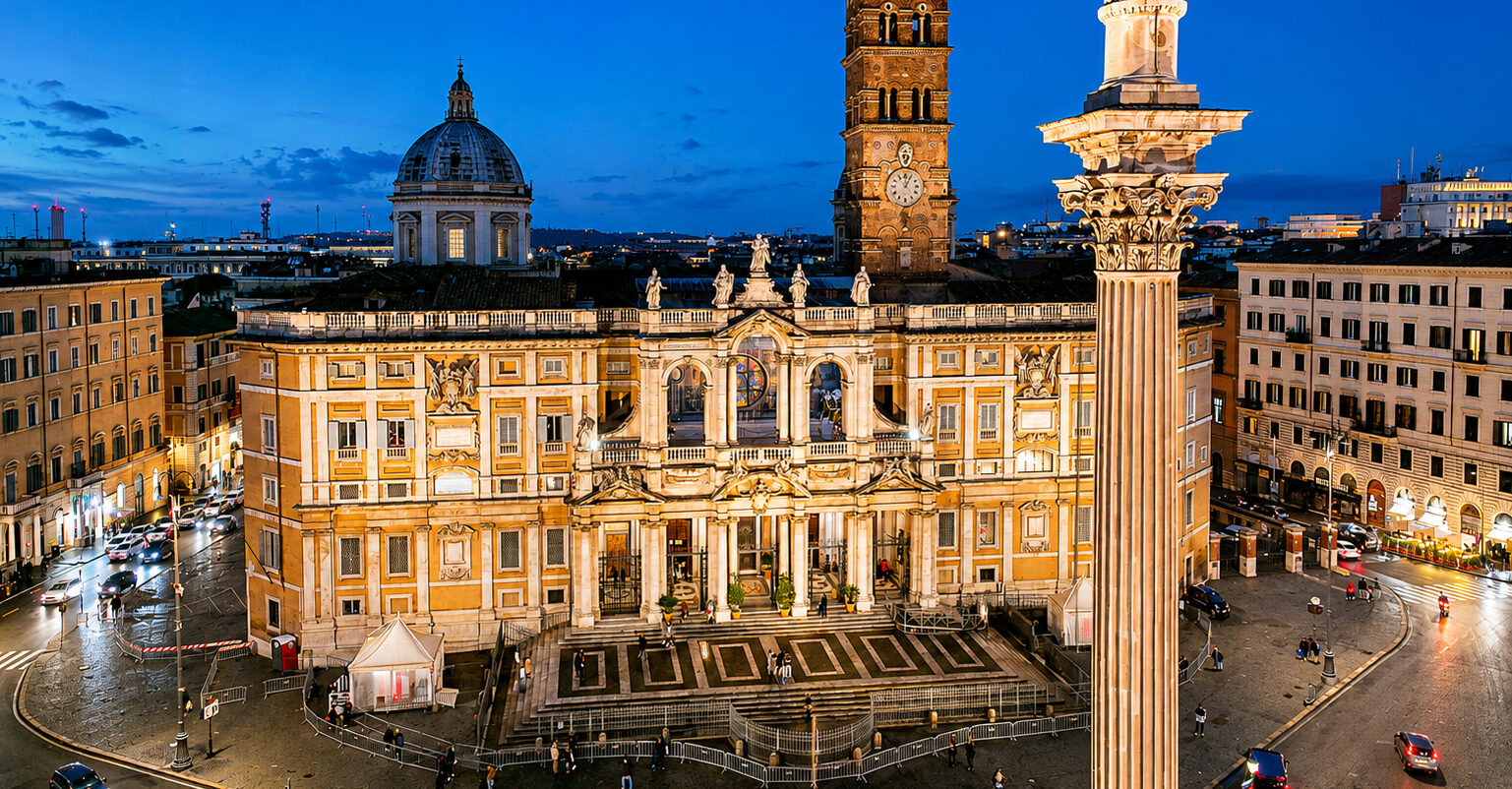
The Basilica of Santa Maria Maggiore or Saint Mary Major is one of the most magnificent and best-preserved ancient churches in Rome and an essential stop for anyone visiting the Eternal City. It is also the final resting place of several popes, including Pope Francis.
According to tradition, it was the Blessed Virgin Mary herself who commissioned the construction of Rome’s largest Marian church.
Legend says that during the night of Aug. 5, in either A.D. 352 or 358, Mary appeared in dreams to the Roman nobleman John and his wife, as well as to Pope Liberius. She instructed them to build a church in her honor at the place where snow would be found the following morning.


According to the legend, snow indeed covered the summit of the Esquiline Hill, confirming the Virgin Mary’s wish.
To this day, the “Miracle of the Snow” is reenacted every year on the basilica’s feast of dedication.
In the evening, white flower petals fall from the church’s loggia onto the square below. Inside the basilica, the same spectacle takes place during Vespers through an opening in the ceiling.
Rome’s largest Marian church was dedicated by Pope Sixtus III on Aug. 5, 434, 1,592 years ago.
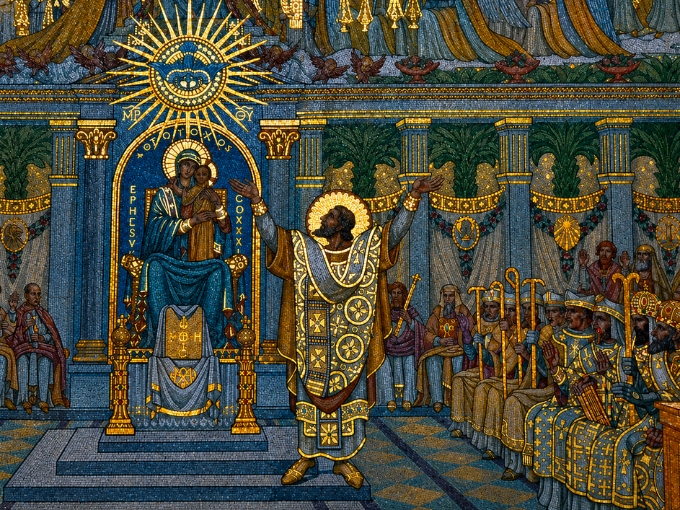
Built after the Council of Ephesus
Only a few years earlier, the Council of Ephesus had concluded by proclaiming Mary Theotokos—the “Mother of God”—a title that emerged from earlier debates over the divinity of Jesus Christ.
Another motivation for building Santa Maria Maggiore was the appearance of Rome itself. In the fifth century, the city was still dominated by pagan temples and monuments.
Constructing a grand church dedicated to the Virgin Mary on Rome’s highest inhabited hill was intended to make a powerful visual statement about the triumph of Christianity.
Unlike the Lateran Basilica and the basilicas of Saints Peter and Paul, which stood on the city’s outskirts or beyond its walls, Santa Maria Maggiore occupied a central position.
Church historian Stefan Heid, who lives in Rome, describes the basilica as a bridge between the Lateran, where the pope resided, and the inhabited city centered around the imperial palace.
“This hill was deliberately claimed with a magnificent building financed by the papal treasury to symbolize papal authority over the city after the emperors had moved to Constantinople,” Heid explains.
The most important papal processions through Rome and to St. Peter’s traditionally passed by Santa Maria Maggiore. Because the basilica houses the relic of Christ’s manger, the pope also traditionally celebrated his first Christmas Mass there.
The first gold from the New World
Santa Maria Maggiore remains one of the best-preserved ancient buildings in Rome.
During its construction, builders reused materials from earlier Roman structures. Recent restoration work uncovered roof tiles bearing stamps dating to the reign of Emperor Nero.
The fifth-century mosaics lining the nave rank among the finest surviving examples from the late Roman Empire.
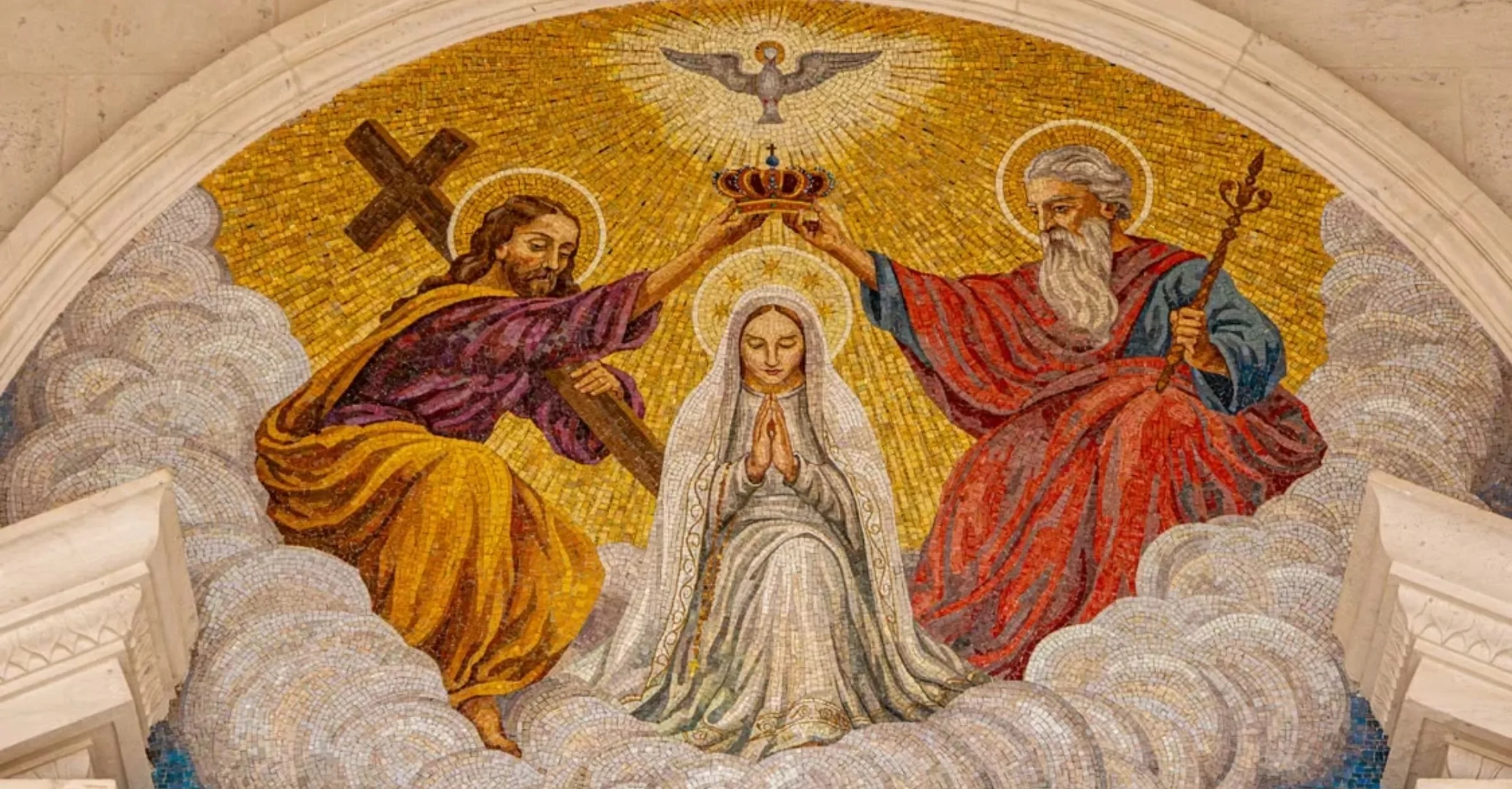
Additional mosaics—including the great apse mosaic depicting the Coronation of the Virgin Mary—date from the Middle Ages.
The magnificent coffered ceiling, completed in the late fifteenth century, is covered with gold presented to Pope Alexander VI, a member of the Spanish Borgia family, by King Ferdinand II of Aragon and Queen Isabella I of Castile.
According to tradition, it was the first gold brought to Europe after Christopher Columbus’s discovery of the Americas.
To this day, the King of Spain serves as an Honorary Canon of the basilica.
A bell for a lost pilgrim
The basilica’s exterior reflects numerous renovations and additions, particularly from the Baroque era.
In the eighteenth century, architect Ferdinando Fuga designed the dramatic main façade while preserving a view of the thirteenth-century façade behind it.
His work received widespread praise, although Pope Benedict XIV reportedly quipped: “Fuga must have thought we were theater impresarios. It looks more like a ballroom.”
Towering above the basilica is its 246-foot (75-meter) campanile, one of the tallest bell towers in Rome.
Built in the late fourteenth century to replace an aging twelfth-century predecessor, the tower was made possible through financial support from Pope Gregory XI, who had previously served as the basilica’s archpriest.
Five bells hang within the tower. The largest, weighing 3.5 tons, was cast in 1851 by Roman founder Giovanni Lucenti. Known as “La Sperduta,” or “the lost one,” the bell recalls a popular legend.
A pilgrim who had lost her way outside the Porta San Giovanni prayed to the Virgin Mary for help. She then heard the sound of a church bell and followed it until she reached Santa Maria Maggiore, where a liturgical service was taking place.
In gratitude, she is said to have endowed the nightly ringing of the great bell, which still sounds every evening at 9:00 p.m.
A center of liturgy and sacred music
Santa Maria Maggiore remains one of Rome’s foremost centers of liturgy and sacred music. On Sundays and feast days, the principal Mass is celebrated in Latin at the baldachin altar.
From 1947 to 1977, the basilica’s musical chapel was directed by Domenico Bartolucci, who was succeeded by Spanish composer Valentino Miserachs Grau, who served until 2019. Both men were accomplished composers.
Grau composed the hymn Al tuo tempio secolare in honor of the basilica and its revered icon, Salus Populi Romani, a hymn Romans sing with particular devotion on special occasions.
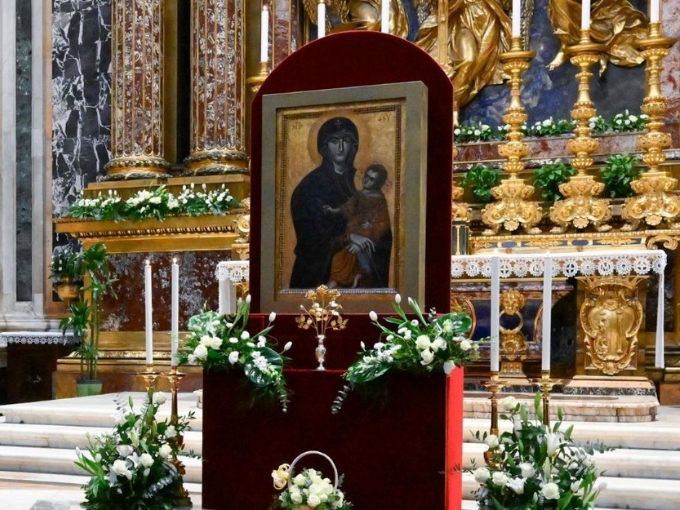
Pope Francis and Salus Populi Romani
The icon of Salus Populi Romani (Protectress of the Roman peoples) gained renewed international prominence through Pope Francis, who paused there in prayer and placed flowers before it both before and after every apostolic journey.
According to tradition, the image was painted by St. Luke the Evangelist himself. In reality, however, it dates to the eighth century.
In his will, Pope Francis requested burial in Santa Maria Maggiore. However, he was not the first pope to be buried there. Six popes had already been laid to rest in the basilica, including Pope Pius V, who implemented key reforms following the Council of Trent.
The renowned Baroque architect Gian Lorenzo Bernini and his father are also buried there.
Following the Requiem Mass in St. Peter’s Square on Holy Saturday last year, Pope Francis’ body was transferred to Santa Maria Maggiore and buried near the Salus Populi Romani icon.
“My tomb should be in the ground, simple, without particular ornamentation, bearing only the inscription: Franciscus,” his 2022 testament states.
An international chapter
Today, Santa Maria Maggiore enjoys extraterritorial status under the Holy See. Its current archpriest is Cardinal Rolandas Makrickas of Lithuania, who also presided over Pope Francis’ burial.
Makrickas had already been serving as the basilica’s Extraordinary Commissioner since December 2021, reorganizing its chapter of clergy after a period of internal difficulties.
One of his predecessors, Cardinal Bernard Francis Law, served as archpriest after resigning in 2002 as Archbishop of Boston amid allegations that he had failed to adequately address cases of clergy sexual abuse. He relocated to Rome before appearing in response to a summons from prosecutors.
The basilica’s sacristy is staffed by members of the Franciscans of the Immaculate, an order that has attracted attention in recent years because of its attachment to the traditional liturgy and subsequent apostolic visitations ordered by Pope Francis.
The basilica’s chapter consists of twelve canons from various countries.
At present, the only German canon is Monsignor Michael Kahle of the Archdiocese of Cologne.
This is a translated and edited version of the interview that first appeared on DOMRADIO.DE and has been republished with permission by Global Catholic.