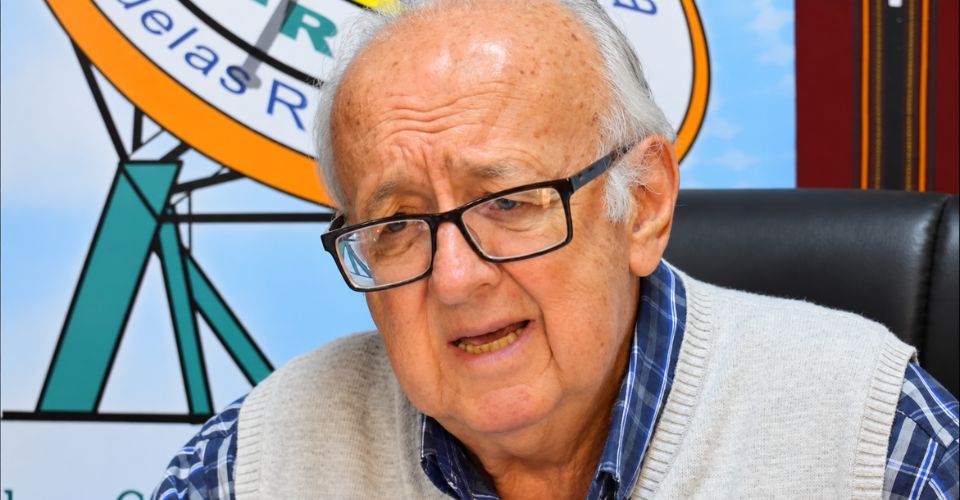
On Sept. 20, 2026, five years will have passed since the death — his “Pascua,” (passing over) as the liberationist tradition calls it, framing a person’s death as a passage into new life, regardless of the liturgical calendar — of Pablo Richard, the Chilean biblical scholar and theologian whose work bound the study of Scripture to Latin America’s struggle for liberation.[1]
Remembering Pablo means feeling his absence, and recognizing how much of his companionship still shapes the way I do theology. I write this from that gratitude, from the pain of not having him near, and from the responsibility of carrying his legacy forward.
His commitment carried real biographical costs. Pablo Richard was born in Chile in 1939 and was ordained a Catholic priest.


He trained rigorously across philosophy and biblical studies: philosophy in Vienna from 1961 to 1963, a theology degree from the Pontifical Catholic University of Chile in 1966, a degree in Sacred Scripture from Rome’s Pontifical Biblical Institute in 1969, and further study at the École Biblique in Jerusalem in 1969–70.
In the early 1970s, he helped found and lead Christians for Socialism, a movement of Latin American Christians engaging with socialist politics.
After the 1973 coup in Chile, knowing that he was being persecuted and threatened with death, he had to live in exile — in France from 1973 to 1978, where he earned a doctorate in the sociology of religion from the Sorbonne.
He left the Catholic priesthood before going into exile in 1973 and later married Gabriela; the couple had children together. She survived him at his death in 2021.
In 1978 he settled in Costa Rica, where he carried out extensive work at and later directed the Ecumenical Research Department (DEI), and taught at the National University and the Latin American Biblical University, among many other organizations dedicated to biblical formation, where his theological reflection was connected to the formation of pastoral workers and to accompanying ecclesial and social processes.
Community-based reading of the Bible was an option he sustained over time, rooted in the conviction that the suffering of peoples challenges the responsibility of the theologian.[2]
Biblical scholarship rooted in community
One of his fundamental contributions was to systematize the biblical hermeneutics of liberation from the practice of basic ecclesial communities. In his article in the first issue of the ecumenical journal Revista de InterpretaciónBíblica Latinoamericana(RIBLA), published in 1988, he explained that this reading sought to recover the historical and spiritual meaning of Scripture from the experience of God in the world of the poor.
That inaugural issue also carried contributions from fellow biblical scholars Milton Schwantes, Jorge Pixley and Elsa Tamez, among others who helped shape RIBLA’s early direction alongside him.
They became subjects of interpretation: people capable of questioning the text, discerning its message and communicating it from their own faith experience. The community thus became a place where theological understanding was produced.[3]
Pablo contributed to giving a very high level of academic consistency to biblical work, but also continuity to that perspective as a collective endeavor.
In evaluating the path of RIBLA and other places where he worked as an author, professor and spiritual companion, he identified among its achievements the articulation of biblical scholarship and the people of God through pastorally oriented exegesis and solid formation of community leaders.
That exchange makes it possible to understand why his work made history and continues to do so for his new readers, helping to strengthen a hermeneutical current and broaden recognition of those who could participate in it.
The biblical scholar found interlocutors capable of enriching his questions, while the community received resources to deepen its reading.[4] That relationship between academic rigor and service to communities left a profound mark on my own formation and on the theology I develop.
Reading Scripture as a source of hope
His commentary Revelation: Reconstruction of Hope (1994) expresses this vocation with particular force.
Richard interprets the book from situations of persecution, exclusion and imperial domination, emphasizing its capacity to sustain resistance and open horizons of life.
The presence of the Risen One occupies the center of this systematic reading: Christ’s victory makes it possible to confront the present, unmask idolatrous powers and cultivate hope for a transformed world. Eschatology thus acquires a spiritual and historical force that commits the community to life.[5]
This perspective offers a resurrecting reading because it helps people rise, recover their dignity and recognize possibilities where oppression seems to close them off.
The New Jerusalem descends toward humanity, God dwells with and from within his people and wipes away their tears (Rev. 21:1-5). Read from the perspective of that promise, the apocalyptic horizon nourishes a spirituality capable of accompanying suffering and sustaining commitment.
For those who study and teach the Bible, a fruitful demand remains: that interpretation allow us to hear the hope contained in the text and discern its consequences for existence.
In The Jesus Movement Before the Church (1998), Richard proposed reading the Acts of the Apostles as the memory of the movement born from the resurrection, paying attention to the central role of the Spirit, the mission and small household communities.
The expression “before the Church” refers, in his approach, to the period before a later institutionalization. His pastoral interest lies in recovering the creativity of the origins as an inspiration for ecclesial renewal: communities that listen, share, cross borders and discover paths under the action of the Spirit.[6]
The recovery of the historical Jesus belongs to this same project. In Memory of the “Historical Jesus Movement” (2009), Richard gives importance to Jesus’ full humanity and to the presence of the poor as subjects of his movement.
His study of the origins seeks to offer criteria for reforming the Church. Returning to Jesus, to his proclamation of the Kingdom and to the lives he gathered around himself means keeping open the question of Christianity’s historical fidelity to its source.[7]
A legacy carried through others
His influence can also be recognized in specific testimonies. Leopoldo Cervantes-Ortiz recalls that his classes and encounters with Richard guided research and projects in biblical interpretation; he highlights his ability to unite critical exegesis with attention to the Latin American reality.
There we see the teacher whose teaching continues to bear fruit through the work of others. His legacy for new biblical scholars includes that intellectual generosity, sharing methods, raising questions and accompanying the formation of an individual voice in the service of communities.[8]
Friendship beyond denominational boundaries
Harold Segura, a Baptist pastor and theologian, offers another dimension of that testimony: friendship, conversation and shared learning crossed denominational differences.
He recalls Richard’s willingness to explain his research and the enthusiasm with which he responded to his questions. This closeness makes it possible to understand the lived character of his ecumenism. The shared Word created bonds of fraternity and made encounters among Christians a space for mutual formation.[9]
The man behind the theology
The memory of Pablo also includes his family life with Gabriela, his wife and companion on the journey. Tamayo remembers them together and mentions their children when recalling the continuity of his memory.
Richard, for his part, acknowledged in the acknowledgments of his commentary on Revelation that the book would have been impossible without the patience and affection of his family.
This acknowledgment allows us to approach the man behind the work, an intellectual journey also sustained by affection, companionship and a shared life.[10]
Carrying his legacy forward
Commemorating his passing over means receiving that inheritance: continuing to study and do theology with rigor, to listen to communities, and to treat knowledge as a form of service.
For me, that responsibility has a face and a name. From my earliest steps in exegesis, I found in Pablo strength, companionship and inspiration — in how he connected rigorous method with the life of communities and their search for a Word capable of illuminating reality.
His closeness was fundamental to my first articles; his rigor was always joined to the closeness of someone who walks beside another person and commits to their growth.
Pablo was teacher, friend and companion on the journey, and his importance in my life remains inseparable from both the affection with which I remember him and the pain of no longer having him near.
An enduring personal bond
Alongside Gabriela, I feel his absence deeply — I miss our conversations, his questions, the companionship that was fundamental while I found my own way of thinking and writing theology.
My dear Pablo: from the hope of the resurrection, I imagine you carrying our questions before the One with whom we so often spoke of meeting, trusting we would find our answers in Him. .
Here I remain, with those questions and many new ones, with what I learned at your side, and with the pain of no longer being able to talk them through with you.
Today I put down my pen, enriched by your blessing, to tell you how much you are missed. The theology I develop bears your mark. For me, you will always be indispensable.
Footnotes
[1] Leopoldo Cervantes-Ortiz, “Bible, Theology and Social Change: Pablo Richard in Person and in His Work,” Protestante Digital, Sept. 24, 2021. https://protestantedigital.com/ginebra-viva/63487/biblia-teologia-y-cambio-social-pablo-richard-en-persona-y-en-obra
[2] Juan José Tamayo, “Pablo Richard, Liberation Theologian Against the Idolatry of the Market,” Religión Digital, Sept. 22, 2021. https://www.religiondigital.org/el_blog_de_juan_jose_tamayo/Pablo-Richard-teologo-liberacion-idolatria_7_2380331945.html
[3] Pablo Richard, “Popular Reading of the Bible in Latin America: Hermeneutics of Liberation,” Revista de InterpretaciónBíblica Latinoamericana RIBLA, No. 1 (1988): 28-31. https://www.centrobiblicoquito.org/images/ribla/1.pdf
[4] Pablo Richard, “RIBLA: 19 Years of Work and 50 Published Issues. A Summary of Our Most Significant Achievements,” Revista de InterpretaciónBíblica Latinoamericana RIBLA, No. 50 (2005): 7-9. https://www.centrobiblicoquito.org/images/ribla/50.pdf
[5] Pablo Richard, Revelation: Reconstruction of Hope. Ecumenical Research Department (DEI), 1994, 17-18.
[6] Pablo Richard, The Jesus Movement Before the Church: A Liberating Interpretation of the Acts of the Apostles. Ecumenical Research Department (DEI), 1998, 15-17.
[7] Pablo Richard, Memory of the “Historical Jesus Movement”: From Its Origins (the 30s) to the Crisis of the Holy Roman Christian Empire (Fourth and Fifth Centuries). Ecumenical Research Department (DEI), 2009, 30-35, 42-43. https://deicr.org/wp-content/uploads/2025/03/PabloRichard-MemoriadelmovimientodeJesus-completo.pdf
[8] Cervantes-Ortiz, Leopoldo. “Bible, Theology and Social Change: Pablo Richard in Person and in His Work.” Protestante Digital, Sept. 24, 2021.
[9] Harold Segura, “Pablo Richard, a Biblical Scholar for Relief in a Latin America of Oppressive Suffocation,” Lupa Protestante, Jan. 20, 2022; testimony dated Sept. 24, 2021. https://www.lupaprotestante.com/pablo-richard-un-biblista-para-el-desahogo-en-una-america-latina-de-ahogos-opresores-harold-segura/
[10] Tamayo, “Pablo Richard, Liberation Theologian”; Richard, Revelation, 13.
This is a translated and edited version of the feature that first appeared on Religion Digital and has been republished with permission by Global Catholic.