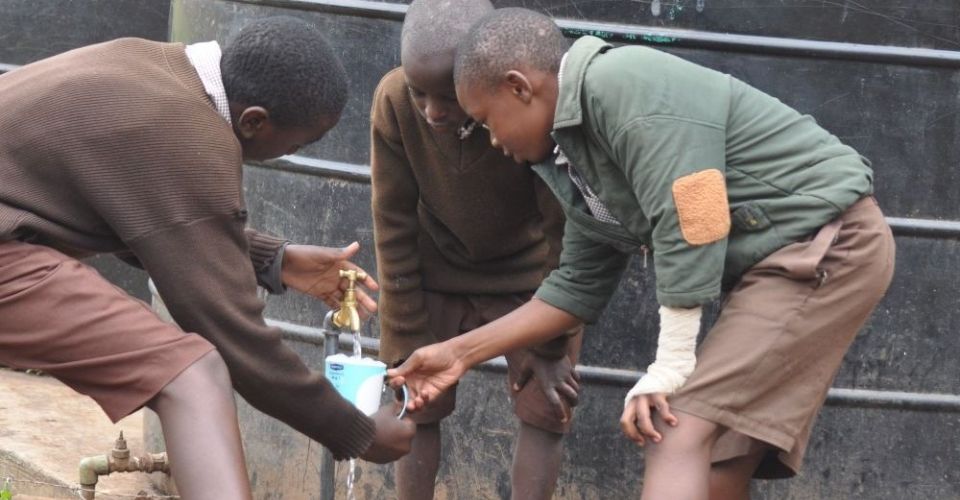
Every morning, a large pot of hot water sits over a fire in the kitchen at Amani School in Riruta, Nairobi. It is not for cooking. It is for children who arrive at school not having bathed because they lack water at home. Before going in for classes, the students collect warm water, bathing soap, and body jelly from the school’s social workers and clean up.
If they need to wash their clothes, they can come in before classes begin, or stay after school. The school provides water, basins, detergent, a change of school uniform, and a place to hang their clothes to dry.
“Our children come from very difficult environments, and sometimes there is no water at home,” said Sr. Teresa Vienda, a member of the Missionary Sisters of the Precious Blood and administrator of the Precious Blood Children’s Family Rehabilitation Centre.


The Precious Blood Children’s Family Rehabilitation Centre and Amani Primary School work with children from around Nairobi, rescuing them from the streets, rehabilitating them, and reintegrating them back to school and into the community.
The majority of the children come from informal settlements where access to clean water, sanitation and hygiene is a daily challenge, and the school becomes their source of these essential provisions.
“We have visited many of their homes,” Vienda said. “The parents are struggling to even buy water. Some families cannot afford the five or 10 shillings needed to buy water, so it’s really a big challenge for our children.”
Vienda, a trained social worker, heads the social department that rescues and rehabilitates the children before they join the Amani School; Sr. Mary Joyce serves as the school principal, and Sr. Irene Ngina manages the store and supplies the children’s daily needs. Together they care for 325 children.
The institution provides virtually everything needed for a child’s education: meals (breakfast, lunch and supper), school uniforms, books, hygiene supplies and clean drinking water.
“Every child has access to clean drinking water. They simply pick a cup from the kitchen and drink from two water tanks we have reserved for drinking water,” Vienda said.
The school ensures the children also take responsibility in keeping their environment clean. Every day, under the supervision of teachers and social workers, they clean different areas of the school including the kitchen, the toilets, the hall and the general compound. The school provides the equipment to ensure the work is done efficiently and safely.
As assistant administrator and storekeeper, Ngina ensures the store is always stocked with essential hygiene items including bathing soap, toothpaste, toothbrushes, detergents, body jelly and sanitary towels. She also keeps shoe polish and extra uniforms in case a child needs to change clothes. Each girl is given three packets of sanitary towels every month, and the office is always prepared for emergencies.
“We are always on standby. Some girls leave their sanitary towels at home. In case of an emergency, they can get some from the social workers. If they stain their clothes, I have spare uniforms which they can change into, bathe, wash what has been stained and go back to class,” Ngina said.
Alice Kerubo, 17, the head girl of the school, is one of the beneficiaries.
❝
“The principles of child protection have to drive the process. Safe water, sanitation and hygiene — this is a key right to every child.
“The sanitary towels help to keep girls in school and out of trouble. If a girl lacks sanitary towels, she can easily get into a relationship with an older man just so that he can buy pads for her. The sisters have prevented that,” Kerubo said.
Ngina acknowledges that sanitation also means providing enough toilets and bathrooms for the children. At the school, boys and girls use separate well-maintained toilets.
A national push for WASH
According to Ngina, the celebration of the Day of the African Child 2026, under the theme, “Ensuring Universal Access to Water, Sanitation and Hygiene for Every Child in Africa,” underscored a sanitation aspect the sisters have been trying to achieve on a daily basis.
“When visiting families, we educate them on hygiene matters, but they do not take it seriously. Hearing the message repeated over and over by different speakers during the celebration of the Day of the African Child seemed to have gotten the message home,” she said.
As Kenya moves toward implementing the Kenya National Water, Sanitation and Hygiene in Schools strategy 2024-2029, the Association of Sisterhoods of Kenya is working with its member congregations to ensure access to safe water, sanitation and hygiene for every child under their care.
According to Sr. Hedwig Muse, a member of the Little Sisters of Mary Immaculate of Gulu and the program manager of Catholic Care for Children in Kenya, access to safe water, sanitation and hygiene for every child is at the core of the mandate of the Association of Sisterhoods of Kenya, and speaks to child rights and safeguarding, sanctified in the Kenyan constitution.
“As we are taking care of the children in the congregation, in the convent, or in the children’s homes, or even when they are in their families or in foster care or adopted, we are saying that we have to act in their best interest,” she said.
“The principles of child protection have to drive the process. Safe water, sanitation and hygiene — this is a key right to every child. If you want the child to grow sustainably and be somebody in the future, you also safeguard them, ensure that they have good health, they have food, they have water, they are growing up in a safe environment,” she added.
Vienda believes the achievement of universal access to water, sanitation and hygiene for every child needs collective action from the community.
“While the government has to play its role in ensuring children have proper sanitation, especially in schools with high populations of learners, the parents and the community can fill the gap through fundraisers and actual building of these facilities,” she said.
She said investing in the health of children today is investing in Africa’s future.
“We say children are the leaders of tomorrow. Providing them with access to clean water, sanitation and hygiene means we are going to have good leaders in the future. A dirty environment exposes the children to diseases including diarrhea and typhoid. We might lose very important people in the future,” she said.
This column first appeared on Global Sisters Report and has been republished with permission by Global Catholic.