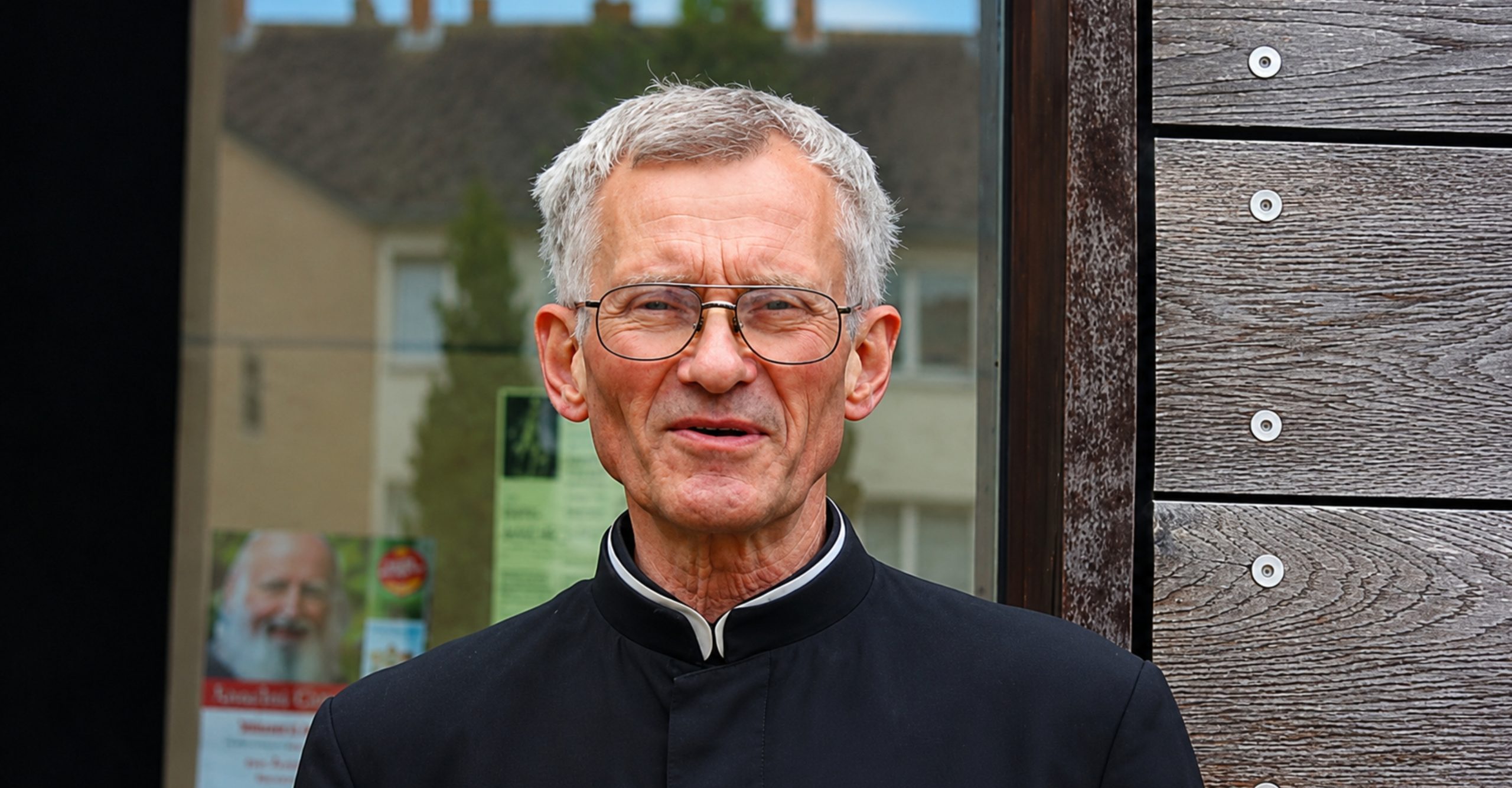
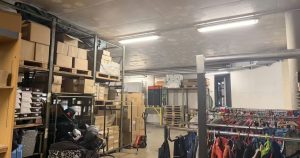
The 1,000-square-meter basement of Germany’s St. Theodor Church, located in the state of North Rhine-Westphalia, is a symbol of the Catholic Church’s practical response to poverty in the neighborhood.
Father Franz Meurer has transformed the place into a support center that functions as a clothing bank, food distribution center, bicycle workshop, and numerous other charitable services.
For Meurer, walking along the corridors of the basement, which stores boxes of children’s clothing, shelves packed with books, and rows of donated bicycles, is part of his daily routine.


“How are you?” says Meurer as he greets volunteers working in the clothing bank and food distribution center.”Have your children already picked up an ice cream?” he adds.
Young children dart past him, moving freely along the corridors as Meurer continues to address people with a deep sense of warmth and familiarity, an unmistakable trait that people around him identify.
His years-long work that spread across a lifetime dedicated to social solidarity has resulted in state-level recognition. Meurer will receive the Mevlüde Genç Medal by the end of this year when he turns 75, after which he will retire.
An award rooted in solidarity
The Mevlüde Genç Medal is an annual award presented by the German state of North Rhine-Westphalia. Established in 2018, it recognizes individuals or groups who make outstanding contributions to tolerance, intercultural reconciliation, and the fight against racism
The medal is named after Mevlüde Genç(1943–2022), who became a global symbol of forgiveness and humanity in Germany.
Genç was a Turkish-German peace activist who, after losing her two daughters, two granddaughters, and a niece in the devastating 1993 far-right racist arson attack in Solingen, Germany, chose to call for calm, reason, and peace.
“Of course it feels wonderful,” Meurer says of the award. “But it’s really an award for our Hövi Project—for everything we accomplish together.”
Preparations are currently underway for Höviland, the parish’s summer holiday program, one of Meurer’s favorite initiatives.
For Meurer, Höviland reflects what the Church should be: ecumenical. Working alongside the neighboring Protestant congregation has become second nature, he says.
“Ecumenism is twice as good—but only half as expensive,” Meurer jokes.
“The poor are God’s friends”
“I stand for a Church that understands this: the poor are God’s friends,” says Meurer when asked about the guiding principle of his ministry.
This conviction has shaped the parish’s life in several practical ways. At parish feasts and other events, everything is free. There are no food stalls or drink sales.
“Otherwise, we’d immediately exclude the poor. That’s why everything here has to be free,” Meurer emphasizes.
The parish relies on generous donations, but Meurer insists that money alone is never the answer.
“Money can’t accomplish anything by itself,” he adds. What truly matters, Meurer says, is the commitment of the volunteers.
Seeing opportunity instead of crisis
Even as retirement approaches, Meurer remains deeply engaged in parish life.
Five pastoral regions and sixteen churches are currently being merged—a development many Catholics see as evidence of decline.
Meurer sees something different.
“Seventeen people have already volunteered to prepare families for baptism. We’ve trained forty-one leaders for Liturgies of the Word. [This] problem is actually our opportunity,” he emphasizes.
Living together despite different faiths
Höhenberg and Vingst are among Cologne’s most culturally diverse neighborhoods. They are home to large numbers of people with migrant backgrounds.
Meurer says that cooperation among Christians, Muslims, and people with no religious affiliation works remarkably well in his area.
He recalls how the people responded after the recent death of a 43-year-old special education school director.
“People from every religion came together. Even those who say, ‘I don’t believe in anything.’ That’s when you see what truly holds people together,” Meurer emphasizes
That same spirit is visible in the parish clothing bank, where volunteer Renate Wesierski carefully organizes donated items—from children’s swimsuits and eyeglasses to bed linens—so that everyone receives what they genuinely need.
Without their dedication, none of it would exist, says Meurer as he points to a group of volunteers sorting boxes of food for distribution.

Looking ahead to retirement
When asked what he will miss most after his retirement this year, Meurer laughs and says that he would miss the daily calls from people who want to “donate clothes.”
“Well, only half joking—that really does happen around the clock,” he adds with a smile.
Looking back over more than three decades in Höhenberg and Vingst, one lesson stands above all others for Meurer.
“You have to start with the people. Good intentions or clever ideas aren’t enough. You have to do what Jesus did: first grow up among the people. Then you learn what brings them joy and what burdens them,” he emphasizes.
For Meurer, democracy itself depends on building solidarity at a local level.
A lifetime of service
Born in Cologne in 1951, Meurer was ordained a priest in 1978.
After serving as assistant pastor in several parishes and later as diocesan youth chaplain, he became parish priest of St. Theodor and St. Elisabeth churches in Höhenberg and Vingst in 1992.
Over the years, he has received numerous honors, including the Cardinal Frings Medal, the Human Award of the Kluge Foundation, the German Fundraising Prize, the Georg Leber Prize for Civil Courage, and the Rhineland Ring of Honor.
Now the latest Mevlüde Genç Medal joins that long distinguished list.
Yet anyone walking through the bustling parish basement quickly realizes that medals are not what motivates him.
Meurer says his life’s philosophy is simple: “People do not exist for the Church; the Church exists for the people.”
This is a translated and edited version of the feature that first appeared on DOMRADIO.DE and has been republished with permission by Global Catholic.