“They were beautiful images, weren’t they?”Antonio Rüdiger, the German football team’s center-back player, said during the post-match press conference following Germany’s group-stage match against Curaçao.
Germany won its opening World Cup group match 7–1. But it was not only the score that dominated social media.
When Deniz Undav scored, Rüdiger ran over to celebrate with him. Together, they performed a traditional Kurdish dance that carries deep significance within the Yazidi religious community, to which Undav belongs.


Rüdiger is a Muslim. He has no personal connection to this cultural tradition, yet he joined in.
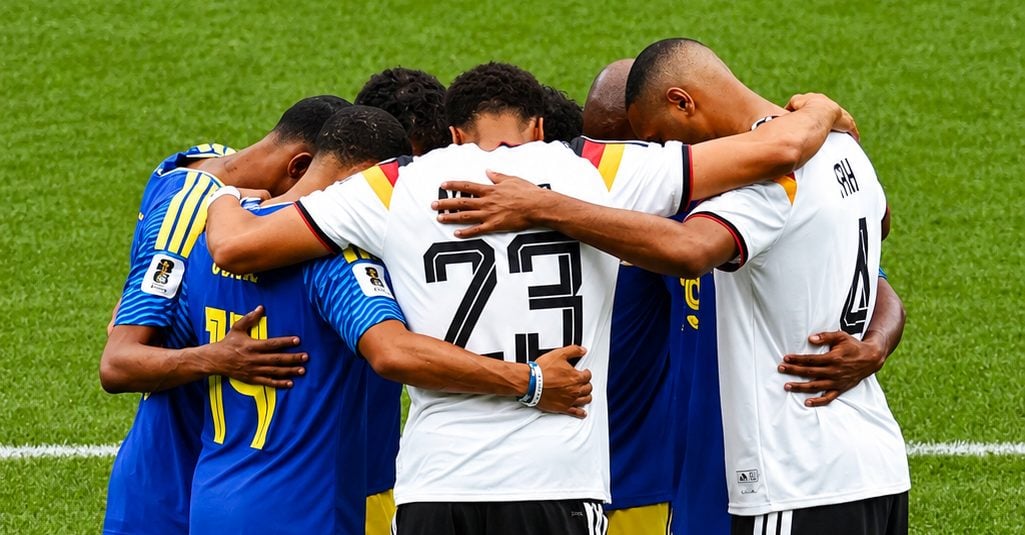
After the final whistle, Felix Nmecha and Jonathan Tah formed a circle with several Curaçao players and prayed together. Both belong to the initiative Ballers in God (BiG).[1]
The BiG is a Christian network that includes believers from both Protestant churches and Free Churches.[2]
Both moments conveyed the same message: a team that stands together regardless of roots, appearance, or faith.
For many of these players, faith and heritage cannot be separated. In the eyes of some people, both continue to mark them as outsiders.
Solidarity that needs no explanation
What made these moments remarkable was not that they happened, but how naturally they unfolded. No one had to organize them beforehand or deliver a speech afterward about tolerance.
“During the match, we’re opponents. After the match, we’re all brothers,” Nmecha said when journalists asked him about the prayer circle.
“It’s about love, about loving your neighbor, about peace and gratitude,” Tah added.
Bernd Neuendorf, president of the German Football Association (DFB), said he did not see anything objectionable in the prayer gathering: “The intention behind it is positive. It shows that football is about more than the game itself—that it also stands for humanity and respect.”
A ‘conditional’ German identity
On the pitch, that unity works. In everyday life, however, things often look different.
One social media user wrote after the match: “When you score goals, you’re German. When you lose, you’re a foreigner.”
Undav himself has spoken about similar experiences.
In an interview, he recalled his father repeatedly telling him: “If a German scores ten goals and you score sixteen, they’ll still choose the other player.”
Undav refused to let that discourage him. He continued playing football simply because he loved the game.
Yet those words stayed with him because many people in Germany know exactly what they mean.
I know that feeling from my own life. Even at school, I often had to prove myself, explain who I was, and speak up not only for myself but also for people with migrant backgrounds.
I experienced similar things on the football field. I remember away matches in rural areas where we were insulted.
One girl on our team who wore a headscarf found it especially difficult. I was born abroad to a Mexican parent and a German parent. When we moved to Germany, I felt like a stranger in a country that was also my own.
I know what it feels like to live between two worlds. That is why I understand what players like Undav and Rüdiger mean when they talk about this pressure.
Some people constantly try to cast you as an outsider, even when you truly belong.
Beyond an image of fraternity
A while back, Rüdiger had to defend himself against accusations of Islamist extremism after posting a photograph showing the tawhid gesture,[3] eventually forcing him to take legal action.[4]
Undav continues to face insults because of his background and his faith—online, from the stands, and sometimes from opposing players.
Neuendorf confirms that the German Football Association is seeing increasing numbers of racist incidents at both the professional and amateur levels:
“It is a major issue online, where people express racist and antisemitic views,” Neuendorf laments.
The men representing Germany on the pitch know this. Yet they still stand together in prayer, celebrate one another’s traditions, and speak openly about what they believe.
Germany is not strong despite its diversity. It is strong because people of many different backgrounds and faiths grow up together, live together, and take responsibility for this country.
Christians, Muslims, Yazidis, Jews, and atheists are united by one thing: Germany is their home.
For one moment, the national team embodied that reality and made Rüdigerask: “They were beautiful images, weren’t they?”
Now these gestures need to become more than just images.
Footnotes
- Founded in 2015 by footballer John Bostock, the organization states that it aims to use the global platform of football to make Jesus known, offering Bible studies, prayer groups, and discipleship retreats for elite players
- A Free Church is a Christian denomination that is separate from government control. Unlike state churches (e.g., the Church of England), these congregations govern themselves, receive no government funding, and rely entirely on the voluntary support of their members.
- In Islam, the tawhid gesture, also known as al-sabbaba or al-sabbaha, is a hand gesture where the right index finger is raised straight up while the other fingers are curled into a fist. It symbolizes the absolute, indivisible oneness of God.
- German footballer Antonio Rüdiger took legal action against journalist Julian Reichelt in March 2024 for falsely linking his religious tawhid (raised index finger) gesture to Islamist terrorism. The German Interior Ministry later stated that the gesture is a legitimate profession of faith and unproblematic regarding public safety, despite attempts by extremists to misuse it.
This is a translated and edited version of the feature that first appeared on DOMRADIO.DE and has been republished with permission by Global Catholic.