
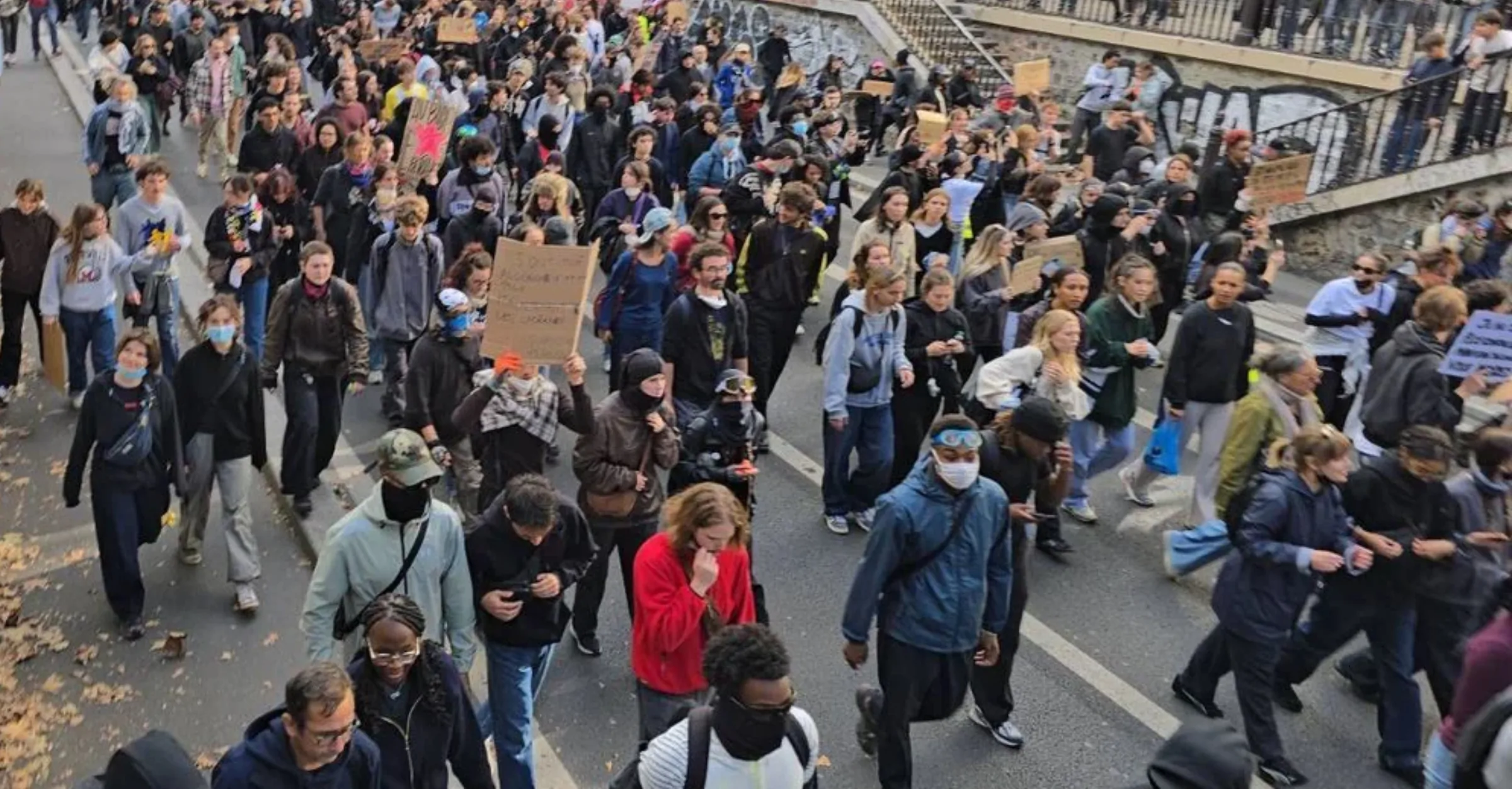
The kids are not OK, judging from the wave of street protests in many European cities, the historical cradle of Christianity.
In the last few weeks, hundreds of thousands of people across more than 20 European countries have staged street protests and strikes over rising living costs, unaffordable housing, underfunded education, and increased military spending.
These protests display the crisis of the “European social model”–government regulation of the economy and redistribution, generous welfare, public services, and social protections.


Thismarks the end of the social contract through which the old continent rebuilt itself after 1945 and brought many Eastern European countries into the EU after the Cold War.
The tensions caused by this strained social modelalso pose a problem for the Catholic Church and the Vatican. Bishops and Church leaders in different countries have reacted differently to the street protests.
Archbishop Mario Delpini of Milan, in his Oct. 25 interview with the Italian newspaper La Repubblica, offered an interpretation of the protest in the framework of Catholic social doctrine, in a language that would make one of his most famous predecessors, saint Ambrose, proud: “Thieves steal from the rich and they steal from the poor. Stealing from the rich and smashing shop windows makes the news; stealing from the poor, occupying homes, driving people into destitution through usury, ruining families by promoting gambling—these things do not make the news, yet they are still acts of theft. Luxury is a scandal, as are many other things. But the rich know how to defend themselves. Destitution is a scandal, too, but the poor do not know how to defend themselves. As far as I can imagine, children from poor families do not typically go around the city looting shops. If there are poor individuals who act as thugs, I believe they face a problem far more serious and profound than simply being from poor families: a problem rooted in indifference, a sense of being lost, and aggression”.
The message of the French bishops was understandably different; on Oct. 19, they issued a statement condemning “the unacceptable violence,” somewhat echoing the French president, Emmanuel Macron, and other authoritative voices in France.
During the Oct. 17-18 weekend, attackers struck city halls and public buildings, leaving some severely damaged and others completely destroyed. Limoges City Hall, a historic 19th-century building in central France, was almost entirely ravaged by fire. Some dioceses have been particularly hard-hit by the violence.
Why the Church should be worried
The Church has a right and a duty to be nervous for what might happen to the old continent in the next few months and years.
Beginning Nov. 29 in Spain, Europe is entering a megacycle of elections and populist nationalist parties might prevail in key countries.
The political landscape of Europe could also become much more challenging for relations between Church and state: not all populists and nationalists are ready to pay lip service—as Giorgia Meloni does—to the Church as a way to promote “cultural Christianity” as an ideological glue to hold the drifting pieces of “Western civilization” together and to isolate the continent from migrants.
The Church should also be concerned, as it is hard to ignore the curious intersection between the timing of these protests and the chronology of Pope Leo’s pontificate.
A striking contrast emerges between the scenes of peaceful jubilation as crowds welcomed Pope Leo in Madrid in June and Paris in September, and the scenes of protest that took place in those same cities a few weeks later.
It would be naive to credit the neo-integralist dream that if only the Catholic Church were in charge, then we would havesocial pacification: this has become impossible in a multicultural, multi-religious, and secularized society.
Karl Marx, by contrast, would say that this pacification would be just one more piece of evidence of the role of religion as the “opium of the people.”
We do not know what Pope Francis would say to Europe today. The Jesuit pope had a direct connection with the outcast and the marginalized, which drew immediate political sympathy. By contrast, Francis was more distant from Europe than his successor.
Pope Leo’s Sept. 28 speech in Metz was inspiring and the most pro-European papal speech in a long time—also thanks to the evident contrast with the world’s most powerful American, President Donald Trump.
The question is what Pope Leo and the Catholic Church in Europe will say about the widespread discontent among the younger generations.
Church’s struggle to connect with street protesters
The Catholic Church and papal teaching are, especially after Pope Leo’s first encyclical, Magnifica Humanitas, intellectually at the forefront of efforts to respond to the digital revolution and its political consequences for the common good.
Leo is articulating a theology of politics that differs from populism by recovering the significance of institutions and structures as instruments of the common good.
Still, the Catholic Church is struggling to connect with the street protesters who are not there to loot and burn but have legitimate, if not sacrosanct, demands.
One of the photos that went viral during the protests in Italy shows a Catholic priest standing in front of his parish church, facing several masked protesters.
During the clashes and unrest in central Milan in October 2026, reports say the priest welcomed passersby and tourists into his church as they fled the violence.
A masked protester gave the priest the middle finger, to which the priest responded unceremoniously with the same gesture: a sign of tension, but also a symbol of the frustration of an aging European Church that has left its old social bloc behind, without knowing quite how to connect with the social bloc of those excluded and disillusioned by the actual social contract that governs Europe today.
The problem, in Europe as well as in America, is how to redeem, theologically, rhetorically, and within Catholic social doctrine, what is good about populism.
The first pope from the USA, Leo XIV, knows that populism has a respectable tradition in US history that cannot be equated with today’s ethno-centric, xenophobic demagoguery allied with techno-authoritarians.
Catholicism must now navigate between the Scylla of nihilistic populism and the Charybdis of an institutionalist defense of the status quo.
Between the end of the 18th and the 19th century, the Church missed the democratic revolution. It was no surprise that this marked the beginning of mutual alienation between the Catholic Church and the working class.
The reconciliation between Catholicism and political modernity – the modern constitutional and democratic state – took place only in the middle of the 20th century, between 1945 and Vatican II.
The Church is facing another revolution. Now, in the 21st century, we are approaching the end of the age in which the Western world’s democratic order was a product of the bourgeoisie’s rise and the masses’ involvement in the political process.
The question is not whether to embrace populism. Rather, it is which kind of populism the Church can engage with while remaining faithful to a theology of institutions as an essential element in the protection and promotion of the common good.