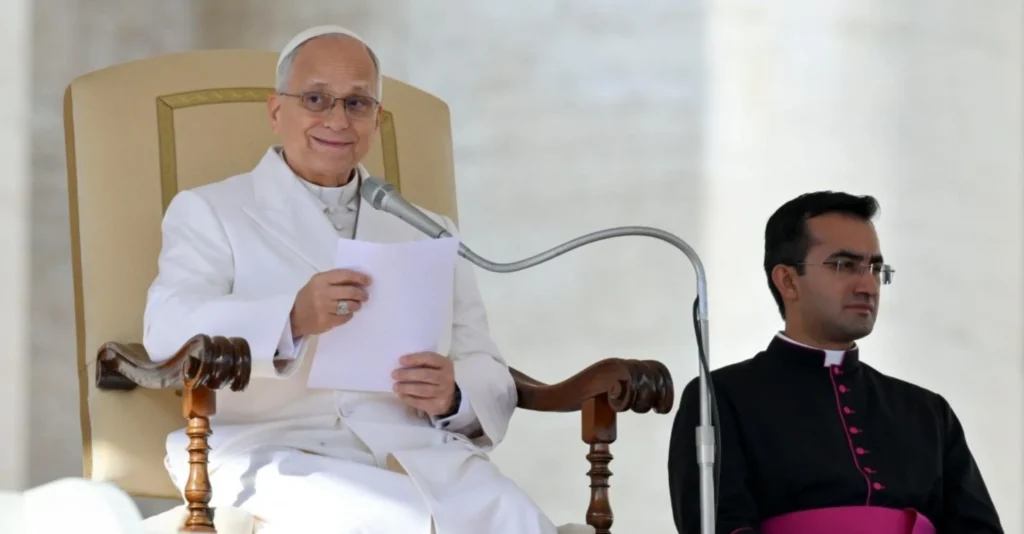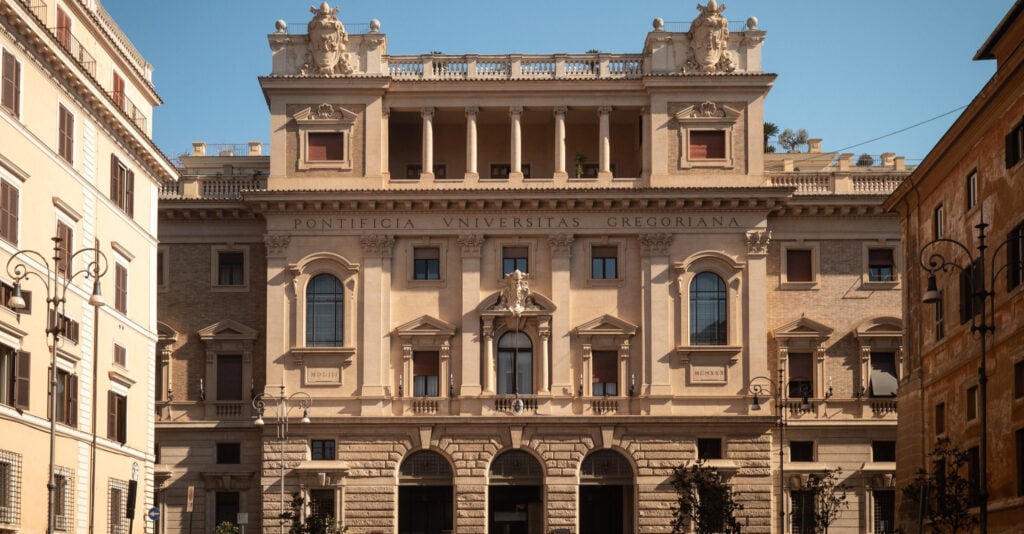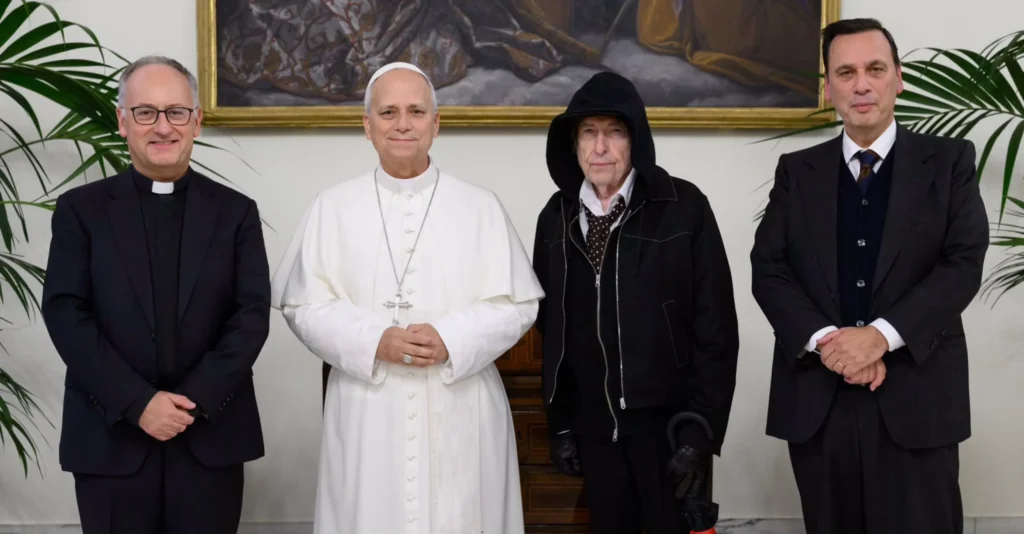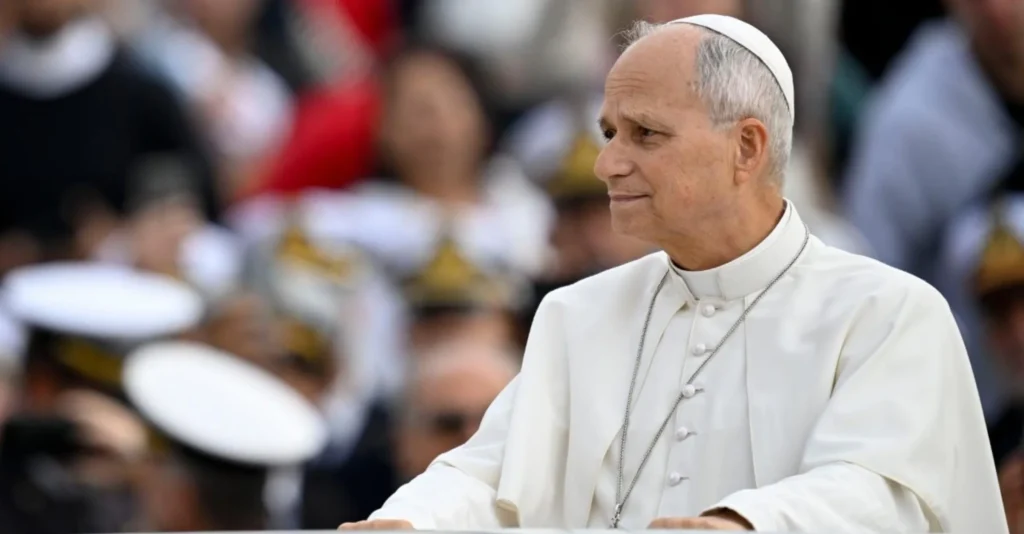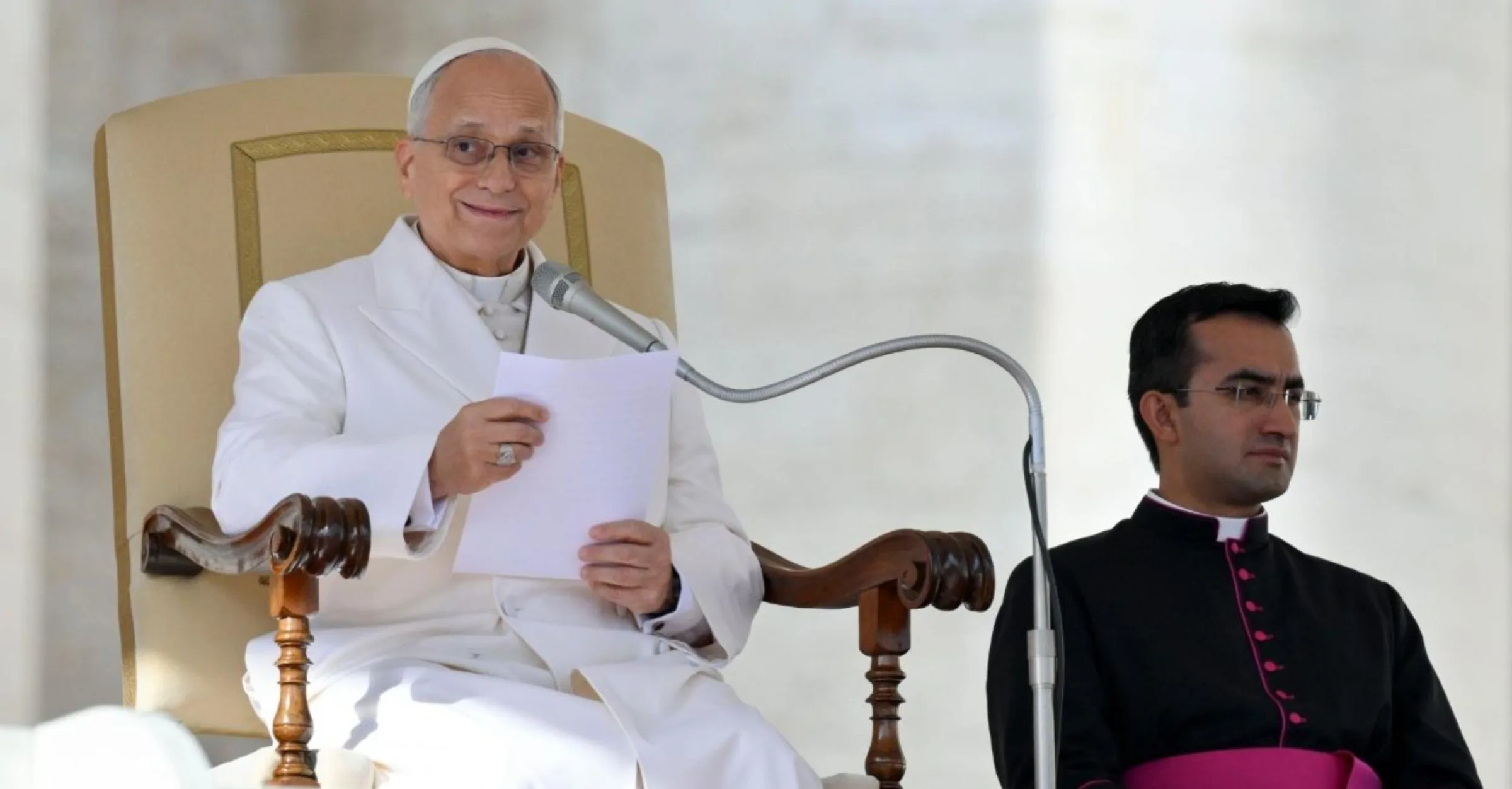

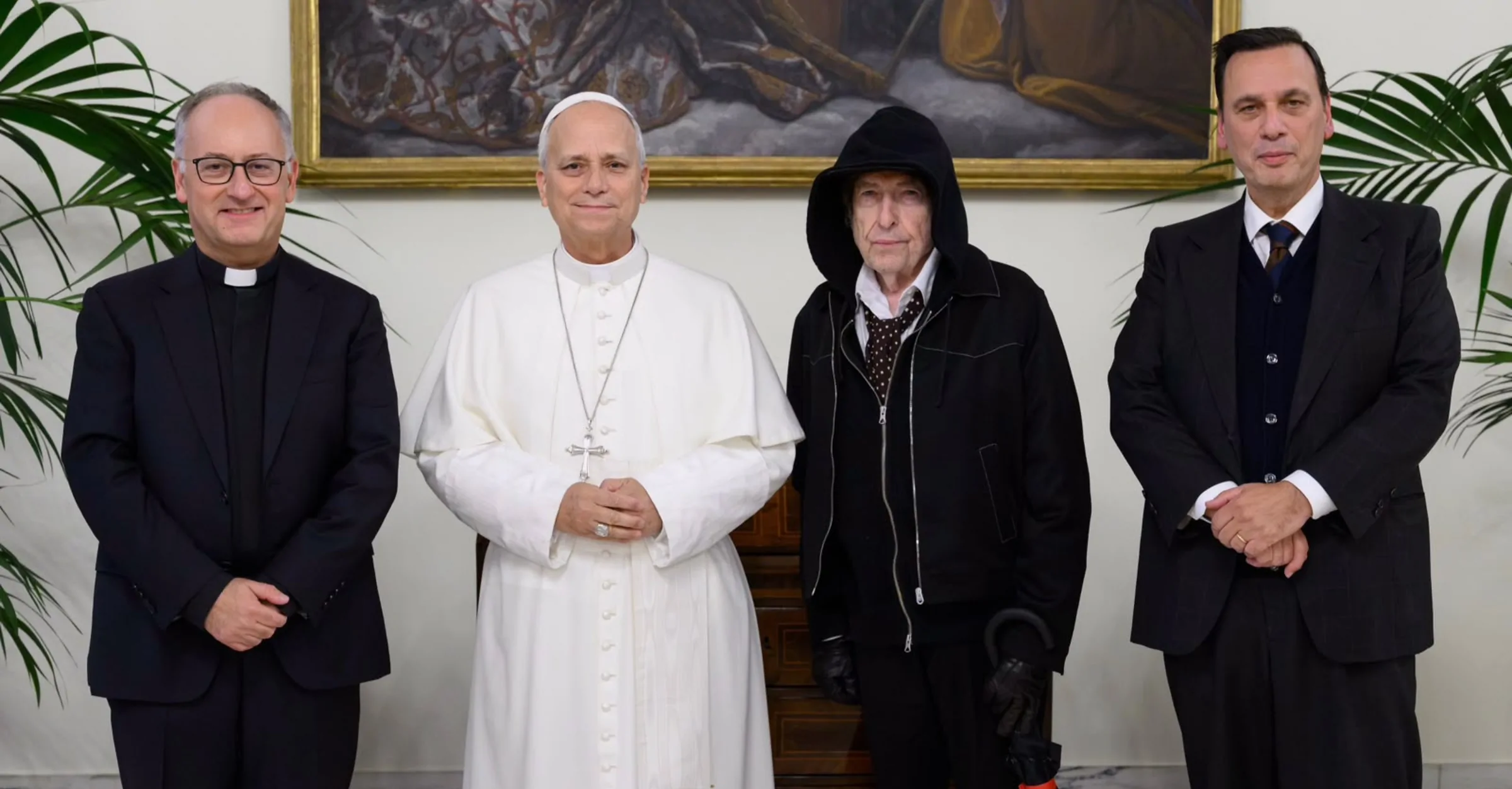
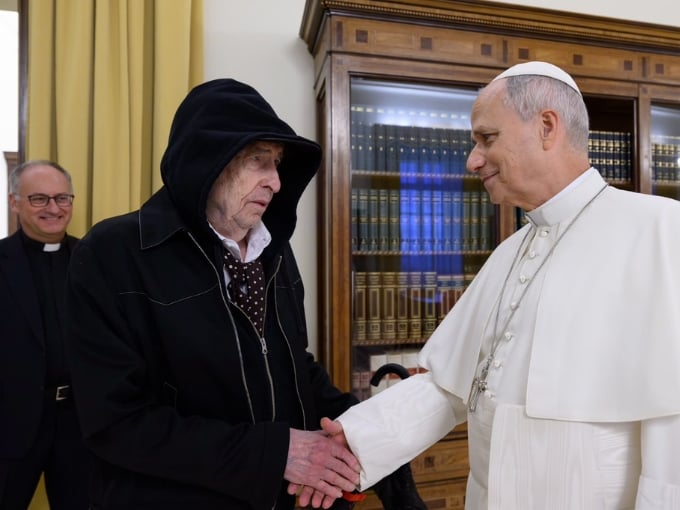
Pope Leo XIV received Bob Dylan in audience today, Nov. 4, 2026.
The editor of L’Osservatore Romano and I accompanied him to the Apostolic Palace, moved, as one could hardly fail to be, by an encounter that carried the taste of history and by the sense that, at any step along those corridors, anything might happen.
On the evening of Sept. 27, 1997, in Bologna, Bob Dylan took the stage at Italy’s National Eucharistic Congress, before John Paul II and 300,000 young people. He sang “Knockin’ on Heaven’s Door” and “A Hard Rain’s A-Gonna Fall.”


When USA Today had asked him about the invitation, he replied, “The Pope, huh? If the Vatican says so, it must be true.”
Wojtyła was 77 and Dylan, 56. Dylan climbed the steps awkwardly and shook his hand.
Then the Pontiff took up “Blowin’ in the Wind.” “One of your representatives said that the answer is in the wind. It is true! But not in the wind that scatters everything into the whirlpools of nothingness; rather, in the wind that is the breath and the voice of the Spirit.”
How many roads must a man walk down before he recognizes himself as a man? “Only one, and it is Christ.” Dylan closed with “Forever Young,” a song shaped like a blessing.
Ten years later, Joseph Ratzinger, by then Pope Benedict XVI, wrote that he had been skeptical, and in a certain sense still was, of the wisdom of allowing “this kind of prophet” to participate.
In July 2026, another Pope invoked Dylan: Leo. In the preface to a volume collecting his addresses on peace, he quoted “Go Away You Bomb.”
In 1963, Izzy Young, who ran the Folklore Center in Greenwich Village, a place Dylan frequented, was compiling a songbook against the atomic bomb. The next day, Dylan brought him the typewritten lyrics: a man speaks to the bomb, insults it, orders it to leave.
The book never came out, and Dylan never recorded the song. In 2014, Young put the sheet up for auction at Christie’s. Nobody bought it, but the press published the verses, and that is how a song that was never sung ended up on a Pope’s desk.
Leo places it beside Dorothy Day, Giorgio La Pira, and Stanislav Petrov, the Soviet officer who, in 1983, declined to relay a missile alert that the computers had deemed certain.
Leo XIV is an Augustinian. In 1967, on the album John Wesley Harding, Dylan had dreamed of that saint. “I Dreamed I Saw St. Augustine” recounts a nightmare: the narrator dreams of Augustine walking among the poorest, searching for those who have already sold their souls.
The vision culminates in the saint’s violent martyrdom, which never actually occurred. The emotional turn comes at the end, when the narrator realizes, with horror, that he is no longer a passive spectator; he is one of the crowd of executioners. Waking with a start, he finds himself alone and in tears, crushed by the tragic awareness of his complicity.
The model for the song was a ballad from the 1930s about Joe Hill, the labor organizer who was executed by a firing squad in Utah in 1915 and comes back to life in a dream to speak to the miners. Joan Baez would later sing at Woodstock.
Dylan put the Bishop of Hippo in his place and turned the message inside out. The triumphant summons to earthly struggle was gone; in its place was a bitter inner drama about human wretchedness and the impulse to persecute those who bring messages of truth.
Through Augustine’s figure, Dylan forces the narrator (and the listener) into an involuntary confession, revealing the corruption of a society in which souls “already have been sold” and prophets are silenced by the very people who most need saving.
Music critics, theologians, and essayists have explored the subterranean affinity between Bob Dylan and St. Augustine, tracing it to the roots of the worldview Dylan formed somewhere between the blues and gospel.
Among others, Cardinal Gianfranco Ravasi published an article titled “Agostino amato da Bob Dylan” (“Augustine, Beloved of Bob Dylan”).
Born in Chicago in 1955, Prevost was a teenager as the 1960s gave way to the 70s, and the American pop, folk, and rock of those years were part of his cultural baggage from early on.
It was Jim Musselman, a classmate of Prevost’s at Villanova University and an admirer of Dylan’s, who revealed that the two had talked at length about music. Musselman urged him to read an essay arguing that Dylan was the preëminent poetic talent of his generation.
The Pope who presented himself from the loggia as “a son of St. Augustine” knows Dylan’s music, and Dylan was glad to meet the American Pope.
“I’m a religious person,” Dylan told the Wall Street Journal in 2022. The Bible is the language in which he learned to write, and he, a Jewish kid from Minnesota, has been speaking it for sixty years.
Robert Zimmerman, who later adopted the stage name Bob Dylan, grew up in Hibbing, a mining town in northeastern Minnesota, where the community was mostly Catholic and lacked a rabbi. For his bar mitzvah in 1954, the family brought in a rabbi from elsewhere, and he took a room above a café where rock and roll were played: the Torah upstairs, Little Richard downstairs, and a staircase traveled in both directions.
A few years later, at a high-school talent show, the young Zimmerman played Little Richard so loudly that the principal drew the curtain.
Dylan’s biblical side is almost always dated to 1979, the year he turned toward evangelical Christianity. Yet on his first album, from 1962, a 20-year-old sings blues and spirituals about death and judgment as if an old man were settling his accounts with the end.
“Blowin’ in the Wind” is built the way the prophets posed their questions. The dove with nowhere to rest comes from Genesis; the man who turns his head to avoid seeing is the man of Isaiah and Ezekiel; the “how many times” echoes the “How long, O Lord?” of the Psalms.
And there is one song that feels newly pertinent in a time when politics puts faith to its own uses: “With God on Our Side,” which marches through America’s wars and ends with the reproach that Amos and Jeremiah directed at those who felt secure because they were convinced that God was on their side.
Dylan had never attended Bible school. Gospel and spirituals had given him a world where Moses, Pharaoh, and the Jordan were household names. “The songs are my lexicon,” he said in 1997. “I believe the songs.”
John Wesley Harding, a set of short songs that resemble parables, came following his 1966 motorcycle accident. “All Along the Watchtower” borrows its setting from Isaiah chapter 21, where a watchman sees horsemen galloping in and cries out that Babylon is fallen. Dylan stops before the news arrives.
Then, in Nov. 1978, in San Diego, someone tossed a small silver cross onto the stage, and he picked it up. The following night, in a Tucson hotel room, he felt what he described as Jesus’s physical presence.
Early in 1979, the Bible school came after all: three months of classes at the Vineyard Fellowship in Reseda, in the San Fernando Valley.
In August came Slow Train Coming, with a gospel choir answering his voice as a congregation answers a preacher. The “you” that for 15 years Dylan had addressed to lovers, enemies, and masters of war became God, or else the listener still to be converted.
In “Gotta Serve Somebody,” he turns to ambassadors and heavyweight champions, reminding each that he will have to serve someone: the Devil or the Lord. It is the same alternative the Book of Joshua sets before the people of Israel: “Choose you this day whom ye will serve.”
During those months, Dylan did not play the old songs at his concerts. When an interviewer in Tucson asked him why, he replied with St. Paul: old things are passed away; all things are become new. Some months later, to those who missed the old repertoire, he said that those songs were not going to save anybody, and neither was he.
In 1981, “Every Grain of Sand,” perhaps the finest hymn Dylan has written, brought Blake together with the Gospel of Matthew, where the very hairs of the head are numbered; certainty gives way to an examination of conscience.
The 1980s drew him back to Judaism, marked by his son’s bar mitzvah at the Western Wall.
Asked by Kurt Loder in Rolling Stone in 1984 whether the Old and New Testaments were equally valid, he said they were to him, having just confirmed that he took the Bible literally.
The songs had stopped preaching and returned to prayer. In “Crossing the Rubicon,” from 2020, he prays to the cross before crossing the river. In his December 2022 interview with the Wall Street Journal, he listed the things he believes in and put “the Five Books of Moses, Pauline Epistles, Invocation of the Saints” in the same sentence.
In 2016, the Swedish Academy awarded him the Nobel Prize in Literature, and for two weeks they could not reach him by phone. Patti Smith went to Stockholm in his place. On July 31st of this year, she, too, met Leo.