
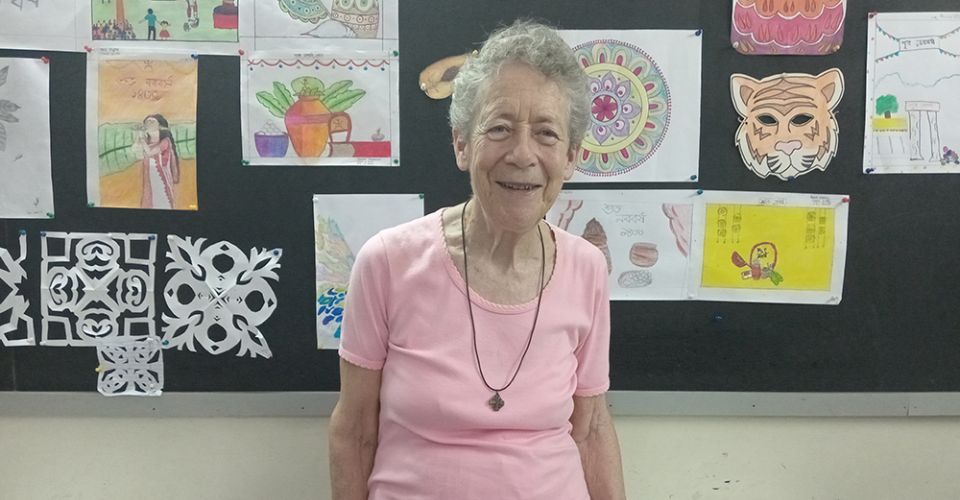
For six decades, Sr. Kathleen Reiley has lived a missionary life rooted in accompaniment, prayer and presence. Since arriving in Japan in 1968 as a young Maryknoll missionary, she has worked with cancer patients and their families, day laborers, refugees, children from troubled homes and communities recovering from disaster.
Along the way, she has also become a bridge-builder between Christian and Buddhist traditions through interfaith dialogue and Zen practice.
Now marking 60 years as a Maryknoll sister, Reiley remains actively engaged in ministry as a volunteer counselor at a children’s cancer hospital and a refugee center in Japan.


During a recent visit to Bangladesh, she spoke with Global Sisters Report about vocation, suffering, hope, interfaith friendship and what continues to sustain her mission.
Global Sisters Report: You are visiting Bangladesh after many years. What are you hoping to learn or share during your time here?
Sr. Kathleen Reiley: I visited Mymensingh 20 years ago with Sr. Miriam Francis Perlewitz. It was an interfaith dialogue colloquium with Hindus and Muslims.
I am inspired by the children. They know so much. Their English is so good. And they ask wonderful questions. Today in history class, one of the texts was about Rabindranath Tagore. I love him. I have his poetry with me all the time really. So I could share that with them. It’s mostly just to realize we are one big human family and we need each other.
And also there are two boys here who lived in Japan for 10 years. And so they went to Japanese schools. I could say Japan is a first world country. Nice buildings, nice trains and cars. But many people don’t know each other and sometimes old people die alone. And they find them a couple weeks later. Children are in competition in school and they are under pressure to pass examinations. Even sometimes, children commit suicide.
So I said to these two boys, where are you happier, in Japan or in Bangladesh? They said Bangladesh. Because in Japan many people only care about money. They are losing their sense of community. So I am going to tell my people when I go back how wonderful Bangladesh is.
You entered religious life at a young age. What first inspired your vocation?
I entered religious life in 1963 when I was 19 years old. My mother and father taught me — “I was hungry and you gave me food. I was thirsty and you gave me a drink. I was a stranger and you took me in. I was sick and in prison and you visited me.” My parents lived their life that way helping others.
I felt Jesus calling me to do the same. So that’s why I work in a hospital where I help children from broken homes. Because I feel that’s what Jesus wants me to do. And also I love children. … I love how Jesus says, “Unless you become as a little child you cannot enter into the kingdom.” So children are my teachers.
Much of your ministry has centered on children with cancer and their families. What drew you to this work?
I have loved children since I was young. I helped care for younger relatives when I was only 8 years old. Later, when I began working in hospitals, I felt especially drawn to children and families facing serious illness.
Today I serve as a volunteer counselor at the National Cancer Center Hospital in Tokyo. I accompany children receiving treatment and support their parents through what is often an incredibly difficult journey.
I believe that Jesus had a special love for children. When I spend time with them, I am reminded of that Gospel truth. They continue to teach me what it means to trust, to live fully and to appreciate each moment.
What have children with cancer taught you about suffering and hope?
If you go to the adult ward, everybody’s quiet and they don’t talk to each other and their curtains are closed. And if you go to the children’s ward, they’re playing, they’re studying, they’re making friends. Children, even when they’re sick, they know how to live in the present moment. So the children are my teachers.
You also helped establish Family House, which supports families of children receiving cancer treatment. How did that project begin?
People travel from the southern part of Japan and the northern part of Japan like a thousand miles to bring their child to Tokyo. The child is in the hospital but the parents have to find a place to stay and hotels are very expensive and to rent an apartment is very expensive.
In the United States, where I learned how to be a counselor in a hospital, I visited Ronald McDonald House — a house for families whose child is in the hospital. … So I said, why can’t we do something like that in Tokyo? And now there are many houses not only in Tokyo, but in other big cities in Japan.
You have worked with people struggling with addiction, refugees and other marginalized groups. What has that taught you about ministry?
I feel that we need each other. And it’s not me helping these poor people. I receive so much from them. The gifts that they have. They know how to share.
You are known for integrating Christian spirituality with Zen practice. How do these traditions complement one another?
We officially are the Maryknoll Sisters of St. Dominic. St. Dominic said we have to be contemplative in action. So we have to pray deeply and in our everyday life. We’re sharing the fruits of our inner life with God.
… But the practice of Zen is 24 hours a day living in the present moment and forgetting ourselves to become one with each other. We are eating, we’re sleeping, we’re studying, we’re riding on a train — moment by moment be totally present to what we’re doing and forget ourselves.
Interfaith dialogue has been an important part of your ministry. How do you build relationships across religious traditions?
I just try to give my love to them the way Jesus loves them. And it’s not what I say. I hope it’s how I live my life that speaks to them of how much I love them.
In Japan, there are very few Christians, like less than 1%, but I think it’s wonderful now that we have more interfaith dialogue. And after the great earthquake, which happened on March 11, 2011, in our town, every year we have a prayer together and it’s 20 minutes of a Shinto prayer, 20 minutes of a Buddhist prayer, and 20 minutes of a Christian prayer. And one year it’s at the Shinto shrine. The next year it’s at the Buddhist temple. And the next year it’s in the Catholic church. And by that we are becoming more and more friends with each other.
After 60 years as a religious sister, what continues to sustain you?
I say to God, “I am too weak to hold on to you, so please you hold on to me.” Because I feel called to religious life but it’s not always easy and so without God helping me, I don’t think I’d still be a sister. But I feel God is holding on to me.
What advice would you offer young women considering religious life or missionary service today?
Listen to your heart. Listen to how you feel God is calling you and take time every day, even five minutes for silent prayer just to be and ask please guide me, please show me the way.
Also read from the Gospels, even a few verses every day. It becomes familiar because it’s a call. It’s a call by God.
Finally, after six decades of ministry, what gives you the greatest joy?
The joy is all the wonderful people God has brought into my life. So many families and children and friends and of course the sisters also.
… I am very grateful for my Maryknoll sisters community, but we are not like some religious communities, where most of their time is together. … But what we have in common is we each feel called to be a mission, to be with the people.
This interview first appeared on Global Sisters Report and has been republished with permission by Global Catholic.