In September 2026, Bogotá hosted a series of gatherings — including the General Assembly of Just Finance at the Jesuit-run Javeriana University and a panel titled “Cultural Battle or Cognitive War?”
In the gatherings, academics, activists and politicians examined the new government of President Abelardo de la Espriella through the lens of what some speakers termed “Christo-fascism” — a phrase coined by Spanish theologian Juan José Tamayo describing the fusion of Christian-nationalist rhetoric with authoritarian politics.
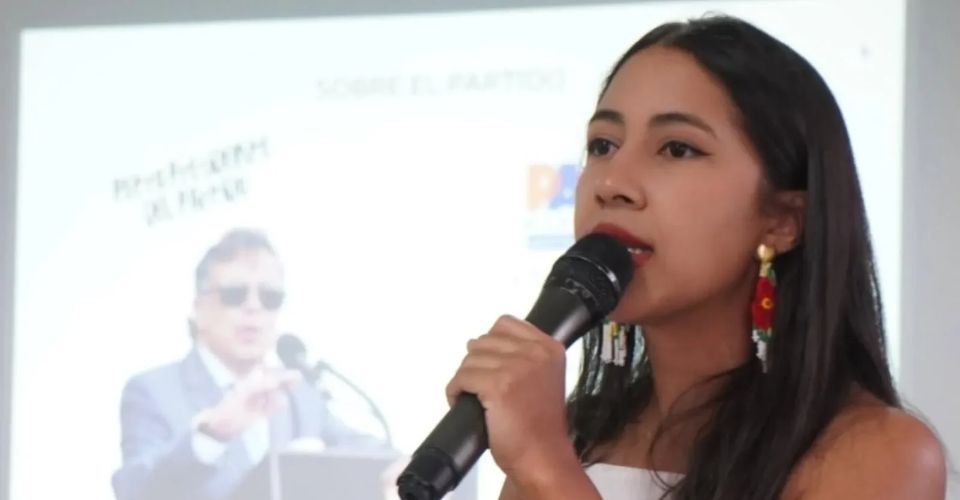
Among the participants was Laura Isabel Vera Zapata, a 27-year-old representative from Valle del Cauca and the youngest member of the Historical Pact caucus in Colombia’s House.


She rose through the student movement at the University of Valle, leading the 2018 tuition-free-education hunger strike as part of “Univalle Unida” before becoming Colombia Humana’s departmental coordinator in Valle del Cauca and, in October 2025, the second-most-voted woman in the Historical Pact’s legislative primary.
Vera Zapata represents eastern Cali, a majority Black and Afro-descendant area where armed groups have long recruited children and adolescents with false job offers — a crisis compounded by the Aug. 10, 2026, magnitude-7.4 earthquake that killed dozens and damaged thousands of homes across Valle del Cauca.
She sits on Congress’s Sixth Commission, which oversees education, technology and transportation.
The following interview, conducted on the occasion of the Bogotá “Cultural Battle” seminar, covers her views on that debate, on Colombia’s new government, and on what she calls “techno-fascism.”
What does your election mean?
Popular youth are arriving in Congress. We are following in the footsteps of those who came before us, fighters and dreamers of a new world.
We are arriving representing not our niche, but the interests of the neighborhood, farmers and the working people, in all their diversity. I will be the youngest congresswoman from Valle del Cauca, and I will assume it with absolute responsibility and stature.
We cannot be less than our people. Thank you, President Petro, for your legacy; we will take care of it.
How did you become the second-most-voted woman in the Pact primary in Valle del Cauca, with 15,000 votes, in October 2025?
I am the youngest congresswoman from Valle; I am 27 years old. I am part of the student movement that organized the national mobilization during the 2021 strike. I represent the first generation of “popular youth” in Congress.
We founded the Colombia Humana student organization in Cali, and we founded “Univalle Unidos” in 2018.
What do you think of this approach of Christo-fascism that was debated at Javeriana University with Jenny Fonseca of CINEP?
The far-right Vice Minister of Higher Education, Camilo Noguera Pardo, appeals to the narrative of “Christianophobia” as a post-truth artifice to falsify history and portray himself as a victim.
Colombia is a deeply spiritual, believing country, drawn to the love, compassion and solidarity preached by Jesus. There is no persecution of faith here; what exists is society’s categorical rejection of fundamentalist sectors attempting to impose the Bible above the Constitution.
“Christianophobia” has never existed in Colombia. What has existed are anti-rights elites and pastors who use God’s name to trample on women, persecute LGBTIQ+ people and deny the dignity of others.
We have not forgotten the school from which the vice minister comes, that of Alejandro Ordóñez (a socially conservative former Colombian inspector general known for his hardline Catholic views) burning books in public squares to exterminate free thought and diversity.
His “faith” has never been love of neighbor; it has been authoritarianism and censorship.
It is clear that now they have Father Rodolfo Londoño de la Espriella, with no experience whatsoever in the sector, appointing him as a delegate to the country’s five largest universities.
A man who knows nothing about higher education, who lived in Madrid and who promotes the idea that LGBTIQ+ diversity ‘must be healed.’ They appoint religious fanatics to monitor public academia in order to attack rights and persecute our students.
They remain complicitly silent in the face of systematic scandals of child sexual abuse within churches, but tear their clothes when the people demand that the state be secular, pluralistic and a guarantor of rights. They seek to portray as ‘hatred of Christians’ what is the legitimate defense of human rights against clans that use pulpits as bureaucratic spoils and an electoral business.
As a believing woman and popular congresswoman, I affirm with complete conviction that Christ never preached exclusion or hatred; Christ walked with the marginalized, the vulnerable and the persecuted.
They are not victims of persecution; they are nostalgic for the privilege of legislating from the pulpit. The social state governed by the rule of law and human dignity are not negotiable, nor do they kneel before any form of fanaticism.”
What has your experience been like in a Christian family?
I come from a Christian family, forged in the spirituality of a poor carpenter, Jesus Christ.
I remember the calling of my parents, two poor young people from eastern Cali, tired of the violent environment, who at the age of 13 arrived seeking peace in a Christian church.
My parents were looking for a logic of solidarity, but the perspective through which Christian churches educate us is the logic of saving ourselves through a neoliberal vocation.
That is why we must think about how to combat techno-fascism and how to speak to everyone, to all the churches, with a spiritual orientation based on the true legacy of Christ. We have to reach all these people with less apprehension.
How did you become a leading figure in the 2018 university strike, going on hunger strike for tuition-free education?
I remember the growth of content creators during the pandemic, when everything was shut down in 2021. I was very young.
My vocation was born as the daughter of the student movement, with the traditional mobilization in the streets in 2020: we organized a hunger strike; the debate was whether they would eat or whether they would drop out of university.
We became known among Colombian youth, actively participating in the Social Uprising (the 2021 national strike and protest wave against tax and policy reforms under then-President Iván Duque).
There we decided to use the tools of the digital generation to make the mobilization in Cali visible. The first arena of dispute was more traditional, with the hunger strike.
We believe in organization that seeks opportunities in the digital sphere.
Thinking about the last presidential elections, I tell you that I DO NOT want us to be complacent. The second round of the presidential elections created a state of comfort.
Faced with the project of the new right in Colombia, we must open new spaces of love and hope, which are always in our hearts to encourage the transformation of the world.
There are algorithms that transform the global economy and politics: what is the vision of the world we seek with the progressive bloc?
We seek a multipolar world, but be careful: we have to strengthen the search for alternative social and political organizations, from the left. We have to pinch ourselves, to stay awake in the face of those who want to take us backward with techno-fascism and techno-feudalism.
Today these fascist-oriented projects are advancing, and I ask myself: how do we return to the progressive wave throughout the hemisphere?
I believe it is a battle; we have to understand these forms of warfare, where the new global right has a warmongering logic, and we have the responsibility to build new margins for collective action. This situation is worrying, and LET US NOT GET COMFORTABLE: this is the task as an alternative movement of the left.
Fascism is resurging because capitalism does not improve well-being in the Global North. Fascism is a card played by capitalism; it is a model of white citizenship, of white supremacy, that has to process frustration in the United States, where millions of people cannot afford health care, where they take your home away because you cannot pay the taxes, and that is how fascism emerges.
New forms of techno-fascism are emerging as a form of authoritarian control based on the alliance between corporate technological power and the new dominant political power.
It is not only a dispute over algorithms. It is techno-feudalism that is changing the economic model.
Can you tell us about your recent trip to Mexico, where you learned about the humanism revolution of Morena?
I was recently in Mexico, visiting youth houses that they call the “Youth Commune,” with young people who have spaces to study, a community dining hall, where they teach you 3D design and robotics.
Young people in Mexico receive training in robotics; it is a challenge for citizenship, to build free peoples.
How do you view technologies at the service of neoliberal capitalism?
I ask myself what challenges we face today in relation to a few billionaire men who use technology as their best tool of combat and look to Israel’s economic model, which sells weapons to the whole world.
President Petro had a clear vision and implemented the first artificial intelligence faculty, but it seemed to me that the other ministries of change were working on their own.
We need to get closer to schools and universities, which have become neoliberal. It is our responsibility as members of the Sixth Commission, which deals with education.
Today technologies are at the mercy of capitalism, which is advancing much faster than the left.
I was invited to an international meeting of CEOs of powerful companies (but they will not invite me again because of what I am about to say now…): it is clear that they are working toward techno-feudalism with the objective of changing the economic model, while the left is thinking about how to make a TikTok video.
It is a priority to think about the international dispute over models of life and economic models in the face of the complexity of the techno-fascism proposed by Peter Thiel.
What legislative projects are you working on as a member of the Sixth Commission of Congress?
I am on the Sixth Commission of the Congress of the Republic, which deals with education, technology and transportation.
There we have to discuss the far right’s projects, impoverishing projects, even with the algorithm determining how we eat. We see far-right thinkers questioning healthy food, giving children Coca-Cola for breakfast.
I believe in the commitment to change, such as agrarian reform. We defend decentralized budgets in the territories that should benefit working people. All of that is a cultural and political battle.
As a young woman — pelada in Colombian slang — in the Congress of the Republic, we have a project to support school meals, to remove packaged foods from children’s diets and dignify those who cook healthy food. My priority is to fight for a project defending popular education as a Common Good.
They sell us the ideas of an artificial-intelligence tiger that looks toward Milei and Bukele (Argentina’s libertarian President Javier Milei and El Salvador’s President Nayib Bukele, both frequently cited by the Latin American left as models of the region’s new right).
It is the economic logic of the new right that wants to eliminate state institutions; chaos serves them. We ask everyone to support us in this legislative effort with the objective that working people live better.
What is your assessment of the recent elections for youth committees?
We understand that political renewal and the intergenerational commitment are developed in secondary schools, in the major arenas of dispute such as universities.
At 12 years old, I was already active in a student organization, and that creates spaces for encounter and renewal. We think that a 15-year-old kid is a priority for training and encounter with thousands of young people; that should be the vocation of the Historical Pact Party.
Look at the elections for youth councils in Colombia: Morena in Mexico is more advanced than we are.
We have to unite three perspectives: the party and its organizational logic, parliament and the legislative issue, and the movement-party as Petro proposes. The Historical Pact Party must contest these three arenas.
The Green Party grew significantly in the youth elections. The Pact lists were not unified and we divided ourselves, and we lost several opportunities.
Now there are new ways of doing politics. I want more political influencers; it is a necessity. People expect a lot from us. Beware of ridicule; we must live up to the mandate of the people who elected us.
Look at the beach show in the Congress of the Republic concerning the impeachment debate of the housing minister, who went to Santa Marta beach during the first days of the earthquake emergency. We must hold major debates and confront the media dispute.
Patria Milagro arrived to see how people’s emotions are shaped. They appeal to emotion, NOT critical thinking. Faced with the mobilization of fear by Trump’s far-right corporatist model, which seeks to control all of Latin America, what is lacking is a clear proposal for people’s lives, a unifying proposal for the left.”
How can the youth mobilization of the Social Uprising be channeled in view of the upcoming municipal elections in October 2027?
We are organizing the primaries in March 2027 to choose the progressive candidate for the mayoral elections in Cali. Cali is a progressive city; we hope our candidate wins in October 2027.
The representation of Valle del Cauca in the House for the 2026-2030 period was marked by clear leadership from the Historical Pact Political Movement, which received 589,949 votes, representing 35.41 percent of total voter participation.
In Cali, young people have always been stigmatized by the elites, and we are fighting against the classism of current Mayor Alejandro Eder. We are organizing a public hearing for this Sept. 21 to demand that the new government provide answers regarding the post-earthquake situation.
Valle del Cauca continues to await answers. The earthquake left damage and victims who are still facing the consequences of an emergency that cannot be allowed to fall into oblivion. Behind every damaged building, every home and every educational institution are rights that must be guaranteed.
What is your opinion about Senator Carolina Corcho?
There is a concrete reality: Carolina Corcho has been traveling throughout the country for two years, carrying out work that no one else has undertaken: bringing many of them together through her training school.
As a result, she has gained not only recognition but legitimacy by carrying out a necessary task, which is the political qualification of scattered supporters and activists.
Cristiano Morsolin, an Italian researcher and social worker based in Latin America since 2001, is the author of 10 books in five languages. He analyzes the relationships between human rights, social movements, emancipatory policies and the geopolitics of Pope Francis and Pope Leo XIV.
This is a translated and edited version of the interview that first appeared on Religion Digital and has been republished with permission by Global Catholic.