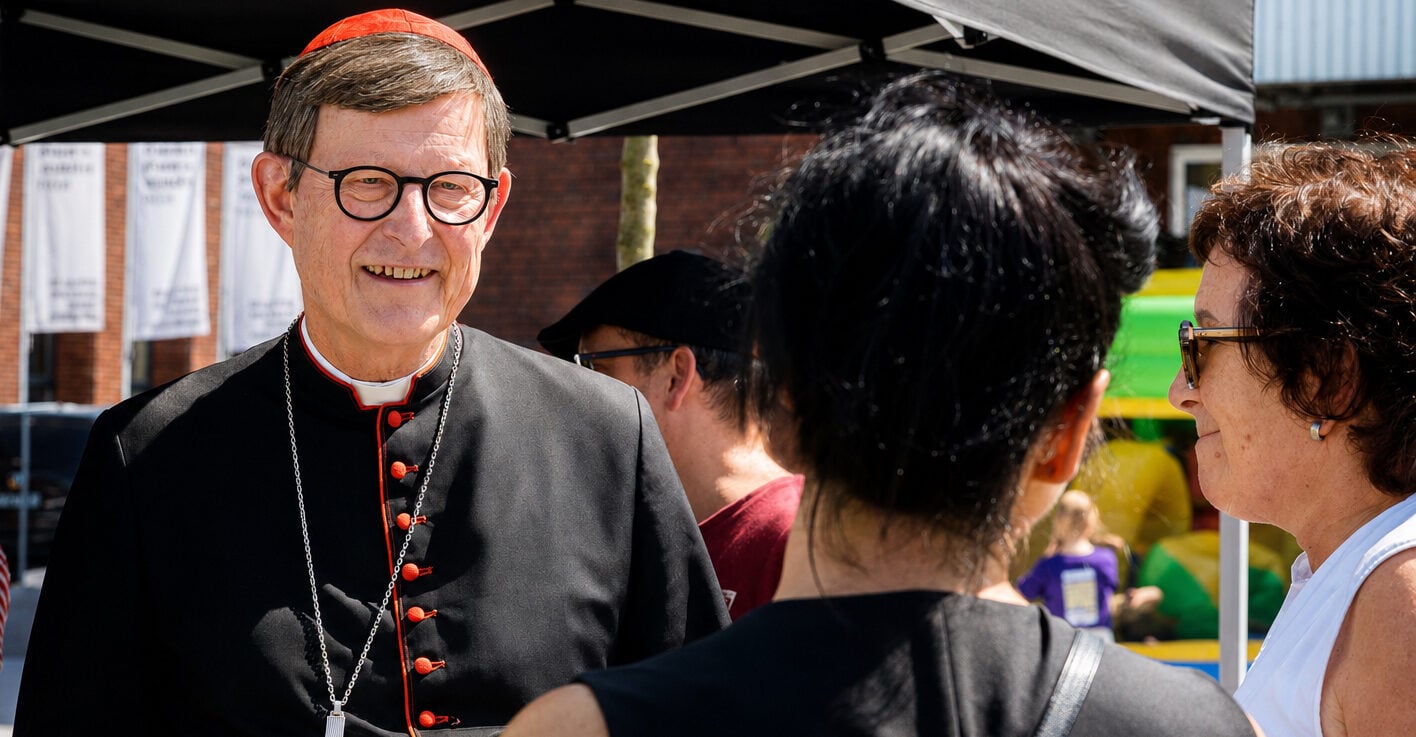
As he turns 70 on Aug. 18, Cardinal Rainer Maria Woelki of Cologne, Germany, looks back on his life journey.
Born in Cologne in 1956 to a family displaced from East Prussia after World War II, Woelki was ordained a priest in 1985 and advanced through the ranks of the archdiocese, serving as an auxiliary bishop under Cardinal Joachim Meisner before becoming Archbishop of Berlin in 2011.
Pope Benedict XVI made him a cardinal in 2012, and in 2014 he returned to his hometown as Archbishop of Cologne, leading the largest Catholic diocese in the German-speaking world, with roughly 1.7 million Catholics.


His decade in that role has been marked by turmoil: In 2018, he commissioned an independent investigation into decades of clergy sexual abuse in the archdiocese but withheld its findings, triggering a crisis of trust that led to public protests, mass departures from the church, and calls for his resignation.
He later released a separate report documenting more than 300 victims and roughly 200 abusers, and in 2021 Pope Francis ordered him to take a six-month leave. Woelki offered his resignation in 2022, though it was never formally acted upon.
In this exclusive interview with Renardo Schlegelmilch, Woelki speaks about his vocation, the difficult years in Cologne and the future of the archdiocese. One thing is certain for him: the mission of proclaiming the Gospel never ends.
In the conversation, Woelki reflects candidly on the abuse crisis and its toll, insisting he “never pretended anything to people” even under intense public pressure.
He also discusses his admiration for his predecessors, Cardinals Joseph Höffner and Joachim Meisner, his working relationship with Pope Leo XIV, and his vision for renewing the archdiocese through new pastoral initiatives, evangelization efforts and youth outreach — all while making clear that, at 70, he considers his mission far from finished.
You grew up in Cologne’s Bruder Klaus settlement, built for families displaced after World War II, like your own. What was that time like?
Those were the 1950s and 1960s — the postwar period, the era of the “economic miracle” (Wirtschaftswunder), West Germany’s rapid economic recovery and growth after the war. Then came the 1968 generation, bringing with it the changes and social questions that arose during that time.
Overall, though, it was a safe period for me, both in my family home and in my parish. We had an active, vibrant youth ministry there.
Father Franz Meurer, now a parish priest, was responsible for the entire parish youth ministry at the time; he’s a few years older than I am.
We had a very lively altar-server ministry and an active youth ministry — youth weeks with numerous activities, three-week summer camps, and solid catechesis. That naturally shaped my faith, and it’s part of why questions of faith have always mattered to me.
When did you become aware of your vocation to the priesthood?
As a child and young person, I was fortunate to encounter exemplary priests who accompanied and influenced me. I was always touched by the fact that these role models had a particular heart for people in general and for young people especially.
Quite early on, I developed the desire to be like them. What they stood for and worked for became my path as well: wholehearted, decisive commitment to the Gospel and to faith in Jesus.
Of course, the path to the priesthood had its highs and lows. At times, I had other ideas about life — first, my high school diploma, then compulsory military service. In the end, though, that desire and that vocation prevailed.
How do you look back on the period of your military service, and on the new debate over compulsory military service in Germany?
(Woelki completed his military service in an armored artillery training battalion when West Germany maintained mandatory military service for young men throughout the Cold War.It was suspended in 2011, but rising security concerns in Europe have reignited political debate over reinstating it.)
At the time, I was drafted into Munster. During the Cold War, it was assumed that this region would be particularly affected if armed conflict broke out.
I never thought we’d find ourselves in such a situation again. I find it not merely distressing but simply horrifying. At present, I find it very difficult to deal with the reports and discussions about rearmament that have become so commonplace.
Ultimately, weapons can never create a lasting and just peace. That’s also what is so terrible when I look at Ukraine and Russia — how many people have lost their lives there,and how many have been left disabled or otherwise affected by war.
Hopefully, peace negotiations can take place soon, and hopefully no more people will have to die. It’s quite clear: There will be no genuine “winners” in this war. But the losers are certainly the innocent people affected by it. War must not have a future, and it must not have the final word.
I’m very grateful to Pope Leo XIV for making clear in his first encyclical that there can ultimately be no truly just war.
Was there a particular person who profoundly influenced you to become a priest?
Above all, it was Cardinal Joseph Höffner. (Joseph Höffner led the Archdiocese of Cologne from 1969 to 1987 and was one of postwar Germany’s most influential Catholic social ethicists.)
He was the bishop of my childhood and youth — the one who ordained me to the priesthood. He was a social scientist and economist, highly respected as a social ethicist, and a great figure of his time.
He always succeeded in translating academic matters into everyday language in a way that made them understandable to politicians, society, and ordinary people.
I greatly appreciated his goodness, warmth, friendliness, and the simplicity with which he treated people. But I also appreciated his clarity and decisiveness, as well as his courage in continuing to address things that were uncomfortable and challenging.
If there’s one bishop who shaped me, it’s Cardinal Höffner. He’s a role model for me.
After your years as a priest and auxiliary bishop under Cardinal Meisner, you became the Archbishop of Berlin, a much more secular environment. What did you bring to Cologne from your years there?
(Joachim Meisner served as Archbishop of Cologne from 1989 to 2014 and was Woelki’s immediate predecessor. Catholics make up only a small share of Berlin’s population, making it what German Catholics often call “diaspora” territory — unlike the historically Catholic Rhineland region around Cologne.)
I still love the city and the diocese. I was very happy in Berlin. I was particularly impressed by the diversity and the steadfast faith of Christians living as a minority there. Their strong commitment, solidarity, and a faith that had matured and been strengthened by external challenges to Catholicism moved me deeply.
I met many people there for whom the church and faith were essentially foreign, but they were curious, and it was possible to talk with them without prejudice.
With a wink, one could say that here in the Rhineland, it sometimes seems as though we were Christians even before Christ — everyone here believes they know exactly what is Catholic and what the church is supposed to be.
From that perspective, I find it much harder here to have conversations about questions of faith and the church, because there’s a great deal that already seems prejudiced one way or another.
Your years as a cardinal in Cologne have been marked by the abuse crisis, your leave of absence, and a crisis of trust, with fierce criticism directed at you, especially here in the city. What would you say about that?
The Archdiocese of Cologne is larger than my hometown — it encompasses many other cities and rural regions, so the city of Cologne itself doesn’t play the decisive role for me. The cathedral and the bishop’s seat are here, and that’s what’s decisive for an archdiocese.
Of course, there were difficult times, but I tried to endure them by trusting in Christ and keeping in mind what I promised on the day of my ordination as a priest and bishop. I tried to remain true to myself and to my faith. That was always more important to me than public recognition or short-term applause.
It’s always been important to me, particularly in my service as a cardinal, that unity with the Holy Father, the Church of Rome, and the faith of the universal Church be preserved.
I can say that throughout all these years here, I never pretended anything to anyone or raised expectations I considered unrealistic, even if many people considered them desirable.
People can hold different views on many things. But there are aspects of our church and our faith that are beyond our control, and it would be dishonest to claim otherwise or merely give a different impression.
I’ve never done that. That’s also how I understand my mission as a shepherd, bishop and cardinal.
Do you see that as a particular responsibility of being a cardinal, one that goes beyond the office of archbishop?
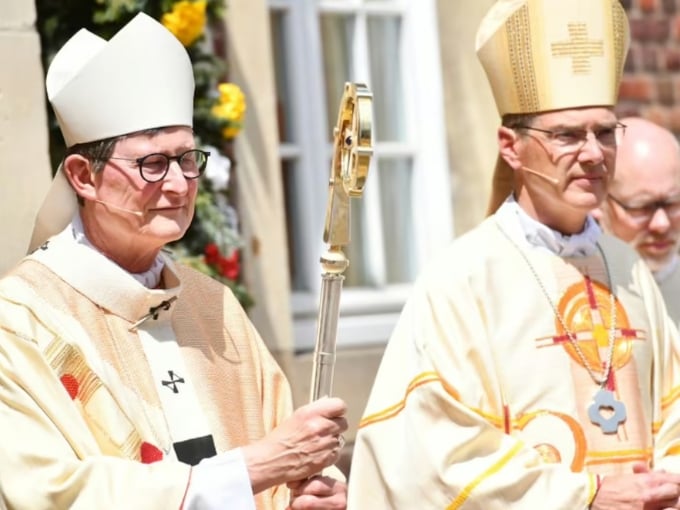
What affects me most is always the moment I have to put on my red cassock. The color of that garment reminds me that, by accepting the dignity of a cardinal, I’m obliged, when the time comes, to bear witness to the faith and to Christ to the very end, even to the point of shedding my blood.
That’s the real challenge, and it also causes me distress again and again, because I ask myself whether I’d really be ready for that. I can only pray that I’d have the strength and courage if it ever came to that.
For me, this awareness is deeply existential: that I’m being called to bear witness in a way that could ultimately mean giving my life. I hope I’ll never have to face that, but ultimately, that’s the real consequence of this “dignity.”
Being a cardinal also means workingclosely with the pope, whom you helped elect in last year’s conclave. What does that look like?
(A conclave is the secret meeting in which cardinals under 80 elect a new pope; Pope Leo XIV was elected in May 2025, following the death of Pope Francis. A consistory, referenced below, is a formal assembly the pope convenes with cardinals, often to induct new members of the College of Cardinals or discuss major church matters.)
Leo XIV is now again involving the College of Cardinals more strongly in his deliberations and consultations. We’ve held two consistories this year. The College of Cardinals is the pope’s senate, which supports him in governing the universal church.
It’s a good thing that the pope allows us to participate in his deliberations, asks for our assessments, and incorporates them.
He’s even set up a separate email inbox so we can all write to him directly about things that matter to us. This allows us to be in very direct contact with him and engage in dialogue.
He’s the first pope to make this possible, and it’s very important to him — he emphasizes it repeatedly.
Looking to the future: You’ve launched major reforms in the archdiocese — a synodal restructuring, new pastoral priorities, a focus on youth and education. At 70, can you say the work will be done in five years, when you’ll be required to offer your resignation?
(“Synodal,” used throughout this section, refers to the Catholic Church’s collaborative, consultative approach to decision-making — an emphasis strongly promoted under Pope Francis and continued under Pope Leo XIV.)
There’s no reason to grow sluggish and sit back with our hands in our laps. To be honest, I don’t think in terms of such timelines. I simply see it as my responsibility to do my part in preparing the church for the future.
To that end, we’ve developed our spiritual vision. This isn’t some pious icing poured over something — these are clear positions that have grown out of our synodal cooperation, helped us establish pastoral priorities for our archdiocese, and are now launching new evangelization efforts and initiatives across the diocese.
We’ve reorganized and further developed the General Vicariate, the central administrative body responsiblefor the day-to-day affairs of a Catholic diocese.
I’m very happy and grateful that, in this process, we’ve also succeeded, after many years, in establishing a department dedicated to evangelization. The decisive thing, of course, is that administration and everything connected to it must serve parish life and evangelization.
I’m very grateful to so many of my employees for what they do and how they do it.
What about the parishes?
We’re trying different approaches, always with one goal: a missionary renewal of everything we do. We want to work more intensively to renew our parishes.
After the sometimes-arduous structural changes, the main task now is to strengthen genuine places where people can experience the faith, building on our spiritual vision.
I dream — and we’re working toward this — that every parish and every community ultimately become a place where people can encounter Christ and embark on a journey of faith. We can build on what already exists, and it’s also necessary to keep trying new things.
I want to encourage those responsible and those actively involved, and as an archdiocese, we want to provide greater support.
We also want to launch new experiments ourselves, establishing new communities that can be thought of as “startups” — communities that reach people who may never have encountered the Gospel and the church, or who have lost that connection. It’s remarkable how quickly these communities have grown.
There’s so much good, so much vitality, and so many new initiatives in our parishes and communities. And yet we must all, personally and as a church community, at both large and small scales, strive to face the challenges of the Gospel every day and be willing to question what already exists and turn back again and again.
For example, we’ll soon be sending teams to our universities and colleges to invite students to explore the faith and Jesus.
We want to support projects in our communities that represent new approaches to bringing faith to people, including Alpha courses and other faith courses. We can gratefully note that the number of adult baptisms is increasing, and I hope it continues to rise in the coming years.
How do you suggest the Church bridge that gap many young families have developed from the church today?
I’m happy and grateful that we’ve managed to establish our daycare provider, Katholino, so quickly and professionally, and that it now encompasses more than 520 parish-run childcare centers. It’s important to us to create safe spaces in our daycare centers and schools where children and young people can grow up in a protected environment.
(Katholino, launched in 2025, has grown into the largest Catholic daycare provider in North Rhine-Westphalia, encompassing hundreds of parish-run childcare centers across the archdiocese.)
We invest in their personal development and education so they can become acquainted with the faith.
In this way, we want to help raise a new generation for Christ — one that will also be willing to take responsibility in the church and in society, a generation that, grounded in a Christian understanding of the human person, upholds an ethic in society, so that our society remains shaped by Christianity and humane values continue to have their proper place.
We have to recognize that a new missionary era has begun for the church, one in which we can no longer take it for granted that people will grow up with the church and the faith, or even come into contact with them at all.
Honestly, I see this as a great opportunity. So many new possibilities arise to talk about faith in Jesus Christ in an entirely new way, freely and without the burden of prejudice or social convention.
But to return to your question about my age: The mission to make all people his disciples and to go out and proclaim the Gospel doesn’t end with one’s 70th birthday. It ends only with one’s last breath.
Church law requires bishops to offer their resignation to the pope at age 75, though cardinals can, in exceptional cases, continue serving beyond that age. Would you even want to?
At present, I take great pleasure in my work — above all because of the many employees so committed to walking this path with me. I’m also very grateful to our pastoral workers here, who, together with me, are striving to live out and implement this spiritual vision.
I don’t know what things will look like in five years. Honestly, I’m not thinking about that at all right now. I still have so much to do, and I enjoy everything we’re working on together.
I also don’t know what my health will be like — the past few years, as you mentioned, were not easy. They don’t leave one unaffected.
The Holy Father has reminded all bishops, including cardinals, that retirement generally occurs at 75. He’s also said this should be the rule for cardinals, though he later qualified that somewhat. I’m completely relaxed and at ease about it.
I live with the awareness that I, too, am not indispensable. We’re all working for the Kingdom of God. There will be a new archbishop after me.
We all build on what the Lord has laid asthe foundation, and we continue building on it, each with our own possibilities, abilities, strengths and weaknesses.
The decisive point is that the Kingdom of God continues to grow among us, takes shape, and moves toward its fulfillment.
This is a translated amd edited version of the interview that first appeared on DOMRADIO.DE and has been republished with permission by Global Catholic.