According to tradition, Lawrence was born on an estate in Osca, present-day Huesca in northeastern Spain.
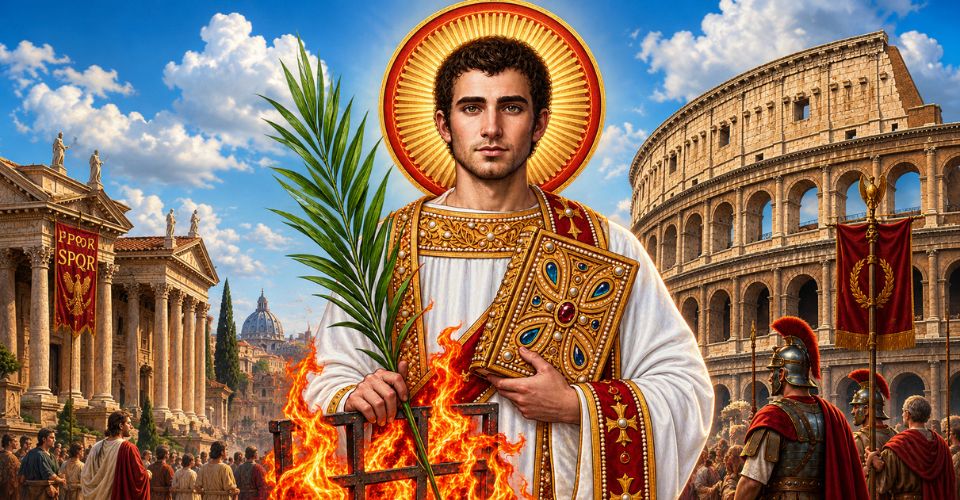
He later came to Rome and became one of seven deacons under Pope Sixtus II. There, he was responsible not only for the treasury of the Church but above all for the poor and needy.
When Emperor Valerian ordered the persecution of Christians in A.D. 258, Pope Sixtus II was executed along with several other faithful, including, according to tradition, several of the seven deacons who served alongside Lawrence.


Right before his death, Sixtus II is said to have entrusted the Church’s treasury to Lawrence.
However, instead of safeguarding gold and silver, the deacon distributed everything to the poor within days, reportedly selling off sacred vessels to fund the giveaway.
When the emperor demanded the treasure, Lawrence simply presented the needy of the city and declared they were the true wealth of the Church — a response that Valerian apparently did not like.
Martyrdom on the gridiron
There are various accounts of the saint’s death. Some traditions say he was beheaded.
The best-known legend, however, tells that Lawrence was tortured to death on a glowing gridiron on Aug. 10, 258.
According to that legend, first recorded by the early Christian poet Prudentius, Lawrence even managed one final act of defiance on the gridiron, telling his executioners, “Turn me over — I’m done on this side.”
For this reason, the grill has remained his unmistakable identifying symbol and can be found in many churches in paintings and sculptures.
Rome’s Basilica of San Lorenzo Fuori le Mura, one of the city’s seven pilgrim churches, was built over the site where he is believed to have been buried.
❝
The best-known legend tells that Lawrence was tortured to death on a glowing gridiron on Aug. 10, 258.
Feast day and legacy
On Aug. 10, the Catholic Church celebrates the feast of Saint Lawrence. Protestant, Orthodox, and Anglican Christians also commemorate him on this day, while the Armenian Apostolic Church does so one day later.
He is venerated today as the patron saint of the poor, as well as of cooks, comedians, firefighters, deacons and librarians — patronages traditionally linked to the manner of his death and his lifelong care for the needy.
Numerous customs have developed around Lawrence. Blessed “Laurentius coals” are said to protect against fire, and the “Laurentius blessing” is believed to help with burns and emotional suffering. In Wuppertal, the German city’s patron saint is even celebrated with a Laurentius octave.
Part of the tradition is also the “St. Lawrence Bread” initiative: blessed bread is passed on in exchange for a donation, for the benefit of charitable projects.
And something else is associated with his feast day: those who look up at the night sky in mid-August may, with a bit of luck, see numerous shooting stars.
Because they often appear around St. Lawrence’s Day, they are affectionately called “the tears of Lawrence.”
The name dates back to medieval and Renaissance Europe, where Christians noticed that this yearly meteor display coincided with the saint’s feast day. They came to see the streaking lights as the fiery tears he shed during his martyrdom.
That folk explanation persisted even after 19th-century astronomers identified the shower’s true source: debris shed by the comet Swift-Tuttle.
Today the shower is known scientifically as the Perseids, a name with its own ancient pedigree — it comes from the Greek “Perseides,” meaning “sons of Perseus,” and refers to the constellation Perseus, the point in the sky from which the meteors appear to radiate.
The constellation itself is named for the Greek mythological hero Perseus, best known for slaying the gorgon Medusa.
In this way, believers say the sky each year recalls, in its own way, a saint whose greatest treasure was the ordinary people.
This is a translated and edited version of the feature that first appeared on DOMRADIO.DE and has been republished with permission by Global Catholic.