




Advocates of ordaining women as deacons refer to ancient texts and art to bolster their arguments. Opponents and doubters question the interpretations of those texts and representations.
It’s interesting that those who demand absolute certainty from ancient sources do not respond to the clearer conclusion that, in those long-gone days, clergy were married. Peter’s mother-in-law was far from the sole papal mother-in-law. There were enough of them to have a coffee klatch in the Kingdom. Apparently, only some ancient evidence is allowed to determine modern practice.
However, disputes over the evidential weight of ancient sources are a waste of time, breath, and ink. Should what was done or not done in the third century determine what should happen or not happen in the twenty-first?


Of course, the one undeniable norm for the Church in all centuries must be Jesus’ teaching in word and deed in the first century.
Where that teaching involves women, he is very clear, though later ancient texts and art contradict him.
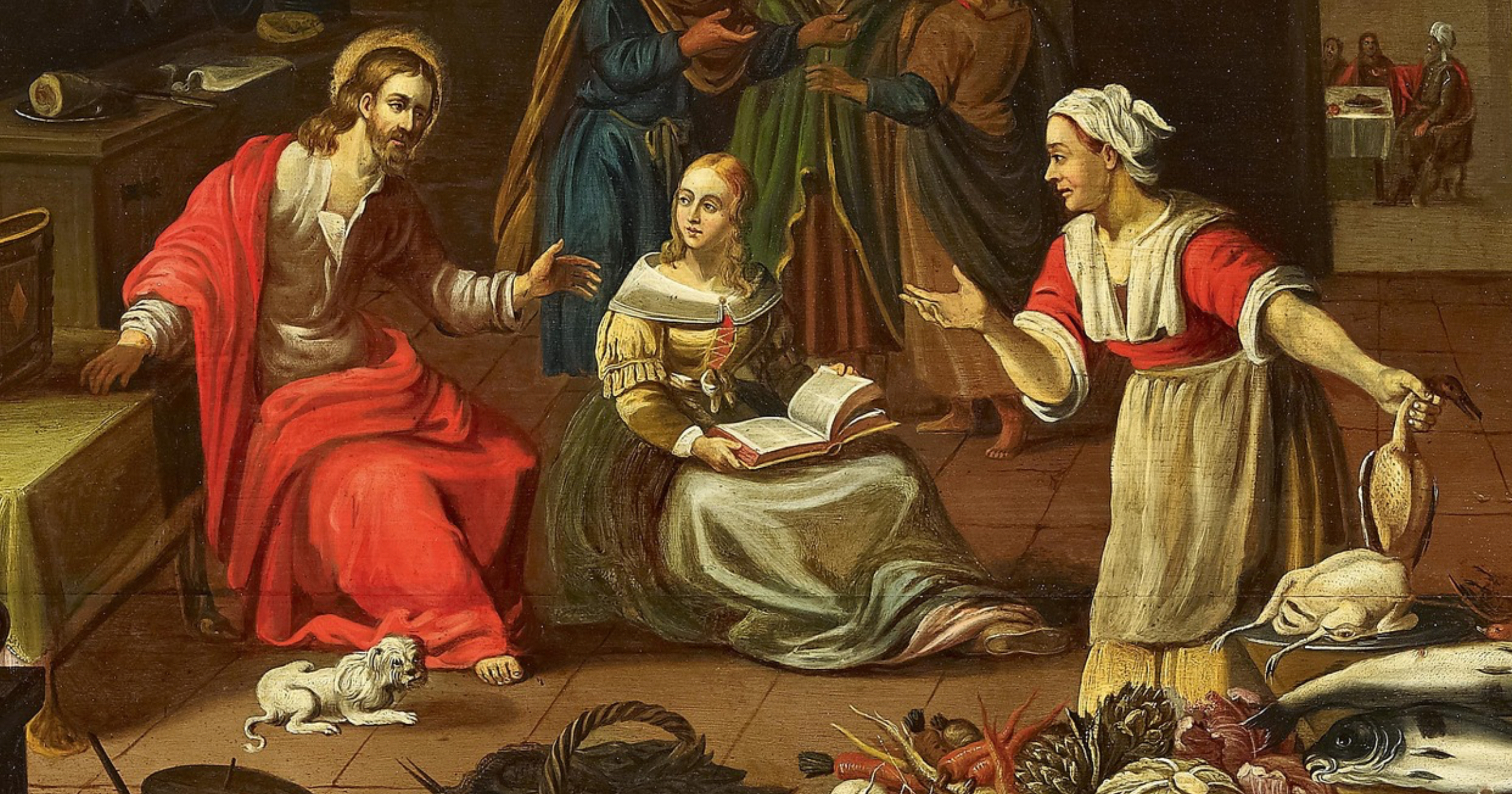
Luke’s story about Jesus in the home of Martha and Mary makes an important point about those whom Christ calls. According to Luke, Mary “sat beside the Lord at his feet listening to him speak.”
Over the years, the contrast between Martha and Mary has been used to set the so-called “active” life against a life of quiet contemplation, especially for women, and to claim that passive attentiveness, symbolized by Mary, is holier than action, epitomized by Martha.
But the story is not about that. To see what Jesus was doing, we need not focus on dinner preparations. We must look at Mary’s posture.
She was sitting at the feet of Jesus. In the world in which Jesus lived and taught, that posture carried a very special meaning, one that those who saw it and those who originally read or heard Luke’s Gospel would have understood. And that meaning would have shocked them. It clearly bothered Martha.
Those who sat at a teacher’s feet were that teacher’s disciples. We still speak of a disciple sitting at a master’s feet. Mary was as much a disciple as Peter, James, and John, entitled to sit at his feet as any other disciple.
But in that time and place, women belonged in the kitchen, doing what Martha was doing. A woman occupying the position of a full disciple was a radical challenge to the society in which Jesus lived. Mary was claiming equality with men! And Jesus not only allowed it; he even told Martha that Mary had “chosen the better part.” He added, “it will not be taken from her.”
In St. Paul’s authentic letters, as opposed to those written in his name after his death, we even see women in leadership roles across various communities. But not long after, equality in discipleship was taken away from the women who followed Mary.
❝
Until we start with this century instead of past ones, the question of ordaining women or even men to a particular ministry is of no use to the mission of the Church.
The force of customary attitudes toward women, even on the part of women, was just too strong. It remains strong.
Today, as attitudes toward women that subverted the practice of Jesus are changing in many places, we must accept that Jesus still has something to teach us that subverts the “normal” ordering of society and the Church.
Today, those who want to restore the equality that Jesus taught are attacked as “radical feminists” without that charge being really defined. But the first radical feminist in the history of our faith was Jesus himself.
So, the question we all — male and female alike — are forced to ask ourselves is: What do we, as individuals and as a Church, do that betrays Mary’s vocation to full discipleship, and what must we do to recapture this important aspect of what Jesus meant his followers to be?
Does this mean the Church should ordain women to the deaconate? No, it does not.
There is a prior question that must be answered, and the one answer that ancient history gives us deals with a deeper issue. That answer is found in the Acts of the Apostles.
The Christian community faced a problem for which Jesus had left no answer. Hellenists complained that their widows were neglected. Since there was no precedent for dealing with the issue, the leaders of the Church created an unprecedented solution, asking the community to name seven men who could coordinate the care of those who were being neglected.
Within a short time, at least two of the seven moved into roles beyond those originally assigned to them. Stephen and Philip are cited in Acts as preachers. Later ancient traditions place most of the rest of the group in leadership roles across various communities in the Empire.
So, the Church faced a practical situation, found no precedent for dealing with it, came up with a response, and then allowed that response to evolve far beyond its original intent. The lesson for us is not in the response, but in the method that underlaid it.
So, the question facing us today is not what the Church did in its early centuries. The question is what the Church must do today to meet the needs and opportunities of the twenty-first century. Pope Leo’s pastoral focus on peace in a fracturing world and the promise and threat of A.I. are two that require creative responses. Another is the environmental crisis.
First-, fifth-, or even twentieth-century answers are almost certainly insufficient.
Until we start with this century instead of past ones, the question of ordaining women or even men to a particular ministry is of no use to the mission of the Church.









3 Comments
Rex Hackett
October 13, 2026From the scriptures a woman could not stand in persona Jesus of Nazareth who is male but the scriptures say that in the Christ there is no distinction between slave and free male or female
So a female can stand in persona Christie the person of Christ….
Why is this text not used more frequently about the question of ordaining male and female to the Diaconate and Priesthood?
Hans Winter
October 13, 2026Can one only engage in missionary work if one is ordained?
What is truly important?
Is it fair that women have to bear children, while men do not?
Was equality not intended by God?
Mario Elizondo
October 14, 2026This newspaper has an obsession with married priests and the ordination of women. The Catholic Church is already full of married priests—in the Eastern churches in communion with Rome and among Anglican or Episcopalian converts. Celibacy is merely a discipline of the Western Catholic Church. However, to maintain the possibility of reconciliation with Eastern Orthodoxy, one would have to follow their rules (which are the same as those of the Eastern Catholic churches): priests marry before ordination, while bishops are chosen from among celibate monks. As for female priests, they existed in all pagan religions during the time of Jesus; in that sense, the radical feminist equality the author speaks of was present among the peoples of the Middle East and throughout the rest of the Greco-Roman world. Curiously, the main proponents of women as leaders of Christian communities were the Gnostics in their apocryphal gospels. But that is another story; the reality we face today requires all Catholics to get involved in evangelization. Trying to “clericalize” many people—including women—is a bad idea. We need Christians in the world (men and women) to first bear witness to their faith and, secondly, to proclaim it. And that is precisely what thousands of men and women are doing as catechists, lectors, Eucharistic ministers, lay missionaries, and so on. This debate—into which we are systematically drawn to divide us into those for and those against—is a waste of time. Furthermore, synodality makes no sense if it merely means clericalizing the actions of the People of God. Nor do we want a Church that functions like an NGO or a democracy modeled on liberal democratic republics. We want holy priests—good shepherds, good preachers, and great scholars of the Word of God. We want holy deacons who are dedicated to the People of God entrusted to their care. We want religious men and women dedicated to the charism of their order, congregation, or institute. And above all, we want laypeople bearing witness to and working for the Kingdom of God.