





Maricarmen, an 87-year-old woman in a wheelchair, has been evicted from her home, despite the mobilization of hundreds of people who have tried to ensure that she could spend her final days in the home where she had lived for seven decades.
Maricarmen lived in the same rent-controlled apartment in Madrid’s Retiro district since 1955, under a lease passed down through three generations of her family.
The apartment had been acquired by Urbagestión, one of those investment funds that make money by speculating on housing prices, a basic necessity that should be within everyone’s reach and that a heartless form of capitalism has transformed into a luxury commodity.


“The current economic system is leading us toward tragedy,” Leo XIV has warned. “The idols of money are stealing our dignity. We are anesthetized to the pain of others.”
The current pope, who so annoys the right, is merely echoing one of the basic teachings of the Gospel: “Truly I tell you, whatever you did for one of the least of these brothers and sisters of mine, you did for me” (Matthew 25:40).
Yet the Spanish Church seems to pay little attention to the words of Jesus of Nazareth. Except for Javier Baeza, head of the San Carlos Borromeo Pastoral Center, no priest has spoken out against Maricarmen’s eviction, even though Pope Francis declared that housing is a sacred right.
A Church that has forgotten its committed priests
Younger generations no longer know that in the 1960s and 1970s, priests committed to building a more just society emerged.
In Spain, figures such as Father Llanos, Mariano Gamo, Diamantino García Acosta, Francisco García Salve and Enrique de Castro stood out.
Now, most priests align themselves with the ideas of “Christo-fascism” and raise their voices only to attack the LGTBI community, disparage synodality or turn the tragedy of immigration into a supposed invasion that threatens the values of Christian and Western civilization.
Their attitude stands in stark contrast to the message of Jesus, who calls for opening our arms to foreigners (“I was a stranger and you welcomed me,” Matthew 25:35), cultivating solidarity and detachment (“Whoever has two tunics should share with the one who has none, and whoever has food should do the same,” Luke 3:11), and refraining from judging and condemning (“Do not judge, and you will not be judged; do not condemn, and you will not be condemned; forgive, and you will be forgiven,” Luke 6:37).
Domesticating the Gospels
It has been said that Emperor Constantine’s conversion to Christianity marked the beginning of a serious distortion of Jesus’ message, but some of us believe that process began earlier, when the communities that wrote the Gospels deliberately omitted everything that could make Rome uncomfortable.
It is worth remembering that the Gospel of Mark, the first of the four to be accepted as canonical, was written in Rome between 65 and 70.
This dating and place of composition reflects a widely held, though not universal, scholarly position; some historians favor Syria or another eastern provincial setting over Rome.
At that time, Christians were suffering persecution under Nero, and a rebellion had taken place in Judea that ended with the destruction of Jerusalem’s Second Temple.
Almost all historians share the view that the first Christians, whom Rome regarded as a Jewish sect, sought to dispel any suspicion of rebellion against imperial authority.
❝
I have no doubt that Jesus would have participated in the social mobilization organized to prevent Maricarmen’s eviction. After all, he drove the merchants out of the Temple.
Hence, the Gospels, written in Greek, attribute to Jesus the command to obey the authorities and place responsibility for his death on the Jews rather than on the Roman occupiers.
Nevertheless, it is highly unlikely that Jesus justified the taxes imposed on the Jewish people, since those taxes sometimes amounted to 60 percent of a family’s wealth produced in a year and were not used to provide services to the community, but to finance the Roman army, maintain the imperial bureaucracy and pay for the lifestyle and construction projects of the capital, Rome.
Jesus’ famous response, “Give therefore to Caesar what is Caesar’s, and to God what is God’s” (Matthew 22:21), was not an invitation to blindly obey the government, but a subtle and subversive questioning of the absolute power of the Roman Empire.
The denarius Jesus examined bore Caesar’s face and an inscription that read: “Tiberius Caesar, Augustus, son of the divine Augustus,” and on the reverse it called him “Pontifex Maximus” (High Priest).
Jesus’ famous response essentially says that this blasphemous coin belongs to Caesar, but life, conscience and dignity belong exclusively to God. This circumlocution avoided a possible charge of treason, but it meant a resounding “no” to Roman oppression.
The Gospels have theological value, but they are not reliable as historical testimony.
Their authors incorporated Greek myths of the virgin birth (Athena, Danaë, Heracles), resurrection (Dionysus, Persephone) and miracles (Asclepius) in order to divinize Jesus and minimize his human dimension.
Despite this, everything indicates that Jesus was born into a working-class family and had brothers and sisters. That does not diminish his greatness in the slightest.
His exceptional character arose from his understanding of God as the Father of Creation and from his proclamation of the Kingdom, a historical and metaphysical utopia that would bring about the triumph of Life and Love over Death and Injustice.
As Jon Sobrino (a Jesuit liberation theologian and close colleague of Spanish-Salvadoran philosopher and theologian Ignacio Ellacuría SJ) pointed out, Jesus was above all a liberator. He not only formulated an eschatological promise, but also proposed a new social model, in which there would be no hungry, persecuted or oppressed people and the last would be first.
Depoliticizing Jesus is to falsify him or, more precisely, to domesticate him, suppressing his transformative potential.
The idea that Jesus died to erase the stain of original sin did not appear until the fifth century with St. Augustine, and the theory of vicarious satisfaction, according to which an infinite offense could only be compensated by an infinite being, did not become a widespread belief until the 11th century, with St. Anselm of Canterbury.
Far from these interpretations, history points to Jesus having been executed for challenging political and religious power with the utopia of the Kingdom. In fact, he died as a seditionist, probably accompanied by other seditionists, perhaps Zealots or Sicarii.
Ellacuría and the civilization of poverty
I have no doubt that Jesus would have participated in the social mobilization organized to prevent Maricarmen’s eviction. After all, he drove the merchants out of the Temple.
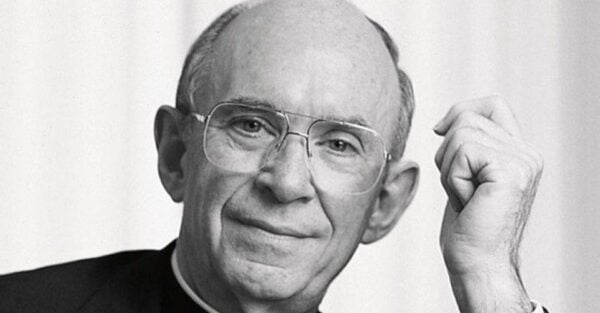
Ellacuría, murdered in 1989 by the Salvadoran army, stated that “capitalism is characterized by an intrinsic malice” and “has never given sufficient evidence of correcting or reversing its harmful course.”
He advocated creating alternatives through praxis in order to materialize the utopia of the Kingdom of God in history.
For Liberation Theology, the school of which the Jesuit was one of its most prominent representatives, Christian salvation is not separate from earthly suffering. God invites us to liberate human beings from everything that prevents them from living with dignity and fullness.
Faith is not a mystical experience, but a transformative force. The Christian message places the poor and oppressed at the center of revelation. They are not merely another social group, but the place from which the Gospel must be read.
Ellacuría proposed the “civilization of poverty” as an alternative to capitalism: “It is not only a matter of creating a new world economic order… but a new civilization, no longer built on the pillars of hegemony and domination, accumulation and inequality, consumerism and false well-being.”
In speaking of poverty, he did not advocate misery, but austerity and degrowth, two principles necessary to distribute available resources in solidarity.
Following Jesus means “doing everything possible so that freedom triumphs over oppression, justice over injustice and love over hatred.” Neutrality is not Christian.
Philosophers and theologians who limit themselves to musing over abstract questions and “do not take responsibility for the reality of the oppressed, ideologically legitimize the oppressor.”
Like Jesus, Ellacuría became an uncomfortable voice, and those in power silenced his outcry with a hail of bullets. He did not die alone, but alongside five other Jesuits, a domestic worker and her teenage daughter.
This refers to the Nov. 16, 1989 massacre at Central American University (UCA) in San Salvador, in which Salvadoran soldiers killed Ellacuría, five fellow Jesuits, and two women on the university grounds during the country’s civil war.
Murdered on the campus of the UCA, soldiers and officers of the Atlacatl Battalion made sure to leave no witnesses.
Injustices such as Maricarmen’s eviction demonstrate that the Catholic Church can take two paths: stand on the side of the victims, as Ellacuría, Óscar Romero and other martyrs did, or remain silent and implicitly justify their suffering.
Pope Francis and Leo XIV seem more comfortable with the first option, but Spanish bishops and more conservative movements, more or less discreet allies of the far right, prefer the second alternative.
Personally, I believe that — as Liberation Theology maintains — God has a preference for the marginalized, exploited and dispossessed, and that anything that involves deviating from this preference can only be described as anti-Christian.
This is a translated and edited version of the column that first appeared on Religion Digital, and has been republished with permission by Global Catholic. The views expressed in this column are the author’s own and do not necessarily reflect the editorial position of Global Catholic.










1 Comment
John Keenan
October 2, 2026Maricarmen’s eviction deserves our compassion, and Catholic teaching takes her claim seriously: Gaudium et Spes §26 counts shelter among what every person needs. But this article uses her suffering to advance claims disconnected from reality and claims that the Church has explicitly rejected.
Mr. Narbona says the Gospels are unreliable history and that the virgin birth and Resurrection were borrowed from Greek myth. Dei Verbum §19 says the opposite: the Church “unhesitatingly asserts” the Gospels’ historical character. He says the belief that Christ died for our sins began with Augustine, yet St. Paul hands on, as tradition he had already received, that “Christ died for our sins in accordance with the scriptures” (1 Cor 15:3) and St John the Baptist declared, Behold, the Lamb of God, who takes away the sin of the world!” (John 1:29), a formula dating to within a few years of the crucifixion. The portrait of Jesus as a Zealot seditionist is a discredited 1960s thesis, and the Zealots did not exist as an organized party until decades after the crucifixion. The attempted diminishment of Jesus Christ failed once more.
He also relies on Jon Sobrino. In 2006 the Congregation for the Doctrine of the Faith issued a Notification finding Sobrino’s work deficient on precisely these points: Christ’s divinity, the saving value of His death, and the “Church of the poor” as the lens for reading the Gospel. The preferential option for the poor is genuine Catholic teaching, but the Church describes it as “neither exclusive nor excluding” that would otherwise reduce it to an ideological platform. (Libertatis Conscientia §68 (1986)).
Nor is capitalism “intrinsically malicious.” St. John Paul II affirmed “the fundamental and positive role of business, the market, private property,” within a sound juridical and moral framework (Centesimus Annus §42 (1991)). Since 1990, markets, not redistribution of wealth, have lifted more than a billion people out of extreme poverty.
Finally, calling fellow priests “Christo-fascists” is an unjust and prejudicial moniker which sits poorly beside the author’s own quotation: “Do not judge.”
As with all parties to human conduct, Maricarmen deserves both charity and justice. In the end, she is getting justice. Further, she is not served by a Marxist rewriting of Western tradition and the dismissal of the Christ who commands the virtues of faith, charity and justice.
John Keenan